|
|
This topic comprises 5 pages: 1 2 3 4 5
|
|
Author
|
Topic: Strong Platter Slowdown and Stop
|
Brad Miller
Administrator

Posts: 17775
From: Plano, TX (36.2 miles NW of Rockwall)
Registered: May 99
|
 posted 10-08-2002 02:18 AM


Dustin,I really think Ted's thing was just coincidence. Not everyone posts all the time for whatever reason and no one is expected to post every day or week. Sometimes people just have nothing to say, but a month later will have a dozen questions or lots of input to someone else's problem. Don't take this thread as a failure to make peace on your part. First off it's not your fault nor responsibility. Second, the situation is pretty cut and dry. I have requested solutions to problems with Strong equipment to Pat and Rick, and Rick is the only one that has given any assistance. Most of the time Pat has not responded to any questions, but the few times he did (like my start cue question) ended up causing more problems with the equipment because I later found out through trial and error that it had to be done another way. If you followed the CNA-150 thread, it turns out that each automation must be set to it's own sync ID (like I originally had guessed) and NOT all set to "0" like Pat said to do. Then there was a serious grounding issue from the original installation which I have since resolved with tips from 3 forum members. Then there was an issue with cues placed on fullcoat occasionally missing a cue, which seems to have been caused by the original point of this very thread. What was happening was that occasionally the Strong takeup platter would crank up to speed and not stop before the elevator slammed into the top of it's travel. This appears to have actually bent the rollers on the failsafe just a tad bit, as when looking head on to the failsafe, the rollers were not level, but angled downward on the outboard side as if they had been pulled on hard. Because of this the gap between the proximity detector and the film was excessive, but it did still manage to read most of the cues. (A theory I heard tonight was that the oxide in the fullcoat was confusing the sensor.) Removing the failsafe and physically bending the rollers back straight has 100% solved the occasional missed cue problem in the houses I have done that to in the last 5 days since I made this adjustment. So I am *almost* ready to report that the CNA-150 issues have been solved...but where was Pat during all of those emails and the phone calls I made? He certainly was not helping or responding in any manner, and that is the issue here. On a similar note that you might not be aware of, Strong does not actually make their platters. Another company makes them for Strong. When I contacted them to inquire about a few things, I was told that since other people had not complained about them that their platters were perfect and nothing was wrong. It was made very clear to me that these guys had no interest in improving their platter design, even though the things I mentioned were minor and wouldn't have cost hardly anything. My question above to Pat about whether Strong is interested in improving their products is directly related to that conversation with the people who designed and build their platters. I simply want to know of Strong International has the same attitude toward customer complaints that the makers of their platters has. Pat has been dodging that one for about 3 weeks now. Speaking of Strong platters, I have devised a super simple breakdown clutch that anyone can build for under $5 with supplies from their local Home Depot. This will work on any platter that requires the motor to be disengaged from the deck for breakdown. The end result is a perfectly tensioned, perfectly flat film wind without operator intervention. Although I am not an advocate of breaking down films at high speed, if you DO need to break down at a high speed for a late night pickup, this clutch will keep the film tensioned well. The projectionists at this theater have been overwhelmed at the difference, and I feel the general population reading this website will find it a great improvement to their platters. Again, we're talking less than $5 here and the one clutch can be moved to any platter in the building, so it's not as if a 20 plex would have to spend $300 to install a clutch on each deck. This place has 3 MUTs and 3 clutches that stay with each MUT. I will post the exact parts needed and exactly how to do it in the tips section hopefully in the next few weeks as soon as I get the time to make a page. As far as threatening Pat's account, you can call it that if you wish. However if he is going to turn his head any time a legitimate problem with his equipment turns up, I see no reason for his presence on these forums. These forums are here for people to spread knowledge and help other people. Whenever a manufacturer posts, I consider that expert advice from as high up as possible. (This is why I only said one week to cool off, not the usual month.) I don't know what kind of stress Pat may be going through right now, nor does he know what kind of frustration I am going through having to self-teach myself problems that other people have already been through. If I was getting good support from Strong, my time spent troubleshooting and figuring out what the problems are would be greatly lowered. Hopefully after Pat gets away from the daily grind and takes a mini-vacation at ShowEast for a week he will return refreshed and with a better attitude toward his customers. If not, then the ban will be permanent and there will be no loss. It's a simple solution, not a threat. So, got any idea about my SCDC wrapping? 
| IP: Logged
|
|
Paul G. Thompson
The Weenie Man

Posts: 4718
From: Mount Vernon WA USA
Registered: Nov 2000
|
posted 10-08-2002 02:30 AM

Pat said:
quote:
The larger take-up rings won't change what happens on the take-up side of the AP Platter. The takeup runs the variac that supplies power to both take-up and payout on an AP-style. The larger ring does help stabilize payout since its rotational speed is reduced, but the take-up isn't affected.
Pat is correct. We must remember the variac controlled platter's operating platform is based on the take-up. The takeup motor has a ballast resistor in series with the motor which will allow for a little correction capabilities in the pay-out. If the resistor was removed in the take-up line, both platters would turn at the same RPM. There would be no headroom for the pay-out to operate with, regardless of what kind of pay-out control is being used. This includes Phase control, or micro-witch configurations. A bigger center ring will not solve any real problems, except for (up to a point) stability of the pay-out. I think the real culprit that knocks rollers out of alignment is the inertia of the rotating platter, not the torque of the motor. The Xetrons XNR's, the older CFS and Potts as well as the Potts A-3 and the Strong A-3 will all do the same thing if the motor is started and then shut down before the platter stabilizes. If you question my thoughts, just try a little experiment. Shut the projector down after the platter stabilizes. If you have a normal rundown time of the projector motor, the platter will come to a nice smooth stop. If it does not, the Variac should be adjusted to the reference mark with the elevator full down with the micro-switch off. I think that is about 50% on the variac's wiper. The Pro-35's and the Centurys don't have that big of a flywheel, so the ramp-down of the projector will be much quicker, and the elevator might strain a little on the upper stop springs of the elevator. The Simplex SH10**, and the RCA 90** and the 1050 should never have that problem. As far as the 5-Star soundhead is concerned, it never has caused any problems with my Strong A-3's. Why Joe's motors have no flywheels is beyond any reasoning. Pat also said:
quote:
The flywheels serve three purposes -- one is to slow the start-up, two is to extend the slow-down, and third is to smooth operation when running at speed. I would never run a Simplex without the proper flywheel, you're just asking for long-term trouble.
Very true on the last sentence. Without the flywheel, the inertia of the take-up platter will over-run everything. The use of a larger ring would require drilling some new holes in the platter dish. If those holes are not exact, the film would not be concentric on the platter. This could lead to print shifting as the show progresses. Also, if one big ring was used to wind the take-up, and for some unknown reason the operator used a smaller ring on take-up for the next immediate show of the same print, a serious problem could develope. The pay-out may constantly fall behind. Pat cited that in his last paragraph:
quote:
AP-style platters technically need the same (or close to the same) diameter on both take-up and payout sides to operate correctly -- they can tolerate some difference, of course, but not on a regular practice.
Why Joe's platters are constantly over-shooting and under-shooting puzzles me, since it is not a variac based machine. I think the SCDC module is the problem or it is a mechanical problem with the pay-out head. If the pay-out heads are switched from one machine to another, and the problem does not follow it, there could be a problem somewhere in the wiring or its electronics. Remember, the old Potts and CFS platters would whip like the dickins on pay-out if the shunt resistor across the micro-switch is burned out. Installing the shunt resistor in the A-3 platter really reduces the violent whipping, whether or not it is using Phase controls or Micro-switches. At one time Pat indicated favorable results with Strong's Phase control retrofits on the old CFS platters. I can vouch for that, as my experiment did the same. Joe might have a severe timing issue, also. I wish I was there to see what the blazes is really going on. At this stage, we know Joe has a problem, with no answers. But one thing will help, Joe. Get some flywheels on your 5-Stars! Gordon, you have a very good point about "bumping" with a 3-phase motors. That could be a disaster.
| IP: Logged
|
|
Brad Miller
Administrator
Posts: 17775
From: Plano, TX (36.2 miles NW of Rockwall)
Registered: May 99
|
posted 10-08-2002 02:35 AM
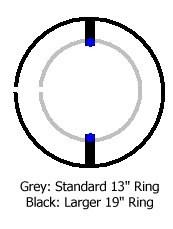
Paul, download the Strong 19" center ring manual. It has a sketch of the ring. As you can see, Strong designed it so that the larger ring uses the same holes in the platter as with their 13" ring. There is no drilling required and it works very well. Christie's larger ring is similar, although I don't know who gets the "credit" for the initial design.I would think that besides Joe getting flywheels that he could adjust the variac so that the platter can barely grab on takeup without the elevator dropping fully. Feel free to point out if I am missing anything with that theory, for it's been a few years since I played with a microswitch Strong and never actually tried that one. That is something that came to mind after the theater closed. One possible tip I got tonight was to order the 70mm kit. Although I've never seen it, apprarently the 70mm kit has a couple of extra elevator rollers, which puts more film in the accumulator, thus making the elevator move slower. Why they don't just do that on every platter is beyond me. If there is a way for someone to pull the film in a manner that would cause the elevator to slam to the top of it's travel, then more thought needs to be put into the design. SPECO solved this years ago with their LP270s. Strong could do it now.
| IP: Logged
|
|
Paul G. Thompson
The Weenie Man
Posts: 4718
From: Mount Vernon WA USA
Registered: Nov 2000
|
posted 10-08-2002 02:43 AM
Brad, if Joe has variacs on his machines, that could be a problem. That being, in the fully raised position, the wiper on the variac could hit the stop and break off. I had that happen once when I set it for something less than 50%. It is more of a critical mechanical adjustment than it is electrical. Please tell him to be very careful if he tries that. I didn't think the SCDC machines were variac based..... And, yes - I'll eyeball that ring as you suggested. I just looked in the manuals section - I didn't see it. Is it hid in a manual somewhere? And which manual?
| IP: Logged
|
|
|
|
|
|
|
|
|
|
|
|
|
|
Paul G. Thompson
The Weenie Man
Posts: 4718
From: Mount Vernon WA USA
Registered: Nov 2000
|
posted 10-08-2002 05:45 AM
That's what I thought it would look like after Brad mentioned it fits the holes used by the 13-inch ring. As I thought about it, I see a problem. Over a period of time, the holes in the platter will become elongated because the increased mechanical advantage of the ring."X" number of pulling ounces on the pins of the 13-inch ring (however many it would be) will represent much less pressure in the holes than it would with a pull 3 inches further away. It might take a couple of years to do that, but it will still happen. Joe, I re-edited my post about the percentage the variac should be with the elevator all the way down. Set it at spec. Anything less of a percentage specified in the book might cause the variac to fail if the elevator is raised to the extreme top position. If the pay-out platter does not creep with the pay-out fully off and the elevator is pinned in the "threading hole" the variac setting is very close to being correct. The threading hole is about 1 inch below the "timing hole" on the platter mast. If it does creep, then the variac is probably out of adjustment. (The percentage point the brush is higher than what it should be.)
| IP: Logged
|
|
|
|
Joe Redifer
You need a beating today

Posts: 12859
From: Denver, Colorado
Registered: May 99
|
posted 10-08-2002 07:25 AM
*Yawn* Just woke up. Looks like I missed out on some discussion.Yes, I have phase controls. I have tweaked with the variac and it does help a little. I can get it so it is just fast enough to take up with the 13 inch ring, but then the platter wraps notoriously when threading, and likes to engage the wrap detector. I imagine if I had the 19 inch ring that this wouldn't be an issue. As far as the 19 inch ring not helping take-up, I think I may have to disagree. I do not have a 19 inch ring to test, but I know that the platter does stop smoother with a bigger diameter wrap on the take up platter. I have had to stop movies for one reason or another after the trailers have ended and the feature was about to begin, and the slowdown and stop was noticeably smoother. Same goes with all of the movies we have with intermissions. The movie stops at the cue, and then sometimes, just for fun, I will motor down the leader a bit and stop it and it slows down fine. And again, everyone thinks I am turning on my motor for a second or two and then shutting it off. NOT TRUE! The motor gets up to full speed and the variac elevator settles near the bottom of it's travel on the platter column. Flywheels will probably help. You can blame the former techs of Mann Theaters in Denver for removing the flywheels (these techs are now with Colorado Cinemas). I am amazed that they left the sound drum flywheel intact!
| IP: Logged
|
|
|
|
Ken McFall
Jedi Master Film Handler

Posts: 615
From: Haringey, London.
Registered: Apr 2001
|
posted 10-08-2002 10:13 AM
Do these platters really need to be able to spin at 100 mph?I know if you slow them down they tend to wrap when lacing.... but if that's the case don't pull the film off so fast. It's only going to take a few seconds more. Kinoton platters, whilst very different from the one's being talked about here, have their initial speed set for slightly faster that that needed to feed film from a freshly pulled ring, about 10% faster is enough. Can your platters be slowed down in a similar manner. As the payout and takeup speeds are controlled by a single variac this should reduce the problem. Does anyone know what the max rpm of these platters is, and what it needs to be to takeup/feed on a freshly pulled ring. As paul says its nothing to do with current etc its purely to do with the momentum of the platter and the fact that the control is calling for full speed when you initially start the projector. As the problem is not there if the platter has become stable, not calling for full speed, reducing the maximum speed will reduce the momentum.... As for using large rings..... they have been a real boon to me. They fit into the same locating holes as the normal rings and have a locking arm so the ring is solid with a print on it. Spooling on a feature is quicker and allows us to spool on the print and drop ads etc in later. We run onto a large ring on a prints last show so there is less tension and speed when spooling off. All in all very good.... except the price!!
| IP: Logged
|
|
|
|
All times are Central (GMT -6:00)
|
This topic comprises 5 pages: 1 2 3 4 5
|
Powered by Infopop Corporation
UBB.classicTM
6.3.1.2
The Film-Tech Forums are designed for various members related to the cinema industry to express their opinions, viewpoints and testimonials on various products, services and events based upon speculation, personal knowledge and factual information through use, therefore all views represented here allow no liability upon the publishers of this web site and the owners of said views assume no liability for any ill will resulting from these postings. The posts made here are for educational as well as entertainment purposes and as such anyone viewing this portion of the website must accept these views as statements of the author of that opinion
and agrees to release the authors from any and all liability.
|

 Home
Home







 Printer-friendly view of this topic