|
|
 
|
|
Author
|
Topic: The best 35mm projector
|
|
|
|
|
|
|
|
|
|
|
|
|
Steve Guttag
We forgot the crackers Gromit!!!

Posts: 12814
From: Annapolis, MD
Registered: Dec 1999
|
 posted 07-16-2007 10:43 PM


Wait a minute...I think you are wrong on that one Mr Hill.
First I think his name was Davies and his method was the closed loop isolation systems to minimize outside influences on wow/flutter.
The Century sound head is NOT a closed loop system. It is a tight loop system and it in fact DOES suffer from outside influences on its sound.
The Davies closed loop system is used in dubbers and in many penthouse readers. The key is that there is but one entry and exit point for the media (for film this is a sprocket but Technics and other used it for magnetic tape machines too). The system also needs to self-balance and have a means for damping, if properly designed. By isolating the media in the closed loop, what happens outside mostly stays outside. As some penthouse and platter users have found out...that is not an entirely true aspect...it isn't perfect. However things can be done to further isolate the loop from the outside. The Cat 699 was better than latter units by having an additional sprung roller to minimize forces on the loop. Reel-to-reel sources perform normally better so long as the clutch pads put even tension on the film.
The Century sound head, neither self balances nor is a closed loop. It is a tight loop system however. For the system to self balance there would need to be a spring used to offset the weight of the rollers being forced down by gravity. Or have the force they exert not be affected by gravity (move left to right). You will note that on most penthouse systems, there is a second spring in addition to the one that ties the two rollers together...its purpose to offset the forces of gravity on the rollers so they will self center when at speed.
In fact, with the Century and slop in the direct drive linkage or with any gear meash or even any bend in a sprocket shaft will affect the flutter in a way that a true Davies loop system will not suffer.
I will give you that the Century design (the whole thing) is a statement in simplicity. It is a very straight film path from top to bottom. The sound head CAN perform very well. Its biggest problem is that no two units are machined the same. The lateral stability of the system is wanting and depends on the bearing quality of the pivots. There is also no provision for the lateral guide roller wearing, other than the drum taper. The damping affect depends on the blend of the Castor Oil...er damping fluid as well as the plugner vs. cup...which seems to be much tighter in the olden days as compared to now.
The bearing receivers in the casting are a bit too sloppy and can be machined non-cocentric. It is not uncommon for the entire Century drum to orbit. This can be mostly negated by changing the loading of the drum shaft by removing the loading spring, pushing the bearing all of the way into the casting so it can't slide anymore (the source of the orbiting drum) and then loading the bearing on its inner race with a wavy washer...this will still allow the drum to be loaded but minimize/eliminate the drum from orbiting.
CE did a good job at improving the film alignment and stabilization with their digital reader version. They changed the the oil pot with an air pot and added a spring to the air pot to deal with gravity. Furthermore, it gets a better wrap on the drum itself with improves with spin up time as well as improving the wrap on the hold back sprocket in the soundhead to reduce perforation stress and dependence on the pad roller.
The Kinoton as well as Simplex (before the dreaded 5-star) are loose loop systems and can perform very well. What Simplex really needs to do is to change their drum and pinch roller so that the edges are all that are pressed on, not the picture area...that was just plain dumb.
| IP: Logged
|
|
|
|
|
|
|
|
|
|
Pete Naples
Phenomenal Film Handler

Posts: 1565
From: Dunfermline, Scotland
Registered: Feb 2001
|
posted 07-17-2007 11:55 AM
quote: Mark Gulbrandsen
What do you goys do for parts?
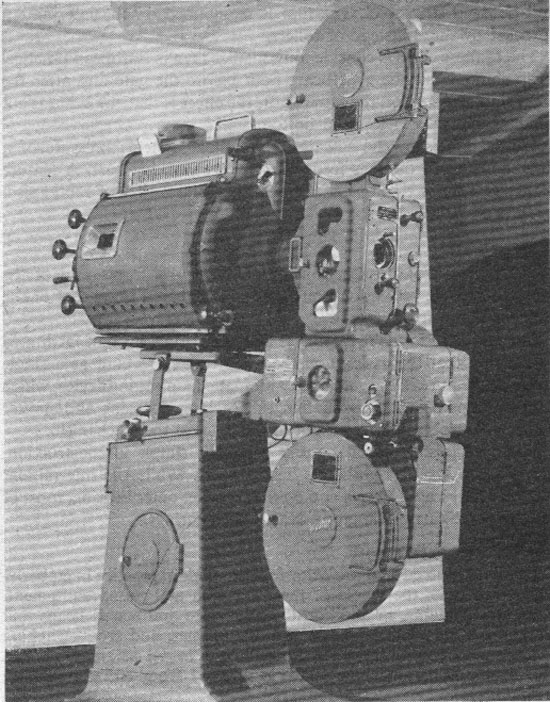
Motors can be rewound, for things like drive couplings and bearings, you can obtain modern equivalents, other than that we've a small stock of parts, and we tend to canibalise out of use heads. Once that stock is gone, it's gone. I can't see us having anything made, there are so few of these in use now. I personally know of 5 in whole of the UK, like I said only 2 of them are on my patch. Fitted with ACL combined optics/lasers they line up beautifully and are very smooth and stable running.
Mark, all the ones I've ever seen like your photo use a springy metal coupling shaft between the rep-set and picture head. It's made of several strands of wire, tightly twisted together and is failure prone on these old machines. The combination of 2001/2003 used a chain drive between the heads. Later variants used a timing belt.
| IP: Logged
|
|
|
|
|
|
|
|
|
|
All times are Central (GMT -6:00)
|
This topic comprises 12 pages: 1 2 3 ... 6 7 8 9 10 11 12
|
Powered by Infopop Corporation
UBB.classicTM
6.3.1.2
The Film-Tech Forums are designed for various members related to the cinema industry to express their opinions, viewpoints and testimonials on various products, services and events based upon speculation, personal knowledge and factual information through use, therefore all views represented here allow no liability upon the publishers of this web site and the owners of said views assume no liability for any ill will resulting from these postings. The posts made here are for educational as well as entertainment purposes and as such anyone viewing this portion of the website must accept these views as statements of the author of that opinion
and agrees to release the authors from any and all liability.
|

 Home
Home








 Printer-friendly view of this topic