|
|
 
|
|
Author
|
Topic: 3D Coming back to film?
|
Julio Roberto
Jedi Master Film Handler
Posts: 938
From: Madrid, Madrid, Spain
Registered: Oct 2008
|
 posted 09-17-2009 04:33 PM


I never understood why some people that should know better claim that, somehow, the over/under 35mm 3D system used mostly in the 80's, from the projection point of view, is any worse than any other 3D system.
Let's see the advantages and dissadvantages and comparisons.
-About the same resolution-per-eye (a bit less, actually) than 2K systems when showing 1.85 material and considerably more when showing 3D 2.35 scope, as the split frame 3D 35mm uses the absolute full frame and spherical optics (while, i.e, scope digital 3D uses a 2048x856 pixel grid, often 4:2:2 10bits jpeg2k compressed to ~120mb/s for each image, as the bandwidth is split in two at 48fps).
-o/u 35mm has about the same illumination problems as digital 3D: the FULL 35mm frame, which yields say 14fl, is split in 2 and then halved once again by polarizers. The same or better than same as RealD (old, non-xl), Master Image (current), and much better than Dolby. There are no "blanking intervals" so no additional loss. If a split barrel lens is used in 35mm, no additional loss. If a mirror/prism box is used, then a little loss is induced, but this is akin to RealD's dual-lens assembly for Sony 4K projectors 3D solution which, mind you, is EXACTLY like over/under 35mm.
-No "3D flicker" (temporal disparities). Only Imax and Sony have this in digital.
The main problem with 80's over/under were: many poor optical adapters yielded uneven illumination. Digital projectors start easier since they use an illumination rod to even out the whole frame. 35mm projectors don't, and thus the corners are significantly darker than the center of the frame. Since the frame is assymetrically splitted, the illumination becomes assymetrical as well, so each eye is seeing an image that is a little different in illumination "evenness" than the other. No good. This could be corrected in the optics, but once again, most 80's optical adapters weren't but 4 mirrors in a wood box with a pair of polarizers made for $100 and sold for $2000.
Sony's over/under has a bit of the same issue, but, hopefully, they have corrected it in the optics and it's not so bad to begin with (due to the integrator rod).
That's it. In theory.
In practice, many of the 35mm optical adapters needed careful alignment that could change if the film was re-threaded or the adapter/focus/etc moved. If the framing was adjusted, the optical box needed re-adjustment as well. Even split-barrel lenses needed good framing on the projectionist side. Not really much of a problem today in endless-film systems (thread one, adjust the optics, leave alone for the whole run). But you know how that goes ...
Over/under is exactly the same 3D as any other 3D. There is nothing "bad" about it at all or any PHYSICAL POSSIBILITY WHATSOEVER THAT PRODUCES ANY RESULTS ANY DIFFERENT AT ALL FROM ANY OTHER SYSTEM.
They ALL strive to do the same: show two (aligned) images on the screen, hopefully at the same time. Most digital 3D system fail and only show the images in rapid succesion. Most optical-multipath systems, like digital imax, dual 35mm, o/u 35mm, Sony, Reald XL (not classic RealD) produce slight assymetrical stereo keystoning, and, perhaps, assymetrical illumination (two hotspots, different brightness in corners, ...)
That's it. There are no other difference. 80's 3D over/under is "so good" that it's being used again in digital in top 4K presentations (sony). Or with this Technicolor system. 35mm dual-projection is so good that is being used again in top digital Imax presentations.
It's stuff like RealD XL, which split the frame over/under with a "polarizing-half-way-mirror" (technically, reflecting polarizer), only to recombine it in the screen (with slight keystone and uneven illumination) ... but they are not even the different eye frames but each single one which still must be blanked out to then project the next-eye in temporal succession.
In another words: RealD-XL has almost all the problems of over/under and all the problems of frame-sequential (to obtain the benefit of avoiding a 75% light reduction and leave it at 50%)
And Dolby uses color filters which messes up the original image's color (with additional color correction to try to re-match it, which of course leads to lower color gamut). Also, the eyes are presented with slightly different colormetry to each (more retinal rivalry).
Don't get me wrong: Dolby is a great system, and one of the best results, but uses more light than 80's 3D and 80's 3D didn't mess up with the colors (anymore than any other polarizing system).
I guess what I'm trying to say is that no system is 100% perfect, but all of them, old and new, always have been 99% there and there are no practical (huge) differences between them. The bad reputation of 80's over/under is, from the projection point of view (not the quality of the films shown), TOTALLY undeserved. Except that it was easy to mess up (also easy to correct) by projectionists ... and we all know how that goes.
I've also seen the surviving vectograph reel and even have some b/w traditional vectographs "reflective prints" at home and some color sterojet transparencies (similar to vectographs, no imbibition but inkjet depositing), and, obviously, the "ideal" perfect 35mm system would indeed be a (high efficiency) vectograph system coupled with a low-gain non-depolarizing screen. I think we can forget that ever happening. The next best thing: a high efficiency (low ghosting, high light output) extremely fast frame sequential system (say, 240hz, instead of today's 144hz, and call it quintuple-flash, instead of triple-flash).
Until then, I'd like to see what Technicolor is up to and why they want $5000 for a split lens with circular polarizers ....
But if indeed studios start to strike over/under 35mm prints ... I know of a lot of people that are going to dust-off their adapters, buy circular filters (or perhaps leave the linear ones) and install new silver screens ... Then it'll be no hurry to wait for 4K cheap projectors and VPF deals to independents.
Technicolor in 3D
| IP: Logged
|
|
|
|
Julio Roberto
Jedi Master Film Handler
Posts: 938
From: Madrid, Madrid, Spain
Registered: Oct 2008
|
posted 09-17-2009 09:18 PM
quote: Jack Theakston
The short answer is-- with over/under, SO MUCH CAN GO WRONG.
Yeah, I totally agree with this. But it's wrong to say stuff like "over/under" sucks. Or dual-35mm (or digital Imax, i.e.) sucks because people weren't able to align/focus both projectors "perfectly" on the screen.
With digital, there are no "framing issues" as framing is always perfect and rock solid. If an expert aligns the 3D optics on a Sony 4K, it's bound to remain fine for a long time, while 35mm will no doubt be thrown out of alignment at some point and the projectionist in charge is going to do the usual average job in the industry ...
I was just saying that over/under 35mm 3D is fine per-se. As is dual 35mm. A different story is getting a projectionist to thread/synchronise/align/focus those things correctly. No doubts it's easier to get that done in digital, since usually projectionists don't have to touch anything, than in 35mm, where projectionist have to splice film, thread, frame, focus, etc.
But do notice that there have been pseudoscopic (reversed) 3D showings in digital too, where the projectors' left-and-right frames had been reversed from the dual HD-SDI cables or the RealD zscreen had the reverse polarity switch in the wrong possition.
And about the light .... digital also loses all the same light and end up with ~4fl. If they would've timed/limit the contrast of the 35mm prints in the 80's to 16fl / 4 (1/4 the light) ~ 4fl then we would've had the same problem/solution (although the silver screens would've double that for those sitting in the sweet spot) and the image would've looked as good/bad as 3D does today in digital.
But, again, I agree it's harder to mess up with digital and "too easy" to mess up with 35mm. But when done right, both systems are fine and it's total boloney that one is significantly worse (or hardly any different AT ALL, for that matter) than the other. Over/under, like done in the 80's, can be fine and PERFECT, when done right.
Only problem being, it was seldom done right ... or that the movies sucked .... or that the movies weren't SHOT right (again, I'm talking about the projection, not the filming here) ...
If Avatar bombs, the 3D will go sooner. But it will "mostly go" anyway sooner or later. No matter if the movies are good, or have big stars, like some of the 50's, or they are cool-scary, like a few in the 80's, people grow tired quickly of the "miniature looking 3D people on the dimm screen" and the "poke me in the eye" tricks. They want to watch a film, not a theme park attraction.
Sure 3D has its place for some children/horror stuff, or for some EFX productions perhaps or an occasional movie, but not for the core movie business, I don't think.
| IP: Logged
|
|
Scott Norwood
Film God

Posts: 8146
From: Boston, MA. USA (1774.21 miles northeast of Dallas)
Registered: Jun 99
|
posted 09-17-2009 10:39 PM


My only direct experience with over/under is from playing with the Paramount system at home. The big problem (other than the low resolution, problems of misframed film, and the dim screen image) is that it's too easy to knock the mirrors out of alignment. This is probably fixable with a better mirror box design.
The other issue is that the box is clearly designed to fit a typical Simplex or Century head and requires large portholes. I don't think that it would be easy to adapt this unit for, say, Kinoton or Cinemeccanica or Norelco projectors. There is supposedly an additional set of parts for projectors with small lens holders, but I don't have those parts.
So, basically, the system limits you to theatres with silver screens, a few models of projectors, large portholes, and competent operators. That seems fairly restrictive.
Has anyone actually used the Technicolor mirror box? Can the new prints be used with the 1980s-vintage mirror boxes and vice-versa? Does it solve the issues that I described above? Can it be used with standard 12x12" portholes?
| IP: Logged
|
|
Julio Roberto
Jedi Master Film Handler
Posts: 938
From: Madrid, Madrid, Spain
Registered: Oct 2008
|
posted 09-17-2009 11:23 PM
Several methods are used to project 35mm over/under. A common and cheap one was the use of mirror boxes. The main advantage being that it was very cheap to build and flexible to align. The disadvantage, as said, that it was just as easy to de-align it and that it was "bulky" and thus needed large-ish portholes. Also, the frame masking was seldom bad, so more often than not needed a bit of help from soft-masking on the port window.
Another widely used method, was to use a prismatic adapter. Instead of 4 mirrors, you got two large prisms. A regular porthole was fine, all other problems being the same (alignment, masking)
Another system, that AFAIK was never used in 35mm but is now used in digital with sony, is to use a prismatic/reflective adapter and two separate lenses.
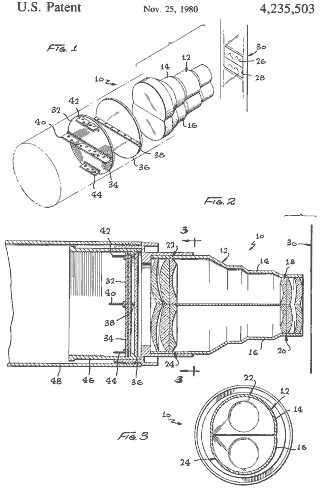
But another system that was widely used in the 80's and is the same as Technicolor is doing now, is to replace the projector's lense with a split-lense single-barrel design. These lenses were available for a long time from ISCO as well as from Stereovision. This system offered the least (virtually none) alignment. You just had to buy the correct focal length for your screen/distance, place the projector in the place to get the perfect spot, focus it and you were done. It also had the best illumination (no light bouncing from mirrors or going through prisms), the least keystoning, etc. But it was usually the most expensive and the one were the polarizers "burned" faster.
The main dissadvantage of the split-lens, besides the price, is that it is only effective for "one system" (i.e. one standard separation between the stereo frames) and only one screen-size/distance. In the 80's, different camera lenses provided images that had slightly more or less separation between the stero images within the 4 perf area. Ideally, lacking a single standard, different projection lenses would've had to be purchased for the different systems. In practice, a lot of soft masking did the patchy job we had come to hate from the 80's when the print didn't match the lens ....
| IP: Logged
|
|
|
|
|
|
|
|
|
|
|
|
Monte L Fullmer
Film God

Posts: 8367
From: Nampa, Idaho, USA
Registered: Nov 2004
|
posted 09-18-2009 06:23 PM
(I'm coming on a little late on this topic..) in the late 70s to early 80's, I had the opportunity to operate all forms of single projector, 3D presentations that is listed above - side by side and over under along with the split lens and the "Paramount and Columbia mirror box".
The famous side by side 3D was the "X-rated" "The Stewardesses" (I had to work this film due to that I was of age since the booth operators were minors at this one theatre..), using linear polarized glasses... and our mods, for our good ol' carbon arc, changeover booth, were the red tint refectors in our Peerless lamphouses, larger carbons since our generator could easily handle the increased current, along with the usage of the split lens and the screen was already silver from the old, two machine 3D usage of the 50's.
Warner did the same side by side with the 3D re-release of "House of Wax" on IB technicolor.
Only big drawback of the side by side was the usage of anamorphic attachments to expand the two images to give a 1.33:1 picture on the screen.
I then did the over/under format which the leaders had definite marks for proper framing. If you were 180* out on the framing, no 3D effect was seen unless you turned your glasses upside down. But still, this over/under using the 'box' held very good effects..and no silver screen usage was needed.
One film in particular that was the "over/under" format was Columbia's 1983 3D sci-fi flik "Spacehunter: Adventures in the Forbidden Zone" which Columbia had their mirror box.
This gave the image of a good 2.35:1 on the screen and it wasn't at all grainy, very bright with using only two sprockeholes of imagery. If I remember right, the film stock was a fine grain variety for being an Eastman positive.
I do think that Technicolor realizes this and is really moving forward in making film stock as sharp as the IB dye transfer prints where this stock will be fully compatible with this new 3D film concept.
I'd rather pull off a deal in a 5 grand lens per each machine than having to pull a deal in 'signing my life and soul away' for digital conversion - a conversion that is so unstable and will alway be unstable with the updates that these units always require .. or sit dead in the corner after new units had to be installed.
-Monte
| IP: Logged
|
|
|
|
|
|
|
|
Frank Angel
Film God

Posts: 5305
From: Brooklyn NY USA
Registered: Dec 1999
|
posted 09-18-2009 07:05 PM
Monte, pay him a decent wage and treat him with respect and he won't need to get organized. I've worked both union and non-union houses and there advantages and disadvantages to both. I work at a venue for 10 years and each and every stage hand, lighting, sound, projection tech all get propositioned every year to join the union and, to a person, everyone says "Go home Mr. Union Man." One year they even put up the inflatable rat in front of the site. It deterred not the patrons nor did it intimidate any of us. I am not saying one way or another if unions are good or not, just that it all depends on the employer. I come from a big union family and without unions there would still be sweatshops. But unions can ruin the work ethic too -- we have all seen it. So you are right there is quite a Catch 22 there.
And Don Furr pointed out that it was FRIDAY 13TH 3D, not HALLOWEEN 3D that I was referring to above. He's right, of course, and it was still too dark. ![[Wink]](wink.gif) Thanks Don. Thanks Don.
| IP: Logged
|
|
|
|
All times are Central (GMT -6:00)
|
This topic comprises 24 pages: 1 2 3 4 5 6 ... 22 23 24
|
Powered by Infopop Corporation
UBB.classicTM
6.3.1.2
The Film-Tech Forums are designed for various members related to the cinema industry to express their opinions, viewpoints and testimonials on various products, services and events based upon speculation, personal knowledge and factual information through use, therefore all views represented here allow no liability upon the publishers of this web site and the owners of said views assume no liability for any ill will resulting from these postings. The posts made here are for educational as well as entertainment purposes and as such anyone viewing this portion of the website must accept these views as statements of the author of that opinion
and agrees to release the authors from any and all liability.
|

 Home
Home








 Printer-friendly view of this topic