|
|
 
|
|
Author
|
Topic: 3D Coming back to film?
|
|
|
|
|
|
|
|
|
|
|
|
|
|
|
|
|
|
|
|
|
|
|
Stephen Furley
Film God

Posts: 3059
From: Coulsdon, Croydon, England
Registered: May 2002
|
 posted 12-30-2009 11:02 AM


'The Good, the Bad and the Ugly' was one of the better looking 2-perf films, and that wasn't even shot on the newer stocks.
Split frame 3-D works quite well on smaller screens; it's difficult to get enough light on larger screens.
It's also really only suitable for 'Scope ratio films; if you're starting out with a frame that small you don't really want to mask it down to 1.85, or similar. There's the side by side anamorphic process which can be used for older Academy ratio films, but that tends to lose even more light.
With the exception of IMAX, 3-D film has come, and gone again, several times. It's been around a long time, long before the '50s, and stereoscopic still photography even longer. Whether it will last any longer this time is anybody's guess. If I owned a cinema I wouldn't consider installing digital projection just to get 3-D, though if I could afford it I might install it for other reasons. If I owned the right sort of cinema, i.e. screen not too large, auditorium not too wide, projection rake not too steep, then I might be interested in the relatively cheap Technicolor option for a few years to see how it goes. I'm still a bit put off by the silver screen though.
Why do they talk only about the number of 3-D screens in North America? Film distribution is an international business, and certain countries, the US, Brazil and China are three I believe, have installed many more digital systems than others. Their main markets may be elsewhere.
| IP: Logged
|
|
Julio Roberto
Jedi Master Film Handler
Posts: 938
From: Madrid, Madrid, Spain
Registered: Oct 2008
|
posted 12-30-2009 11:42 AM
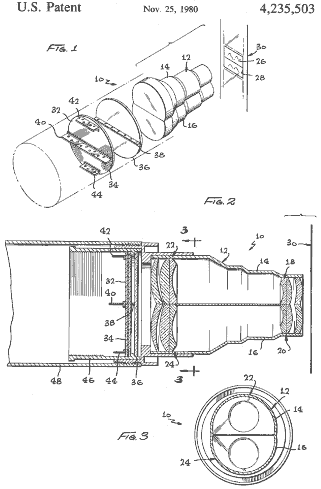
Of course over/under split-lens has been WIDELY used before. The first 3D films I ever projected were done that way. Even with circular polarizers, like some showings of Jaws 3D, although linear was the norm back then.
2 perf "quality" is just fine. I think that all of us around here agree that a "well made" print today can hold 4K of detail (in the 4-perf area). That is, 4096x2160 pixels.
4K is, once again a reminder, FOUR times the amount of pixels as 2K, so you can fit FOUR (not just two) 2K images into a 4K "area".
So even if you don't make full use of the ratio and mask the film 1.85 onto the 2-perf area, theoretically, you still have TWO full 2K resolution images in there out of the FOUR full-2K images that fit if you use all the film.
Remember that a Scope digital 2K film is, i.e., only 2048x856 pixels in resolution. I think that fits in a 2-perf area just fine. And that even a flat one is only 1998x1080.
About the difficulty of illuminating large screens, specially in 1.85 films, just a quick reminder that Hollywood is fine illuminating it to 3.5fl with 3D digital, so why not with film? Also, remember that the entire 4perf area is used as a illumination cone (above-and-below) without a masking plate eating any of it, so you actually start-up with about 25% more light than a regular "3-perf" masked flat film.
Do the math and you'll see that over/under film 3-D, which is full "4 perf" area illuminated and splitted 2-perf-and-2-perf, has no problems competing with digital in resolution (1998x1080 or 2048x856 in Scope) or light (3.5fl to 5.5fl).
The main obstacle for 3D on film is twofold. First, TRUE availability worldwide of prints. Second, alignment/framing, which I have the feeling is going to be a problem as it requires operators belonging to the human species. Primates are not suitable.
A third dissadvantage of illumination assymetries (the corners "don't match up") can be dealt with before hand either within the lens itself with optical compensation or at the time to print the negative from the computer through digital filtering. Cheap and easy. Same as the reduced illumination level obtainable (say 4fl). Just time the negative with that level in mind to make best use of the contrast available in the film. Labs have been making low-con prints forever to be used with the weaker "lamps" used by telecine machines.
If Tech3D can promise that most distributors will hand out 3D prints in Spain and sell the lenses under $5K, I'll be waiting in line to install quite a few of those.
quote:
for once still believe that the Infitek technology can be employed in the 35mm area utilising the 3D filter wheel in conjuction with DTS timecode! Also from the Technicolour brochure does that mean that each image is flashed 24 times per second at each eye?!!
The technicolor system shows both images "at the same time" (shutter blade permitting) sort of like Sony 3D does. It is 24 fps per eye if you want to see it that way, but it's simultaneous, not one-eye-see-black-while-the-other-sees-a-different-frame. Here, while the shutter blade remains open, both eyes see their images at the same time. This NEVER happens in Dolby/RealD/MI, where both eyes never, nor for a split second, see the same image. One must always be seeing black.
In your usual 2-blade shutter projector, that would look like 48 "flashes" per eye (simultaneous, so you can think of them as 96 flashes if they were sequential).
Of course trying to spin an Infitec filter would be nearly impossible (film can not really run at over 24fps plus it would be mechanically incompatible without any special shutters). But you can just place two passive infitec filters in front of a split lense (like Technicolor, just remove polarizers first) or a mirror box. Voila. Film 3D with Dolby glasses (the print would have to be color-corrected before duplicated, though).
| IP: Logged
|
|
|
|
Julio Roberto
Jedi Master Film Handler
Posts: 938
From: Madrid, Madrid, Spain
Registered: Oct 2008
|
posted 12-30-2009 12:09 PM
Well, film can only really run at 24fps with a normal, unmodified projector.
Most shutters "sweep" the framing area "irregularly" starting in a corner and going down (or up) until it's fully covered for a while and then showing it again. This motion covers the whole 4-perf area before going to the next frame.
For a sequential system (i.e. a spinning wheel like Dolby or MI), the wheel puts the correct-eye filter in front of the image at the right time and then switches to the "other" filter when the NEXT image (frame) for the other eye is shown.
If you attempt to do this "as-is" on an unmodified 35mm projector, which again runs 24fps even if "doubled-flashed" by a two-blade shutter to 48hz, you end up with 12fps for one eye and 12fps for the other. Waaaaayyyy too low.
You can not even "double flash" the 12fps because the two-blade shutter shows the SAME image twice, not DIFFERENT images like a digital projection can do.
In a digital projection, the PROJECTOR ingests the left-right frames pair at 48fps and stores them in memory. Then it shows the left one for 144th of a second (aprox.) that is picked-up by one eye, while the other eye remains seeing black.
Then shows "complete black" for a little bit while the filter wheel (or the RealD zcreen) reaches the correct position (both eyes see black). Then it shows the right-eye frame for another (aprox.) 144th of a second for the other eye (the first eye now sees black).
Then, it goes back to the SAME left-eye view it had stored in RAM memory and shows it AGAIN (the same old "left-eye" view). And repeats the whole thing 3 times before going to a NEW set of left-right frames. This way, it "simulates" a 144fps sequence while only requiring a 48fps stream.
You can't do this on a physical projector since it doesn't have a "memory" and the film can not run "back-and-forth". And the stream is only 24fps to begin with.
If you modified a shutter in a projector with a horrendously complicated design and used split-frame 3D (thus sort-of simulating a 48fps sequence), it could conceivably be used with a filter wheel. But then, the projector would be incompatible with anything in the market, so it's of no use.
Besides, it's supersimple to use a projector with PASSIVE filters instead of using a spinning "active" filter wheel. So why even try?
| IP: Logged
|
|
|
Powered by Infopop Corporation
UBB.classicTM
6.3.1.2
The Film-Tech Forums are designed for various members related to the cinema industry to express their opinions, viewpoints and testimonials on various products, services and events based upon speculation, personal knowledge and factual information through use, therefore all views represented here allow no liability upon the publishers of this web site and the owners of said views assume no liability for any ill will resulting from these postings. The posts made here are for educational as well as entertainment purposes and as such anyone viewing this portion of the website must accept these views as statements of the author of that opinion
and agrees to release the authors from any and all liability.
|

 Home
Home





![[Big Grin]](biggrin.gif)
![[thumbsup]](graemlins/thumbsup.gif)
![[beer]](graemlins/beer.gif)



 Printer-friendly view of this topic