|
|
 
|
|
Author
|
Topic: 3D Coming back to film?
|
|
|
|
|
Julio Roberto
Jedi Master Film Handler
Posts: 938
From: Madrid, Madrid, Spain
Registered: Oct 2008
|
 posted 01-13-2010 08:06 AM


RealD has always been a "scam" or sorts .... Good thing they didn't obtain "monopoly" status.
While the Dolby system doesn't require the payments of "any amounts" for either glasses or RealD-type royalties, it's not "free of costs per 3D film shown".
As we know, there is a cost in labor and consumables in dealing with the pick-up and re-sanitation of the glasses, as well as the loss of glasses to theft and breakage and end-of-life glasses cycle. Granted that the cost in water, detergents, electricity for washing/drying the glasses, and even replacement of damaged units is LOWER than current throw-away-glasses (like Master Image) or royalties (like RealD), but it's not free. For the same example of 10 films/year with 5000 audience each, it would be $0.15*50000=$7500. Very reasonable.
And we won't even mention Dolby's up-front cost, which involves the purchase of digital, plus very expensive 3D hardware of several tens of thousand, plus the restriction of using only servers which do Dolby color correction (which usually means higher priced models), plus many thousands of dollars in 3D glasses (600 glasses=$16.800). Also Dolby often needs the bigger, more expensive projectors and higher lamps/electricity costs.
I ran a spreadsheet of costs for different systems (I'll try post it here after I'm done with other things and translate it to english). Dolby is indeed the 2nd best option in the long run, after ... surprise, Technicolor if you run 10 3D films a year to 6000 or more audience each and manage a $1 profit for yourself per person on 3D surcharges.
Of course, after 10 years the Dolby equipment doesn't just "breakdown" and eventually, probably after 12 years or so, it would start being cheaper to go Dolby than to go Technicolor at these price schemes. Hopefully after 3 years, Technicolor would reconsider or ... just go away fully replaced by digital anyway.
This is assuming the studios would pay for Tech3D glasses for 10 years, which I'm not so sure about.
You can also think of Tech3D as "free". Have one installed for the cost of the screen (which is good to have for digital anyway, call it a $5000 investment). If you don't show any 3D films, you owe nothing. If you show 1 film, you must pay $2000, so you need $2000 in extra profits. Figure you show it to 2000 people and charge them $2 extra ($2000 for the distributor, $2000 for you). Now you paid Tech3D. If more than 2000 people come to the film, you keep $1 for each extra profit. If you show more than 6 3D films a year, you "keep" an additional $2000 for each film you run (with a minimun of 2000 audience).
| IP: Logged
|
|
|
|
|
|
|
|
Julio Roberto
Jedi Master Film Handler
Posts: 938
From: Madrid, Madrid, Spain
Registered: Oct 2008
|
posted 01-13-2010 05:22 PM
Yeah, a non-silver screen totally screws the polarization (fully unworkable).
I run some numbers, and they proved interesting. They are NOT meant to represent fully real scenarios/prices, just some hypothetical stuff. Corrections and suggestions very welcome.
First spreadsheet tries to figure out how much up-front cost it will take to make a screen 3D that seats 300.
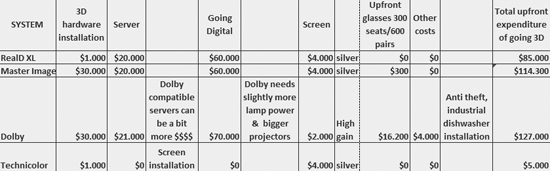
It reaches the conclusion that to turn to RealD XL, it would take some $85k, factoring a cheap digital projector and cheap small lamp, due to Reald's XL nice light performance and silver screen gain and virtually free Zscreen and $0 for upfront glasses.
It then figures Master Image is a bit more at $114k, due to the purchase of the filter disc mostly.
It then figures Dolby is even more at $143k, due to the need for a more expensive projector with a bigger lamp, a slightly higher $$ server to be compatible with dolby color correction, lower non-silver screen cost, but $16k for 2 pair of glasses per 300 seat plus $4000 in dishwasher/anti-theft purchase and installation. And the Dolby filter wheel, of course. It shows wrong in the spreadsheet
This other spreadsheet figures how much it costs to run 10 films/year in 3-D with an audience of 2000 each film. It figures RealD wants $10k for royalties, MI $13k for glasses, Dolby $3k in glasses/lamps related expenses, and Tech3D $12k in rent.
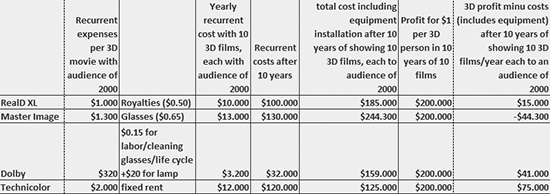
After 10 years of showing 10 films per year to 2000 people each, if we write-off the initial cost of equipment and we can make a clean additional $1 "gross profit" out of the 3D surcharge for each of those people, we figure a "net profit" of $15k for RealD, a LOSS of $44k for MI, a profit of $41k for Dolby and a profit of $75k for Technicolor.
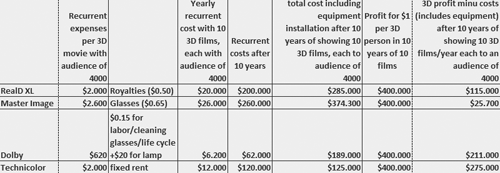
If we increase the numbers to same 10 3D films/year but 4000 patrons each film instead of 2000, then we write off the equipment and get net profits after 10 years for all systems of RealD $115k, MI $25k, Dolby $211k and Technicolor $275k.
If anybody notices any major errors in the numbers or anything, please let me know.
The prices are just approximations and equipment prices in Europe are higher than in the US, so they should be taken only at their RELATIVE value, rather than face. If you find i.e. that server prices of $20k don't match at all projector prices of $60k and it should be more like $15k on the average, pls let me know.
The closer we can get to good real ball-park numbers, the better.
Korean manufacturer Master Image was recently bought by a USA company. I have the feeling they may start to work with the studios to obtain the $$$ for the glasses from them, as RealD does and Technicolor pretends, to improve their competitivity.
XpanD numbers would be similar to Dolby's, as their up-front glasses are more expensive and require $1/month in batteries, but also they don't require any special screen, neither silver nor high gain, and their light performance usually is ok with smaller lamps than Dolby. Also, no $$$ for a Dolby filter wheel and the claimed life cycle of their glasses is 3 times that of Dolby.
I already enquired Technicolor and hope it works out and they produce copies of at least 8 good films in Spain with it. If not, there is no need to pay pretty much anything to Technicolor, so no big deal if you don't have competition around with digital 3D yet and wanna wait for cheap 4K DCI (<- if that ever happens)
EDIT: Notice an error that makes Dolby look better than it should by about $15k, so factor that in. Don't feel like changing/re-uploading the spreadsheet, as it was a quick hackjob translation from the spanish cost study and would have to re-do it.
| IP: Logged
|
|
|
|
Julio Roberto
Jedi Master Film Handler
Posts: 938
From: Madrid, Madrid, Spain
Registered: Oct 2008
|
posted 01-13-2010 07:25 PM
Well,
Remember in those numbers the cost of the server/its installation, is separate, as is the cost of the 3D hardware/its installation, as is the cost of a new screen/its installation.
So basically, $60.000 is just for the projector.
Sure you need to factor stuff like new lamps, etc, that are not included in those numbers, but a "plain projector w/installation" can be had for $60.000/$70.000, I guess. If we all feel this is wrong, I can update the figure to better represent reality. As I said, they are just some ball-park gross numbers that don't have to match reality verbatim.
| IP: Logged
|
|
|
|
|
|
|
|
|
|
|
|
|
|
|
Powered by Infopop Corporation
UBB.classicTM
6.3.1.2
The Film-Tech Forums are designed for various members related to the cinema industry to express their opinions, viewpoints and testimonials on various products, services and events based upon speculation, personal knowledge and factual information through use, therefore all views represented here allow no liability upon the publishers of this web site and the owners of said views assume no liability for any ill will resulting from these postings. The posts made here are for educational as well as entertainment purposes and as such anyone viewing this portion of the website must accept these views as statements of the author of that opinion
and agrees to release the authors from any and all liability.
|

 Home
Home







![[dlp]](graemlins/dlp.gif) conversion) and how long the
conversion) and how long the 


 Printer-friendly view of this topic