|
|
 
|
|
Author
|
Topic: 3D Coming back to film?
|
Julio Roberto
Jedi Master Film Handler
Posts: 938
From: Madrid, Madrid, Spain
Registered: Oct 2008
|
 posted 01-15-2010 07:52 AM


quote: Steve Guttag
Does anyone know of a Technicolor deal where you can simply purchase the lenses? Also, has anyone looked into just reusing the lenses of the '80s but with circular polarizers?
Technicolor hasn't answered my emails yet, but it seems like their agreements are all going to be a fixed amount per-film, with a maximun yearly cap.
I guess part of the agreement of offering to do over/under prints for studios "for cheap/free/same price" will imply that such prints are only used in cinemas with their system. Besides, the studios probably want some assurance that their prints are being shown in "top quality, modern systems", to avoid the patchy quality of many 3D projections during the 80's.
I hope they have set up a distribution system for the glasses and offer to do the dirty work of delivering them for the distributors for a price, so that they come free to theatres as RealD's do.
Using an 80's lens is probably not supported by a custom spacing, but using an optical adapter like a mirror box should probably work without much trouble.
You can, of course, fit the 80's adapters or lenses with circular polarization filters, heat considerations permiting.
| IP: Logged
|
|
|
|
|
|
|
|
|
|
|
|
Julio Roberto
Jedi Master Film Handler
Posts: 938
From: Madrid, Madrid, Spain
Registered: Oct 2008
|
posted 01-15-2010 07:19 PM
The way I read it, it goes as Steve says.
My understanding, and of course I could be wrong, is that:
-The theater pays for a professional installation done by a Technicolor certified technician
-There is a gentlemen's understanding that, if there is a Tech3D print available of a title you'd like to play in your house, you would book it for their system (i.e. and not in 2D or in another non-tech3d auditorium).
-You pay $2000 per film flat fee to a maximum of $12k/year (i.e. "free" for the rest of the year after 6 films are shown). You agree to this price scheme for 3 years, and it's negotiable after that on a year-by-year basis.
-Technicolor makes the mastering/processing for the studios at cost/free and the prints at the same identical price they have always gotten for 2D 35mm prints, with the gentlemen's understanding that they will be used to be booked for their system (I guess otherwise Technicolor would start charging more for producing the master or perhaps even printing the prints).
-Technicolor offers to supply and ship out glasses to theaters at good cost for studios as RealD does, or you can otherwise get the glasses directly or however you want.
Could be better, but it doesn't look so bad to me.
They say they are really expecting this to catch up, and even in Spain they are working out the deals as we speak hoping for the first print in March.
Time to place up orders for Silver screens quickly!!!
| IP: Logged
|
|
|
|
Julio Roberto
Jedi Master Film Handler
Posts: 938
From: Madrid, Madrid, Spain
Registered: Oct 2008
|
posted 01-15-2010 09:01 PM
quote: Steve Guttag
What incentive would the Studio have for increasing their film manufacturing costs
That they get ~60% of the 3D surcharge that way. If they give you a 3D print rather than 2D and you charge people $2.50 extra, about $1.50 more could go to them. With that, they pay the $0.50 for the glasses and pocket the $1.
They were going to run a 35mm for you anyway, so the cost to do it over/under is the same to them if the mastering costs are low/none, which Tecnicolor is willing to do since that way people book their system and they get $2.000 from the theater.
Technicolor was going to get an order for a print for theater X whether 2D or 3D, i.e, so they don't really make significantly more number of copies by offering 3D. They just stay in business longer with film, make a profit out of the 3D rents, and offers studios an inexpensive way to make $1 more per patron to those not willing to switch to digital in 3D surcharges.
| IP: Logged
|
|
|
|
Julio Roberto
Jedi Master Film Handler
Posts: 938
From: Madrid, Madrid, Spain
Registered: Oct 2008
|
posted 01-15-2010 09:11 PM
Well, ideally, they'll want to do both.
But let's say $1000 is the cost of a distributor to a print (2D or 3D) for theater X and $75 if they were to ship out a KDM/hard drive instead.
How much is the profit for a 60% cut of a 3D surcharge if they allow theater X to run it 3D? With 1.000 audience, that's likely your $1.000 extra right there for the studio. They paid off the print. Since doing the print 2D or 3D doesn't significantly matter to them ...
Ideally they'll want both. For you to save them the cost of the print (say $1k) and for them to pocket their cut of the 3D surcharge (say $1/patron). And, in the future, to save them the cost of glasses (say $0.65/patron) as well.
But that ain't happening anytime soon at $100k/screen convertion prices for so-so 2K DCI solutions on small independents ...
Even more, distributors are willing to pay the (aprox) $1k/print cost in VPF anyways ... at least to the majors and integrators (or Paramount to everybody) for the next 10 years or so, so in the short term, 35mm print or digital hard disc costs them about the same ...
Although we have always known that 3D was an excuse by the majors to make digital easier to swallow (or should I say to force digital down the throat), sometimes the producer of a 3D film may be a small independent that wants it shown that way to boost their grosses with surcharges and may force the distributor to use all available 3D systems.
| IP: Logged
|
|
Julio Roberto
Jedi Master Film Handler
Posts: 938
From: Madrid, Madrid, Spain
Registered: Oct 2008
|
posted 01-21-2010 08:18 AM
Oh well.
Now there is a choice. Maybe.
http://www.oculus3d.com/Oculus3D%20OculR%20Brochure.pdf
quote:
Oculus3D™, a company focused on film-based 3D projection technology, today announced its first product, the OculR™ system, a low-cost 3D lens and print format for the installed base of 35mm movie projectors.
The OculR system eliminates the need for exhibitors to purchase a new digital system to play 3D films. The OculRsystem also does not require exhibitors to pay per-seat or per-show royalty fees. The OculR lens provides exhibitors with a 3D solution that works with all standard 35mm projectors, delivering superb quality film-based 3D presentations that are equal to or better than more costly digital options. The OculR3D system consists of the OculR lens for the theater’s 35mm projector, a “silver” movie screen and low-cost plastic frame linear polarizer eyewear, delivering the finest 3D image at an affordable price. The OculR lens can be installed rapidly, eliminating theater downtime and providing a minimum brightness of 6 foot lamberts, which equals or exceeds the brightness of most digital and single-projector film systems to ensure flawless 3D performance for exhibitors.
“The team at Oculus3D has created a cost-competitive and projectionist-friendly 3D film-based delivery system that bypasses the problems of the resurrected, discredited, and obsolete ‘over/under’ film-based approach of the 80’s that plays inside-out images much of the time,” said Lenny Lipton, president and chief science officer, Oculus3D.
Economic Benefits to Theater Owners and Studios
Exhibitors and studios will benefit equally from the OculR system because the industry is unable to meet current audience demands for 3D presentations as the number of 3D feature releases will continue to grow in 2010. The motion picture industry is missing out on millions of dollars of revenue because of a shortage of 3D screens.
“We see a substantial worldwide market for the OculR 3D system and estimate some exhibitors could save $150K per screen in equipment, 3D software conversion and installation costs while the studios could add a meaningful number of new 3D screens in 2010,” said James Marsh, analyst, Piper Jaffray & Co. “Exhibitors who have been concerned about the cost of switching over to a digital cinema system now have an interesting new option to consider.”
Oculus3D estimates that it can get theater owners up and running with the OculR system (the lens and upgraded movie screen) for approximately $20,000 - $25,000 per screen. This is 85 – 90% less than investing in a digital projector approach.
The OculR print format is created by applying an algorithm to the final digital intermediate file to produce a master negative. Release prints are then made using standard lab techniques and costs are identical to making a standard print, making conversion from 2D to 3D a seamless process for the labs, exhibitors, and studios.
“Our product stops the forced marriage between digital and 3D as many exhibitors are being pushed into replacing workhorse film projectors to take advantage of the boom in 3D movie releases,” said Marty Shindler, founder and CEO, Oculus3D. “OculR will help meet movie patron demands for 3D while saving an estimated $150,000 to $175,000 in per screen set up costs and eliminate hardware and software ongoing maintenance expenses.”
“There is a pressing need for 3D film systems on a global basis for two key reasons including a higher volume of 3D theatrical releases as well as the high import duty costs associated with digital projectors in many parts of the world,” said Albert Mayer Jr., executive vice president and chief technology officer, Oculus3D. “With OculR, exhibitors can help meet movie patron demand for 3D.”
About Oculus3D Corporation
The mission of Oculus3D is to offer quality 3D projection at lower cost with higher profits for exhibitors and studios. The principals, Lenny Lipton, Al Mayer, Jr. and Marty Shindler have a combined 100 years of experience in the movie business. For more information please visit [URL=http://www.oculus3d.com.
So now we know what Lenny Lipton was up to since he got (kicked?) out of RealD. ![[Wink]](wink.gif)
Well, the system does have some advantages (starts with better lighting symmetry, hard to screw up splicing/framing/aligment). Also, it pays off for good with the money saved with Technicolor in just 2 years. Better light for 1.85 films, worse for Scope than Tech3D.
And, of course, some disadvantages, like possibly higher keystoning and larger light loss compared to a split-lens.
Overall, no big difference from Technicolor, except I think Technicolor is going to get more support in prints and glasses distribution, which are key to make the system successful.
If only Technicolor could push the manufacture of over/under prints worldwide, ship glasses for distributor at their cost and be a tad cheaper ...
At least in the 50's there was (mostly) just one system. Dual projection.
And in the 80's another ... (mostly). Over/under.
Even during the 90's Imax was sort of a standard ...
But now, there is dual projection, single projection, digital, 35mm, over/under, side/side, ghostbusted, non ghostbusted, Dolby color corrected ...
-XpanD (and its clones 3Din, EdeD, Nestri): shutter glasses
-Dual projection: well, dual projection.
-Imax: dual projection with the front rows of seats removed.
-RealD: Liquid crystal polarizer rotator.
-RealDXL: add a mirror box with dual image output to the above.
-Dolby: sort of super time sequential anaglyphic.
-Master Image: just put the two filters in front of the projector real fast.
-Sony: who needs two projectors when you can have two lenses?
-Technicolor: who needs two lenses when you can make a split-one?
-Oculus: who said mirror/prismatic boxes were out of fashion? ![[Razz]](tongue.gif)
All this exciting, never-ever-ever-ever seen before technology is, of course © James Cameron who has spent 20 years developing it exclusively for Avatar.
| IP: Logged
|
|
|
|
Julio Roberto
Jedi Master Film Handler
Posts: 938
From: Madrid, Madrid, Spain
Registered: Oct 2008
|
posted 01-21-2010 09:36 AM
Well, Imax has been doing linear for years, so you could say that it was digital that started the craze for "incompatible" circular.
Anyway, they probably want to have a saying in the sale of glasses, which is where money comes from. I wouldn't even be surprised if they custom manufacture a particular angle (say 10º/100º) just to screw up everybody with a stock of standard glasses. They do have a point that linear offers (very small) better performance, in both ghosting (unless you turn you head) and illumination, as well as in cost.
Personally, I would do circular if I were them, though. People like it better when they can turn their head. And they can make it propietary all they want (like reversing left and right lenses, or making any custom angle).
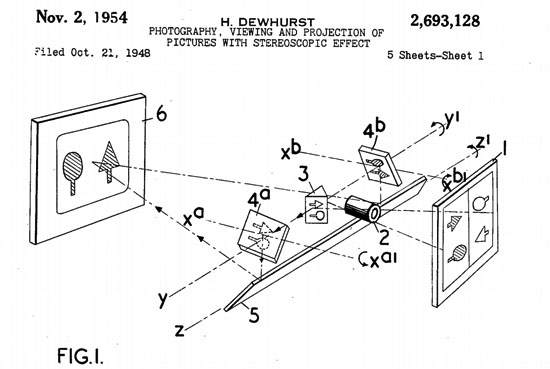
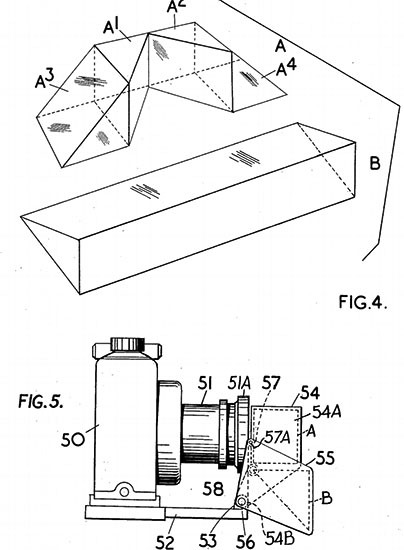
Anyway, if you want to see how it works, it's all here in this 1948 patent (except why 2 mirroed prisms and a mirror costs $20k)
http://www.freepatentsonline.com/2693128.pdf
| IP: Logged
|
|
|
|
|
Powered by Infopop Corporation
UBB.classicTM
6.3.1.2
The Film-Tech Forums are designed for various members related to the cinema industry to express their opinions, viewpoints and testimonials on various products, services and events based upon speculation, personal knowledge and factual information through use, therefore all views represented here allow no liability upon the publishers of this web site and the owners of said views assume no liability for any ill will resulting from these postings. The posts made here are for educational as well as entertainment purposes and as such anyone viewing this portion of the website must accept these views as statements of the author of that opinion
and agrees to release the authors from any and all liability.
|

 Home
Home





![[Confused]](confused.gif)



 Printer-friendly view of this topic