Film-Tech Cinema Systems
Film-Tech Forum ARCHIVE


my profile | my password | search | faq & rules | forum home
  next oldest topic   next newest topic
» Film-Tech Forum ARCHIVE   » Operations   » Film Handlers' Forum   » Service Tech Opinions on 70mm Norelco Ad (Page 3)

 
This topic comprises 5 pages: 1  2  3  4  5 
 
Author Topic: Service Tech Opinions on 70mm Norelco Ad
Mark Gulbrandsen
Resident Trollmaster

Posts: 16657
From: Music City
Registered: Jun 99


 - posted 05-09-2014 11:03 AM      Profile for Mark Gulbrandsen   Email Mark Gulbrandsen   Send New Private Message       Edit/Delete Post 
Back in the day prints used to fade just from being run so many times. Early Eastman was not long lived and the short life was exacerbated by the high heat from the huge arc lamps in use at the time. The DP-70 still offers the best cooling of any 70mm projector out there. The gate plate on them is silver plated copper as are the aperture plates. Some prints would have to be replaced during a very long run road show engagement ... and most of them were run just twice daily. Beginning in the mid 1970's prints began lasting much longer with Fuji making some real breakthroughs. Just imagine running an Imax with a 15kw lamp on that old early 1960's 70mm stock... 50 to 100 passes perhaps at best!

Mark

 |  IP: Logged

Victor Liorentas
Jedi Master Film Handler

Posts: 800
From: london ontario canada
Registered: May 2009


 - posted 05-09-2014 01:11 PM      Profile for Victor Liorentas   Email Victor Liorentas   Send New Private Message       Edit/Delete Post 
At our 70mm house in London the Park theater played The Empire Strikes Back exclusively all summer in 70mm.

By the end of it's long run the Fox logo had been removed and entire sections of it,a few seconds here and there.Not sure how much but I was given about 3 seconds of an important space shot. Imperial march introduction.

They had to switch to the 35mm back up for the final week which was end of September.
The piece I have showed a brittle sprocket damage state.

Over the years I heard these prints were prone to succumbing to brittle damage but I also heard it was being mis threaded too often.
I know Jedi ran without these issues 3 years later but perhaps they were aware of the problem by that point.
They were dual Vic 8 carbon arc.

 |  IP: Logged

Sam D. Chavez
Film God

Posts: 2153
From: Martinez, CA USA
Registered: Aug 2003


 - posted 05-09-2014 01:30 PM      Profile for Sam D. Chavez   Author's Homepage     Send New Private Message       Edit/Delete Post 
Disney ran 70mm on Star Tours rides in Orlando and got 5000 runs before replacing prints due to color fade. Polyester stock. Occasional mechanism failures would result in the projector and blimp being ripped out. They had spares ready to go.

 |  IP: Logged

Steve Guttag
We forgot the crackers Gromit!!!

Posts: 12814
From: Annapolis, MD
Registered: Dec 1999


 - posted 05-10-2014 06:47 AM      Profile for Steve Guttag   Email Steve Guttag   Send New Private Message       Edit/Delete Post 
The K-B Cinema in Washington, DC played Empire Strikes Back in 70mm from the opening day until about November (don't remember the month exactly)...but Paul McCartney's "Rock Show" replaced it. In any event, same print for the entire run and virtually blemish free.

The projector(s)? Norelco AAII. Those machines started life at the K-B Apex and were there until it closed in 1976ish. They were then donated to the Loews Jersey.

At the Cinema (or any K-B Theatre) we never needed a replacement 70mm print. Our worst 70mm experience at the time was running Temple of Doom on the Christie AW3 in 70mm. The humidity that summer combined with that film stock and how Christie arranged the center cluster rollers would pinch the film at the bottom and the film would un-thread itself in mere moments. Flipping the film had the film film "hug" the center roller and one location put a "guard" on the guide posts to prevent the film from being able to slip out on its own.

 |  IP: Logged

Leo Enticknap
Film God

Posts: 7474
From: Loma Linda, CA
Registered: Jul 2000


 - posted 05-10-2014 03:46 PM      Profile for Leo Enticknap   Author's Homepage   Email Leo Enticknap   Send New Private Message       Edit/Delete Post 
quote: Mark Gulbrandsen
Back in the day prints used to fade just from being run so many times. Early Eastman was not long lived and the short life was exacerbated by the high heat from the huge arc lamps in use at the time.
And some were faded by repeated projection, but not time. If you get a 70 year-old IB print that has hardly been projected at all, the colors are likely still to be great (assuming nitrate decomposition hasn't done for it). But a 1960s one that has done 500 passes will have thin, washed-out dyes. Same thing with Kodachrome reversal dupes.

 |  IP: Logged

Steve Matz
Jedi Master Film Handler

Posts: 672
From: Billings, Montana, USA
Registered: Sep 2003


 - posted 05-10-2014 05:46 PM      Profile for Steve Matz   Email Steve Matz   Send New Private Message       Edit/Delete Post 
I always wondered on CINERAMA where they were projecting 3 separate 35mm Prints at once if one or more Prints started wearing more than the others and upset the projection IMAGE Balance after a long period of time. I never heard how many projections they were getting from a print back then. I think the Cinerama Venue we saw in Seattle during the Worlds Fair in 62; they were using Century C Projectors...

 |  IP: Logged

Mark Gulbrandsen
Resident Trollmaster

Posts: 16657
From: Music City
Registered: Jun 99


 - posted 05-11-2014 02:55 PM      Profile for Mark Gulbrandsen   Email Mark Gulbrandsen   Send New Private Message       Edit/Delete Post 
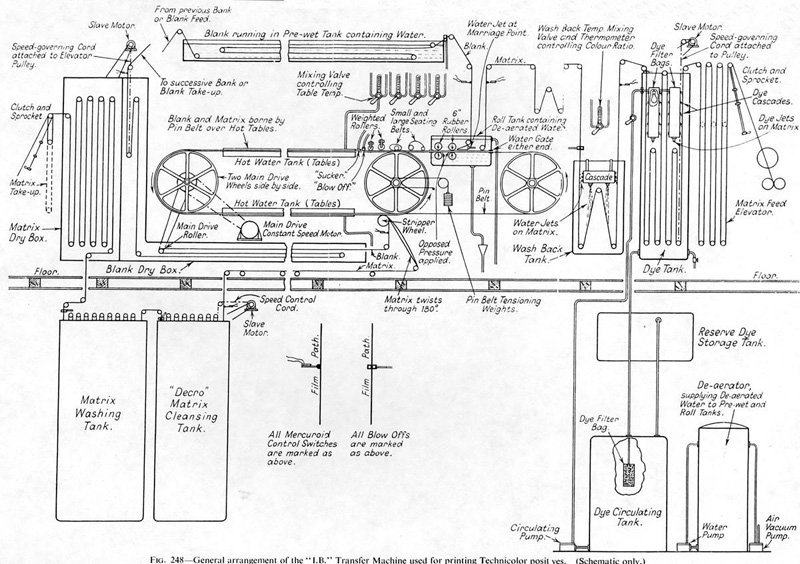
Most big Cinerama pictures were dye transfer Technicolor. Those prints are still being projected to this day. Technicolor kept a 1000' reference reel of every film they printed so they could make exact duplicates again at a later time. And since Technicolor could change the color balance and density somewhat on the fly it was easier to keep them matched up. Technicolor printing was an absolutely amazing process and if you study the materials, chemicals and equipment used to do it it is really amazing that it could even be done. There were some Eastman 3 panel movies though. Windjammer I believe was Eastman... at least the surviving ones are. Cinerama Holiday had some Eastman prints. Eastman is also not too difficult to match up when printing as this is a known art but is about to vanish for ever.

The following diagram shows just one third of the printing machine. There were stages just like this for Magenta, Yellow and cyan dyes. The completed print was dried and went through high speed inspection projectors and reels were put on cores and shipped. The cool thing is it was carried out in the light. Once the sound track and frame lines were printed onto the receiver film and processed there was no light sensitive film to worry about.

 -

 |  IP: Logged

Robert Furmanek
Expert Film Handler

Posts: 113
From: Clifton, NJ, USA
Registered: Jun 2012


 - posted 05-11-2014 11:09 PM      Profile for Robert Furmanek   Author's Homepage   Email Robert Furmanek       Edit/Delete Post 
Mark: I was under the impression that none of the three-panel films were printed in dye-transfer until the early sixties with HOW THE WEST WAS WON, BROTHERS GRIMM and a reissue of scenes from THIS IS CINERAMA as THE BEST OF CINERAMA?

 |  IP: Logged

Mark Gulbrandsen
Resident Trollmaster

Posts: 16657
From: Music City
Registered: Jun 99


 - posted 05-12-2014 08:54 AM      Profile for Mark Gulbrandsen   Email Mark Gulbrandsen   Send New Private Message       Edit/Delete Post 
The print of This Is Cinerama I watched in Dayton was very definitely dye transfer.

 |  IP: Logged

Robert Furmanek
Expert Film Handler

Posts: 113
From: Clifton, NJ, USA
Registered: Jun 2012


 - posted 05-12-2014 09:11 AM      Profile for Robert Furmanek   Author's Homepage   Email Robert Furmanek       Edit/Delete Post 
I'm pretty sure that's a 1960's printing.

 |  IP: Logged

Mark Gulbrandsen
Resident Trollmaster

Posts: 16657
From: Music City
Registered: Jun 99


 - posted 05-12-2014 09:27 AM      Profile for Mark Gulbrandsen   Email Mark Gulbrandsen   Send New Private Message       Edit/Delete Post 
Hard to say. I do remember John saying it was made up out of a number of different prints as were most of his 3-panel films. The prolog was the drive in version in spite of the fact that I had sent him an original 35mm B&W prolog I found in the Palace Theater booth in Chicago.

 |  IP: Logged

Steve Matz
Jedi Master Film Handler

Posts: 672
From: Billings, Montana, USA
Registered: Sep 2003


 - posted 05-12-2014 04:20 PM      Profile for Steve Matz   Email Steve Matz   Send New Private Message       Edit/Delete Post 
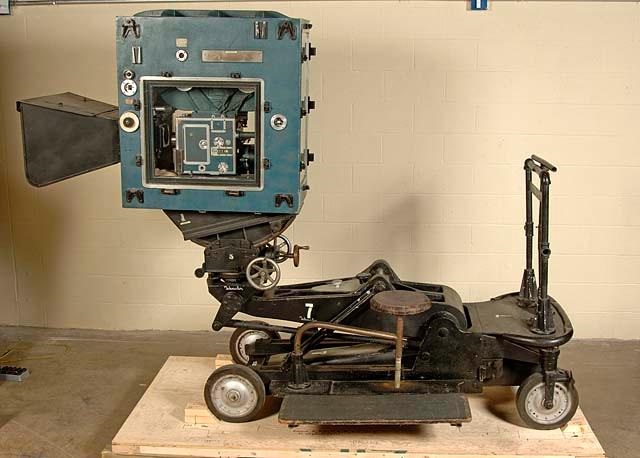
Thanks Mark, Very interesting about having a Reference Print for Cinerama Productions which would make sense since you want all those Prints to have the same consistency. Reading the Book on the Making of Wizard of Oz and all the work both in actually Filming 3 strip Technicolor and the complicated and expensive Lab Processing.It still is amazing how many films were made threw the Years using that process...

Intersting to note that Technicolor Corporation didn't sell any of their Equipment to Studios or anyone for that Matter. it was all leased out and at the time of Filming Wizard(1938); there was a 2 year waiting list from different Studios that had a feature they wanted to shoot in 3 Strip.

Employees of Technicolor would deliver the Cameras,Equipment,etc. early in the Morning and stay there all day til Shooting was over for that day; than load everything back up and take it to their headquarters where it was inspected,cleaned, etc. then delivered again the next day for that day of Filming. Technicolor never let any of their cameras,etc out of their site or left them over night at any Production they were being used.

There is a 3-strip Tech Camera in the Smithsonian and I believe a couple more still in existence. One of them way back when fell into the Grand Canyon some how.

 -
Technicolor DF-24 3-Strip 35mm Beam Splitter Camera

 |  IP: Logged

Leo Enticknap
Film God

Posts: 7474
From: Loma Linda, CA
Registered: Jul 2000


 - posted 05-13-2014 12:17 AM      Profile for Leo Enticknap   Author's Homepage   Email Leo Enticknap   Send New Private Message       Edit/Delete Post 
Two cameras were exported to Britain in the late '30s and were in constant use until 1955 (including throughout WWII). The wet leasing and "color consultant" system operated there, too, and there was a dye transfer printing line at their UK lab in West London. At least one of them is now owned by the National Media Museum in Bradford, though when I saw it in, I would guess, 2003 or '04, it was in an exhibit store and not on public display. The curator who showed it to me told me that it was in fully working order, and that he was trying to get a project together to shoot some new footage on it, with surviving cinematographers and camera assistants who used it in the '40s and early '50s. I don't know if that ever happened, or where the other one is (or even if it still exists).

 |  IP: Logged

Thomas Hauerslev
Master Film Handler

Posts: 451
From: Copenhagen, Denmark
Registered: Aug 2000


 - posted 05-13-2014 05:00 AM      Profile for Thomas Hauerslev   Author's Homepage   Email Thomas Hauerslev   Send New Private Message       Edit/Delete Post 
Amadeus had a very long run in London - see this add: http://in70mm.com/library/70mm_in/england/london/images/amadeus_1082.jpg

"South Pacific" played 4 years in Copenhagen 1958 - 1962 - maybe only 2 70mm prints.

There are many other examples. The DP70 is the best - simple!

 |  IP: Logged

Stephen Furley
Film God

Posts: 3059
From: Coulsdon, Croydon, England
Registered: May 2002


 - posted 05-13-2014 07:28 AM      Profile for Stephen Furley   Email Stephen Furley   Send New Private Message       Edit/Delete Post 
Wasn't there a 3-strip in MOMI at one time? There was certainly one in the Science Museum in London before they removed from display just about anything of interest.

There's a famous picture of an actress being filmed by a blimped camera, I can't remember what the film was now, but other than that I've never seen the blimp for it. I was at an event some years ago where Jack Cardiff talked about mounting the prism in the first camera to arrive in this country.

Of course, Kodak introduced the dye-transfer printing process for still photography, sometime in the '40s I think. By the '70s it was alreadty in decline, and something over twenty years ago Kodak discontinued all of the materials, but a handful of photographers bought up stocks of all the materials while they were still available, and somebody even tried coating their own matrix film.

The photographer Ctein finally stopped making dye transfer prints a few months ago, and is selling off his sets of work prints and matricies, at a much lower price than his normal prints. The print I was sent is a very good one, and of course for still photography where the matrix size is the same as that of the print, as opposed to a cinema print there the image is greatly enlarged onto the screen, the reduced sharpness is not as noticeable as it is with a cinema print.

 |  IP: Logged


All times are Central (GMT -6:00)
This topic comprises 5 pages: 1  2  3  4  5 
 
   Close Topic    Move Topic    Delete Topic    next oldest topic   next newest topic
 - Printer-friendly view of this topic
Hop To:


Powered by Infopop Corporation
UBB.classicTM 6.3.1.2

The Film-Tech Forums are designed for various members related to the cinema industry to express their opinions, viewpoints and testimonials on various products, services and events based upon speculation, personal knowledge and factual information through use, therefore all views represented here allow no liability upon the publishers of this web site and the owners of said views assume no liability for any ill will resulting from these postings. The posts made here are for educational as well as entertainment purposes and as such anyone viewing this portion of the website must accept these views as statements of the author of that opinion and agrees to release the authors from any and all liability.

© 1999-2020 Film-Tech Cinema Systems, LLC. All rights reserved.