|
|
 
|
|
Author
|
Topic: Dolby Cinema
|
Antonio Casado
Film Handler
Posts: 36
From: Madrid, Madrid, Spain
Registered: Apr 2013
|
 posted 12-05-2014 02:24 AM


quote:
quote: Antonio Casado
I have one OLED TV (LG 55EC930V) and the blacks they have is the best thing that I see in my life. The "blacks" of ANY cinema screen makes me laugh. Including this Dolby Vision or future Laser Projection, of course.
Have you seen it yet?
No, of course. But I can imaginate it, is very easy: White screen (not cares if masked or not...is white) + Dark grey black...boom!.
I mean...true black in Cinema Projection is nearly impossible. I can get deeper blacks in my JVC D-ILA 350HD instead. I can prove it, nearly the 100% of the screens display the "black" like a 10,10,10 in RGB numbers. This is not black, sorry.
Black is the complete absence of light, like OLED does.
I continue to go to the cinema, because want to see those giant screens in front of my face. But I´m pretty dissapointed because the experience lived in that is not 100% accurate for me.
I got better contrast in my tiny home projection screen that the 90% of the screens in Spain (I cannot talk for about others Countries...)
| IP: Logged
|
|
Marcel Birgelen
Film God
Posts: 3357
From: Maastricht, Limburg, Netherlands
Registered: Feb 2012
|
posted 12-05-2014 03:53 AM
I'm still under the impression that you should not judge anything before you either have sufficient information of how it actually works or if you've seen it for yourself. Right now, you don't have either of both, but you already give it the thumbs down.
My 15 year old CRT projector which I still use for some movie watching now and then will also do "true blacks". It's my job to avoid light bouncing off the screen to not reflect back onto that same screen. If I manage to do that, I can assure you, the black is as good as it gets.
Will an OLED screen produce blacker blacks? Probably, although not really relevant in correct setups. Can it produce better colors? Most likely. But it will take a few more iterations before any OLED screen of the same size will become remotely affordable. Also, TV screens are mostly employed in rooms with plenty of other light sources, their screen therefore should avoid reflecting this same ambient light. But for some stupid esthetic reasons, almost all manufacturers use glossy screen finishes...
All current DLP projectors suffer from light leaking trough and DCI projectors, which have three DMDs are certainly no exception. It's rather hard to tame a multi-kilowatt light source with a bunch of tiny mirrors. There's still a lot of room for improvement here, but once this has been fixed, the white screen in front isn't your biggest enemy. Your next enemy will be badly masked Exit signs, badly engineered aisle lighting and people leaving the light on in the projection booth.
| IP: Logged
|
|
|
|
|
|
Bobby Henderson
"Ask me about Trajan."

Posts: 10973
From: Lawton, OK, USA
Registered: Apr 2001
|
posted 12-05-2014 10:01 AM
quote: Mike Blakesley
As for the ever-increasingly immersive thing... I'm all about good sound. I love good sound, but I just don't see the huge need for all this immersivity or whatever you want to call it, especially if it's going to double (or more) the cost of a movie ticket. When I am watching a movie I get involved in what's going on on the screen. I'm not exactly caring if the bullet hits are in a certain spot overhead vs. just coming from the side. Just plain old surround sound gets the job done for me.
While Dolby Atmos is an expensive surround sound format the funny thing is in Dolby Cinema's concept the Atmos component is going to be one of the lesser expensive things. That motion graphics wall in the front entrance, be it LED-based or a collage of flat panel monitors, is probably going to cost a lot more than the sound system. A pair of 6P laser projectors is going to be expensive as hell.
The scary thing for movie theater operators is, like with IMAX, it sounds like they're going to be on the hook paying for the construction of that unique auditorium building. Dolby and its movie studio partners will fund the hardware going in it. But what is the dividing line on who pays for what? If the Dolby Cinema auditorium is going to have some of the same kinds of in-wall and in-floor treatment as its private screening rooms will the theater operator have to pay for that or will Dolby?
quote: Marcel Birgelen
The idea is not just to improve the contrast or make white more white. It intends to broaden the color gamut of images, to more realistically simulate nature. So, not only brighter white, but also brighter yellow, brigher red, etc.
Dolby Vision sounds to me like it is meant to compete with other emerging standards, like the Rec. 2020 color space. HDTV sets currently sold (including 4K UHTVs) are limited to the Rec. 709 color space. TV sets that support Rec. 2020 color space will cover more than double the CIE 1931 color space (75.8% versus 35.9%). How is a Dolby Vision enhanced monitor going to compare to a UHDTV set that just supports Rec. 2020?
Repeating what I said earlier, there's no way to go with this wide gamma route without adding more bits of color depth in actual movie/TV show production. That's going to cost more money in terms of processing power, bandwidth and storage requirements.
It's perfectly acceptable for Dolby and other technology companies to push the boundaries of what's possible with color reproduction in projectors and video monitors. However, have they been watching many movies lately? Lots of movies these days aren't exactly what I would call brilliantly colorful. Often they're dreary looking, sometimes with a urine colored bath.
quote: Marcel Birgelen
You don't need OLEDs for massive screens, but you could theoretically use massive LED screens. I've seen several demos of 4K LED walls and from a certain distance, they look VERY impressive. The problem is the massive screen door effect though, once you get up close to them.
I don't think there's any practical way to scale OLED panel production to the size of a movie theater screen. It's challenging enough as it is to get OLED panels up to normal "big" TV screen sizes like 55".
A LED-based "jumbotron" style screen might be more possible, but would still be expensive as hell just to get to a 2K pixel count, nevermind quadrupling it to 4K. It would require a LOT of maintenance. Driver board panels have to be swapped out when a pixel gets stuck/goes bad. The jumbotron has to be continually adjusted to make replacement driver boards match the color and intensity of older existing boards. If that isn't done you'll see a whole lot of blocky squares of varying brightness -the dreaded quilt look.
quote: Marcel Birgelen
The main attraction is still just the movie itself. And if the theater gets it right and avoids unnecessary distraction, a lot of those technical bells and whistles are just a bunch of gimmicks. Then again, the only way for technology providers like Dolby to stay relevant is to come up with something new once a while. Also, if you're in a hugely competitive market, where everybody competes with essentially the same content, you will need some distinguishing features to stay ahead of your competition.
One possible good thing about Dolby Cinema: it will probably raise the bar on what's expected in a premium priced big screen theater. It might actually force theater chains to disclose just what is in their "premium" house to justify the damned surcharge.
Right now, all a theater operator needs to tack on a $3 surcharge is build a somewhat bigger auditorium, install a masking free, wall to wall screen and turn up the sound a bit. That's it. You could still be watching the same damned 2K resolution picture from a single projector and hearing 5.1 sound, but you've just paid a bunch more to see it in a somewhat bigger auditorium.
And now, going off topic a bit:
quote: Allan Barnes
STILL LAUGHING HERE IN CANADA. THIS PROCESS WILL SOLVE YOUR RACE WAR.
This is assuming racism doesn't exist outside the United States?
![[Roll Eyes]](rolleyes.gif)
| IP: Logged
|
|
Antonio Casado
Film Handler
Posts: 36
From: Madrid, Madrid, Spain
Registered: Apr 2013
|
posted 12-05-2014 11:08 AM
Marcel, is obvious that I don´t have seen, but it´s the same obvious thing that a white screen cannot compare to a OLED screen, as are different things.
And I like a lot OLED, and I think that is the future. These deeper blacks are really atracting and is the way to go.
In fact I have done a photo of my OLED and my projector showing the same image, to match it, and finally I done it (this with another technology is really hard to set):
http://imageshack.com/a/img540/307/xy8Rn0.jpg
About the glossy panel, it not aesthetical, is simply that a matte panel introduce blur to the image and the sharpness is reduced. I don´t like it as well as you, but there isn´t any other option to make the best sharpness.
| IP: Logged
|
|
|
|
Marcel Birgelen
Film God
Posts: 3357
From: Maastricht, Limburg, Netherlands
Registered: Feb 2012
|
posted 12-05-2014 01:25 PM
quote: Bobby Henderson
Dolby Vision sounds to me like it is meant to compete with other emerging standards, like the Rec. 2020 color space. HDTV sets currently sold (including 4K UHTVs) are limited to the Rec. 709 color space. TV sets that support Rec. 2020 color space will cover more than double the CIE 1931 color space (75.8% versus 35.9%). How is a Dolby Vision enhanced monitor going to compare to a UHDTV set that just supports Rec. 2020?
Their central white will probably be brighter than D65, but I guess it will be very similar. At least will they provide a delivery format and branding for this kind of content. The difference will be the most profound for the exhibition industry, it will probably take a few years before a non-proprietary implementation for a broader color gamut will become available.
quote: Bobby Henderson
Repeating what I said earlier, there's no way to go with this wide gamma route without adding more bits of color depth in actual movie/TV show production. That's going to cost more money in terms of processing power, bandwidth and storage requirements.
CIE 1931 is mostly done with just 8 bits (per color) and many claim it's sufficient for consumer applications. So, regarding Rec. 2020 or similar color spaces... Those 12 bits per channel give you 4096 steps in x, y and z. If you but them on a non-linear scale, maybe they still have sufficient resolution for what human vision is capable of "resolving". I cannot really give an answer to this, as it would require some scientific evidence and conclusive A/B/N tests.
quote: Bobby Henderson
It's perfectly acceptable for Dolby and other technology companies to push the boundaries of what's possible with color reproduction in projectors and video monitors. However, have they been watching many movies lately? Lots of movies these days aren't exactly what I would call brilliantly colorful. Often they're dreary looking, sometimes with a urine colored bath.
We can also slowly start the discussion of we actually want our movies to look different than they've looked for quite a while now. If HFR can movies look like video, will "HDR" not potentially do the same? Or maybe even worse?
quote: Bobby Henderson
A LED-based "jumbotron" style screen might be more possible, but would still be expensive as hell just to get to a 2K pixel count, nevermind quadrupling it to 4K. It would require a LOT of maintenance. Driver board panels have to be swapped out when a pixel gets stuck/goes bad. The jumbotron has to be continually adjusted to make replacement driver boards match the color and intensity of older existing boards. If that isn't done you'll see a whole lot of blocky squares of varying brightness -the dreaded quilt look.
Well, I've seen both a 4K and an 8K (2x4K) LED wall in a demonstration. It looked rather awesome, from a certain distance though. They managed to calibrate those things to perfection, at least I couldn't spot the individual panels that made up those walls. The brightness of those was also astonishing. I could, in a somewhat distant future, see those kind of walls completely replace projection screens in many applications.
And while it's clear we're nowhere near yet, stuff like color intensity and calibration could probably be automated by placing a camera in front off it and running a smart auto-calibration program. Somewhat more advanced panels could, maybe, be told to temporarily disable single defective pixels. Costs are also related to volume and those new high-end projection systems also don't come cheap obviously.
What keeps bugging me though is, how could you fix the giant gaps between the pixels? And what about speaker placement? Do you want to put a bunch of powerful speakers behind such a wall?
quote: Bobby Henderson
One possible good thing about Dolby Cinema: it will probably raise the bar on what's expected in a premium priced big screen theater. It might actually force theater chains to disclose just what is in their "premium" house to justify the damned surcharge.
Just like IMAX does to some extend, it sets a certain base line of standards, rather high standards for now. Without comparing the merits of any of them, it's like THX on steroids.
quote: Antonio Casado
Marcel, is obvious that I don´t have seen, but it´s the same obvious thing that a white screen cannot compare to a OLED screen, as are different things.
Well, my point was that it's apples and oranges. OLED screens work great in environments with lots of ambient light. White screens will not. Nobody can construct an OLED screen the same size as a cinema screen and it will take a few iterations before we even come close. Still, we can construct an auditorium that only leaks a minimum of light back onto the screen. The black in those auditoriums will be great.
No current projection technique, not even DiLA is capable of delivering true blacks, so currently there is just no comparison.
The image you pasted is more an advertisement of the brightness of your OLED screen than the lack of real black in the projected image.
quote: Antonio Casado
About the glossy panel, it not aesthetical, is simply that a matte panel introduce blur to the image and the sharpness is reduced. I don´t like it as well as you, but there isn´t any other option to make the best sharpness.
I've heard this "improved picture quality" argument and I call B.S., at least for 95% of the cases out there. Do you think that at the average viewing distance of a normal TV, this will make the least bit of impact? My current notebook has a matte screen, I can still clearly discern every single pixel, so what would a glossy screen add, besides a few unwanted reflections? And what's more distracting? Reflections or blur you can't see?
quote:
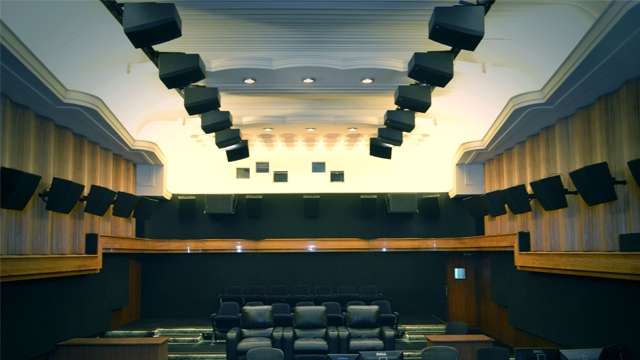
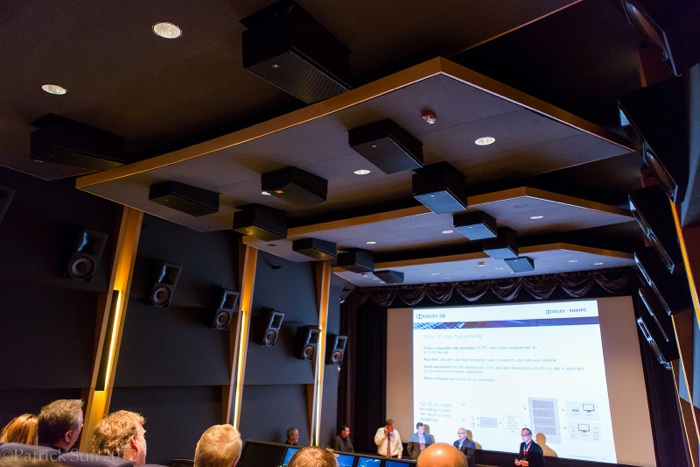
I always thought it was the hallmark for Dolby to show off the Atmos speaker arrays inside a cinema, now they are going the transparent route for this Dolby Cinema. I just find that a little strange. Why hide what is arguably the most visually defining feature (even if it is ugly [Big Grin] ) of the Atmos concept?
I doubt anyone at Dolby sees the sheer volume of visible speakers in the average Atmos equipped auditorium as a strong selling point of the technology...
| IP: Logged
|
|
|
|
|
|
|
|
|
|
|
|
Marcel Birgelen
Film God
Posts: 3357
From: Maastricht, Limburg, Netherlands
Registered: Feb 2012
|
posted 12-05-2014 07:37 PM
For me, it doesn't need to be all Disney themepark-esque, where all the technology is almost completely hidden from sight, but I sure do agree those speakers look ugly.
So, if you have a beautifully room, no matter if it's a more classical one or a modern design, I fully understand why you would want to limit the amount of visible technical clutter of whatever origin inside this room.
For what it's worth: THX Auditorium #1 (the one that used to be the reference theater) at Skywalker Sound also has all its speakers completely hidden from view.
quote: Marco Giustini
Yeah, let's go back to Dolby SR.
Heck, let's just get back to silent movies. If they put in a live orchestra, it would actually justify those $20 ticket prices. ![[Wink]](wink.gif)
| IP: Logged
|
|
|
|
|
|
All times are Central (GMT -6:00)
|
This topic comprises 11 pages: 1 2 3 4 5 6 ... 9 10 11
|
Powered by Infopop Corporation
UBB.classicTM
6.3.1.2
The Film-Tech Forums are designed for various members related to the cinema industry to express their opinions, viewpoints and testimonials on various products, services and events based upon speculation, personal knowledge and factual information through use, therefore all views represented here allow no liability upon the publishers of this web site and the owners of said views assume no liability for any ill will resulting from these postings. The posts made here are for educational as well as entertainment purposes and as such anyone viewing this portion of the website must accept these views as statements of the author of that opinion
and agrees to release the authors from any and all liability.
|

 Home
Home

![[Big Grin]](biggrin.gif) ) of the Atmos concept?
) of the Atmos concept?
![[Razz]](tongue.gif)



 Printer-friendly view of this topic