|
|
 
|
|
Author
|
Topic: Dolby Cinema
|
Marcel Birgelen
Film God
Posts: 3357
From: Maastricht, Limburg, Netherlands
Registered: Feb 2012
|
 posted 12-22-2014 04:15 AM


I’ve tried to shoot some pictures, but a cellphone camera just couldn’t handle it. To quote Zaphod Beeblebrox: "It's the weird colour scheme that freaks me. Every time you try to operate one of these weird black controls, which are labeled in black on a black background, a small black light lights up black to let you know you've done it."
This essentially describes the whole layout of the room. Everything, except the screen, is black.
The "immersive tunnel" at the beginning is essentially a long, dark tunnel with indirect blue lightning all the way to the auditorium. It starts with about 15ft of slightly curved screen. This screen is a short throw projection affair. Four standard "office" LED DLP short throw projectors stitched together via edge blending and concealed in the ceiling. The whole thing runs a short loop based on the current movie and some generic Dolby content featuring some animated fanciness. After the projection, you get some "movie related multi-channel sounds" on a loop from some concealed speakers. Then you continue your journey to the auditorium itself. The space under the raisers of the auditorium has essentially been used to create this tunnel. There is a whole concept behind this tunnel and its design with curves and bends: You exit the busy lobby, the noises of the lobby slowly die away, while you enter the realm of the movie... The whole thing feels more like a theme park attraction than a movie theater. It remains to be seen how much of this effect gets still trough on a busy night.
The room is just sparsely lit. Besides the blue glow around the screen and the blue halo along the aisles, there's just the legally minimum of required light coming from lights in the ceiling. There’s also no other aisle lightning, so no shiny LED strips radiating their red, green or blueness at the screen. Emergency lightning also has been sufficiently masked to not interfere with the screen.
Something that will probably evade most casual visitors is that the walls of the auditorium, because it's so dark, are indeed all paneled and angled, much like a stealth fighter. It will take your eyes a few minutes to see just parts of it.
The seats are comfortable fake leather seats with headrests, but unfortunately with hard plastic arm rests. Also, those are not double armrests like in the concept pictures. The best part is the extreme legroom. Most people will be able to stretch their legs to full extent with still some room to spare. I'm unable to reach the seat in front of me and I do have rather long legs.
There are 64 speakers and 5 subwoofers in the room, none of them visible to the naked eye. They're indeed all concealed behind either the screen or the side panels. The Dolby Atmos system in this room sounds great, the acoustics in the room surely help. It's not the best I've heard, but we're entering the realm of "What does it matter? It's more than good enough." here. One of the most positive side effects of the acoustic treatments of the room: During the silent moments of a movie, it's totally silent. No audible noises leaking in from the lobby, the adjacent rooms, projection booth or air conditioning.
One of the biggest letdowns is the screen itself. It's a plain white screen, which is obviously an advantage over a silver screen. But like with almost all those new, premium concepts, there’s no masking whatsoever. Since the rest of the room is essentially black, if the content fits the screen exactly, this is no real distraction. Unfortunately, the screen is one of the common width type of screens, which in my opinion, is a missed chance to diversify from most of those other "PLF" concepts that use "flat screens".
The image is created by two Christie 6P laser projectors in a dual-mirror Christie Duo configuration. With their external laser light sources, fed via fiber and no need to fit a multi-kilowatt xenon bulb in their belly, they look rather nimble for what you would otherwise expect to find in such a big room.
One of the few barely usable pictures I managed to create is the one of the 3D glasses, using a bag of crisps as contrast. As you can see, those are not the standard Dolby 3D glasses, their glasses are bigger.
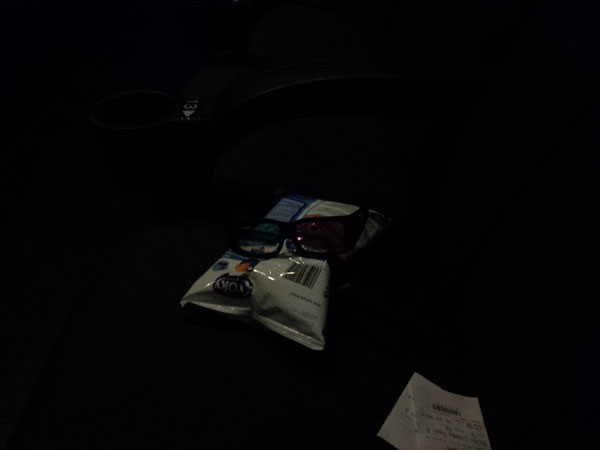
I've tried my own (far superior) Infitec 3D glasses with this system, unfortunately, they're not compatible with the 6P laser system. Seemingly, the color primaries differ from the standard Dolby 3D deployment.
The provided 3D glasses, although larger than the standard glasses, aren't the best unfortunately. Many of them suffer from color defects in the extreme left and right (left being green and right being red) and also have this distracting white glare around the corners, comparable to what you'll predominantly find in the barely usable plastic version. Dolby really needs to fix this, which seems to be possible, because those über-expensive Infitec glasses don’t have those defects and at the given ticket price, you might expect flawless glasses. The interesting part is that one pair of glasses are better than the others.
If you have seen laser before, you might know what to expect. Laser projection for normal 2D DCI content looks very much like a regular, Xenon projected image. The difference is noticeable only in content that actually uses the broader color gamut and besides a few short demos and snipes, there's no content in "Dolby Vision" just yet. The few trailers there are, make those 2K Dolby Atmos trailers look stupid. So, this HDR content looks great, but more like computer graphics on steroids, not really cinematic. For normal, recorded content, it looks a lot more like "being there", which will also not really improve the cinematic looks. A lot like HFR, the whole HDR process will have a steep learning curve and also will take time to get accepted by movie buffs, I'm not yet sure if I actually want this to seep through to feature films in general.
For 3D, this system is a whole different matter though. The difference is almost night and day. It delivers 3D images at about the same brightness you'd expect from a good 2D show. This really is a game changer for 3D. Besides the problems with the glasses, Dolby 3D delivers this enhanced brightness without any crosstalk whatsoever, not even in the subtitling, which is traditionally hard to do. All in all, this is remarkable, given the brightness of the two combined pictures.
So, now for this black thing, which is also supposed to be an important part of “Dolby Vision”. Let me first start by saying: No, black still is not black, unfortunately. Also, the unavoidable letterboxing on an unmasked screen for anything but "flat" also doesn't help. But, the black on black with black buttons and handles design of the room helps. Also, the greater contrast due to more brightness also adds in obviously. The black is probably one of the best blacks I've seen using DLP projectors up until now and comparable to what would be achievable using 35mm.
The Netherlands is one of the few markets in mainland Europe that has, given the population density, some credible Digital IMAX presence. As a matter of fact, there is a Digital IMAX screen just a few yards away. Both concepts are similarly priced and if you compare both concepts, Dolby Cinema wins hands down. The picture is about equally big, but in 4K, which even helps for 2K content, because there's practically no more visible pixel grid on those oversized screens. The dual laser projector outperforms the dual 2K IMAX xenon projection in every aspect regarding brightness, the room is acoustically better, the sound systems outshines it in both raw power, clarity and detail. Also, although not entirely due to IMAX alone, the seats in this auditorium are far better as is the legroom, which will be greatly appreciated by all visitors.
| IP: Logged
|
|
Bobby Henderson
"Ask me about Trajan."

Posts: 10973
From: Lawton, OK, USA
Registered: Apr 2001
|
posted 04-09-2015 01:37 PM
Bump.
I was tempted to start another thread about this, perhaps in the "large format" forum, which could be called the Fake Large Format Forum once film-based processes have vanished completely.
Anyway, it's interesting news (from the L.A. Times) regarding Dolby Cinema in the United States.
quote: L.A. Times, Richard Verrier
AMC and Dolby are teaming up to build 100 high-tech theaters
AMC Entertainment, owner of the nation's second-largest theater chain, is partnering with San Francisco-based Dolby to bring sharper images and more lifelike sounds to cinemas.
The companies said they would debut 100 high-tech theaters over the next decade that will include Dolby Vision, a new laser projection system that offers sharper and more vivid images than conventional screens.
As part of the agreement, AMC will renovate its existing premium theaters, known as ETX and AMC Prime, and convert them into new venues called Dolby Cinema at AMC Prime.
Along with reclining seats that vibrate with the action on screen, the theaters also will be equipped with Dolby's Atmos sound system, which provides lifelike sounds of music, people and objects that flow around the theater in sync with the movie action.
Locally, AMC will debut the knew Dolby Cinema in Burbank in May, and in Century City in June. In all, 14 of the 100 new theaters will open in Southern California over the next decade, along with locations in San Francisco, Las Vegas, Philadelphia, Miami, Boston, Denver and Seattle.
"Guests should be prepared to be blown away when we launch this amazing theater experience," AMC Chief Executive Gerry Lopez said in a statement.
Financial terms of the partnership were not disclosed.
Theater chains such as AMC have been investing heavily in new technologies and premium services as a way to attract new moviegoers at a time when cinemas face rising competition from Netflix and other entertainment options that give consumers less incentive to leave their homes for the multiplex.
"We have what we believe is the ability to deliver a differentiated and unique experience that moviegoers can't find anywhere else," said Doug Darrow, senior vice president of cinema at Dolby.
| IP: Logged
|
|
|
|
|
|
|
|
Marcel Birgelen
Film God
Posts: 3357
From: Maastricht, Limburg, Netherlands
Registered: Feb 2012
|
posted 04-10-2015 04:08 AM
I've seen their first install in the world in Eindhoven, which I described to some detail in the post above. They also explained their concept and what they try to achieve.
quote: Bobby Henderson
I thought the angled walls are there to improve sound quality -basically to control reflections of sound waves.
Those angled, deep black walls serve both purposes, both to suppress sound reflections but also to minimize light reflections. It's so dark in there, I couldn't take pictures of those angled walls, even with the house lights on.
quote: Bobby Henderson
The thing I don't like about Dolby Cinema: the screen. From the pictures I've seen the screen looks too small for the room size. It is shaped for common width, which is terrible. No masking, no curtains and a blue halo has the screen looking more like a TV set.
The screen is indeed, an unmasked common width affair. Proportionally to the room, it's smaller than the average IMAX digital installation. Since everything around the screen is in different shades of blackest black, if the content fits the screen, you won't miss the masking once the show started. But yeah, what about all those other non-flat aspect ratios...? I would have expected Dolby would have gotten this right...
Furthermore, the laser projection adds nothing really worthwhile for your average 2D DCI content. It's bright, but not really brighter than a well lit average sized Xenon digital screen.
Like I mentioned before, the wide-color-gamut content really IS impressive, but I'm still not sure if I want my movies to look like Candy Crush on overdrive.
| IP: Logged
|
|
|
|
|
|
|
|
Marcel Birgelen
Film God
Posts: 3357
From: Maastricht, Limburg, Netherlands
Registered: Feb 2012
|
posted 04-18-2015 06:40 PM
The correct term is indeed Wide Gamut, although the term Bobby used, wide gamma, isn't all that wrong.
REC 709 covers about 75% of the DCI-P3 spectrum, so yeah, there are more (possible) colors in Digital Cinema already, compared to standard HD broadcasts and DVD/Blu Ray content.
I do not generally disprove this wider color gamut, but still it's a tool which should be used with care. Unfortunately, history has proven us that care and consideration often fly out the window in favor of showing off the latest gimmicks.
| IP: Logged
|
|
|
|
|
|
|
|
|
|
|
|
|
|
All times are Central (GMT -6:00)
|
This topic comprises 11 pages: 1 2 3 4 5 6 7 8 9 10 11
|
Powered by Infopop Corporation
UBB.classicTM
6.3.1.2
The Film-Tech Forums are designed for various members related to the cinema industry to express their opinions, viewpoints and testimonials on various products, services and events based upon speculation, personal knowledge and factual information through use, therefore all views represented here allow no liability upon the publishers of this web site and the owners of said views assume no liability for any ill will resulting from these postings. The posts made here are for educational as well as entertainment purposes and as such anyone viewing this portion of the website must accept these views as statements of the author of that opinion
and agrees to release the authors from any and all liability.
|

 Home
Home

![[Smile]](smile.gif) for Dolby and I am happy for them.
for Dolby and I am happy for them. ![[Frown]](frown.gif)


 Printer-friendly view of this topic