|
|
This topic comprises 5 pages: 1 2 3 4 5
|
|
Author
|
Topic: Billy Lynn's Long Halftime Walk - tech specs
|
|
|
|
|
Harold Hallikainen
Jedi Master Film Handler
Posts: 906
From: Denver, CO, USA
Registered: Aug 2009
|
 posted 10-27-2016 11:31 PM


We had a request from Sony as to what firmware versions supported what framerate. They provided test content. I suspect this was sent to all media block suppliers. Based on this information, they should be able to determine where it would play at what frame rate.
I do appreciate that the studios are willing to experiment with new technologies and work with manufacturers to make it work. It reminds me of all the various leading edge technologies done in film (sound, stereo sound, noise reduction, digital sound, 5.1 sound, 7.1 sound, object-based sound, color, high dynamic range, different aspect ratios including Cinerama and Vista Vision, etc.
It's a fun industry! Of course, all these technologies have to get people willing to pay to go to the movies. If they don't, studios and exhibitors won't pay for the fancy new technology. But, some of this comes "for free." I suspect that being able to handle higher frame rates is likely to be standard in media blocks, if it is not already. If it's time to replace, there's just the migration to the higher capability. Same for 4k. On high dynamic range, I guess the move to smaller DMD chips has hurt contrast, so maybe we need to spend more money for the larger chips. I guess contrast is also affected a lot by how well the optics are designed and how clean they are.
So, what technology will get more people to the movies? Great content helps, but eventually the content ends up at home, so we need to give people a reason to see it in the theater. Is the great technology that will get more people to the movies the recliner seat? My wife and I don't really like the big bulky recliners at a local theater. We go farther back in the auditorium for the more conventional seats. Also, not a big fan of reserved seating. For a while, the seat numbers were not visible in the dark auditorium. They now have them on the floor, which helps. Anyway... time to stop rambling...
Harold
| IP: Logged
|
|
|
|
|
|
Carsten Kurz
Film God
Posts: 4340
From: Cologne, NRW, Germany
Registered: Aug 2009
|
posted 10-28-2016 05:55 AM
Harold - one issue in this case certainly was - these many different HFR versions work against the struggling towards uniform release formats.
For The Hobbit, there was a screen qualification scheme started in advance. Only those screens passing the test would be granted HFR DCPs.
So today you could say any screen HFR capable would be able to play a 48fps 3D feature. But that happened four years ago, and many more screens are now HFR capable, at least 48fps capable. 60? No one tested that so far.
Billy Lynn' is not a block buster, so they didn't start an evaluation of the exhibition side about which format's they'd be able to play. Sony would have to guess or make all versions available on one disk (probably two, as they would have IOP 24fps and SMPTE HFR DCPs).
And this testing is not necessarily a works/don't works, it could be unreliable playback, bad colours, flash rate issues, etc.
Then there's electronic delivery. I don't think Billy Lynn is prominent enough to allow to distribute it in 6 different formats over DCDC...
Of course, the pull could also be related to the bad reviews of the HFR experience - although I'm not able to judge how the general public actually perceived these, as from over here, I see both negative and positive reviews.
At least for this aspect, Sony could have seen this coming very early in the process, they should have been prepared for it. So I think the decision, if it proves authentic, must have been because of above mentioned technical distribution issues.
You know I am following the ISDCFs efforts for the IOP/SMPTE transition. This HFR uncertainty shows some of those problems as well. Neither studios nor exhibition know for sure what all the systems in the field are capable of, both equipment/firmware and setup wise. There is servers, there is projectors, there is 3D systems, there is TMS's. All need to play together.
Obviously, Sony did not trust the exhibition industry to sort this out themselves. And I guess they were right to do so. Too many locations with no knowledgeable staff.
Technically, this is a very complex problem. After the digital rollout has finished for most of the world, the installed equipment, even though software based and as such considered 'flexible' to a great amount, presents itself stuck at 24fps just as in 35mm times. The digital cinema revolution has become it's own deadlock.
As I said many times, I am not a HFR fan from a cinemagoer's perspective, but am of course interested in technical and perceptional advancements. I am a bit disturbed this is happening. It could mean the end to HFR, and possibly other technical advancements as well.
- Carsten
| IP: Logged
|
|
Steve Guttag
We forgot the crackers Gromit!!!

Posts: 12814
From: Annapolis, MD
Registered: Dec 1999
|
posted 10-28-2016 07:15 AM
Carsten,
You are incorrect on the server qualification part of Billy Lynn. Sony indeed sent out test DCPs so exhibitors could qualify their servers, in advance. The test target consisted of two patterns:
1) Full white block and one of a grey block.
Any flickering is a fail.
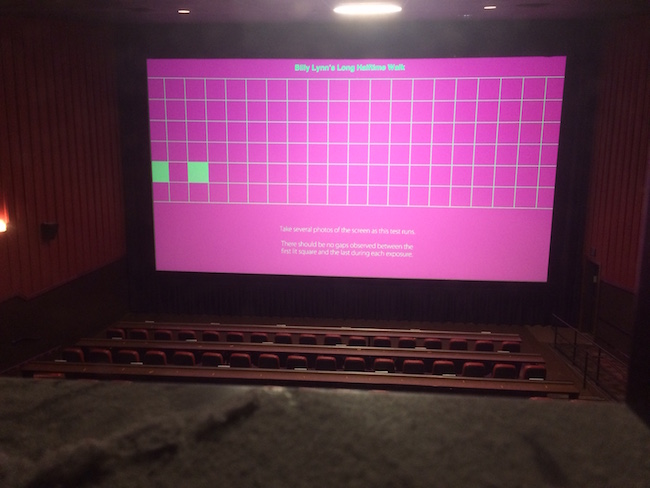
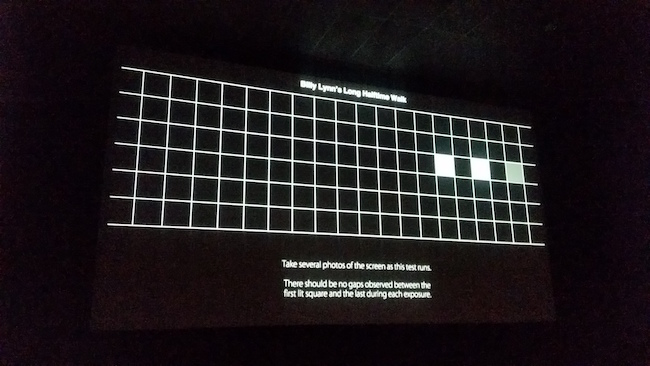
2) a grid pattern with a moving white block within the grid. You take a photo (or several photos) while the block is moving. If there are any discontinuities, then it is a fail (e.g. one block lit, the next not, the next lit).
This is an example of both a colorspace fail as well as a 60fps fail:
This is an example of the right colorspace but still a 60fps fail:
And finally, this is an example of a color and frame rate pass:
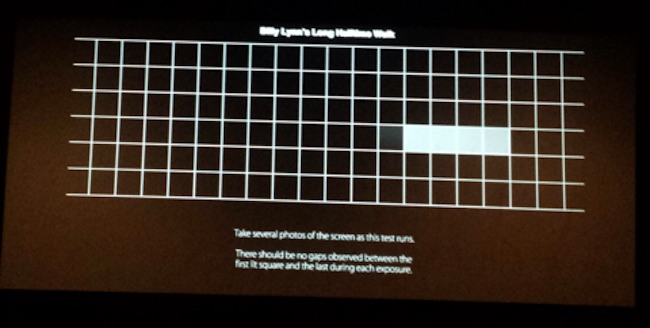
These were all done in 2D theatres interested in showing the movie in 2D HFR. I think the scary thing for Sony are the first two examples (the fails). These were sent to me by exhibitors that THOUGHT that they had passed!!!! I guess they figured if that they got ANY image on screen, it was a pass (ignoring the text in the image that told them what they were supposed to be looking for. If many exhibitors had opened the movie with those sorts of disasters, it would reflect very poorly.
The other possibility is that they looked at the proposed 60fps 2D and 3D versions and deemed them to be too Hobbit like and piss off people from HFR altogether. Though I'd think that the 2D wouldn't suffer so since it shouldn't have a time-variant issue like 3D will with a single projector.
There are a couple of things I think Sony and server manufacturers could have done to make things better:
While the server companies did do research as to what their products were capable of (Harold mentioned it and Dolby issued a Field Bulletin), nobody really said, in order for this to work, put your server in to "this mode" and configure projector with "these files." So it was left to the exhibitor to test, evaluate and experiment (if they even knew there was a problem.
The other thing they could have done is take the old DTS/Jurassic Park approach. Provide the TRAILERS in the various formats so the perspective exhibitors could get a proof-positive that things look correct. If HFR is all it is cracked up to be, people should be WANTING to see it in HFR if the preview showed it off, right? As it is, the only way to get actual content was to get a KDMed test drive. The preview route would have not had that hurdle and accomplished what was needed.
Well, this is does remove a potential fiasco from me, at least. I had several sites that were ready to run it (and I have configured there servers/projectors now) but I knew there would be last minute people in the bigger plexes since they can always play anything (smaller screen count people have to make choices).
For the record, I'm not against high-frame-rate and thought the ShowScan process was the best I've ever seen movies look. However, thus far, HFR-3D hasn't been a good combination for me. I don't like the 3D process at all and I see odd motion artifacts in HFR-3D (the Hobbit and in test material)). So I was kindof looking forward to seeing how 60fps 2D would look...it see if the technology was there and if it was cinematic or gimmick. I'll say that the 30fps 4K image of Oklahoma! in DCP didn't look right and had a bit of that "sped-up" look to it, which I don't get. It was 2D and didn't look that way on 70mm so i don't see why it should have been strange just because it was DCP unless there was something up with the transfer or perhaps the projection technology.
| IP: Logged
|
|
|
|
Bobby Henderson
"Ask me about Trajan."

Posts: 10973
From: Lawton, OK, USA
Registered: Apr 2001
|
posted 10-28-2016 11:20 AM
I think the 2D HFR and 3D HFR thing might be best if research and development continued in the special venue and motion simulator/thrill ride market. It's obvious there is far too great a disconnect between movie productions and commercial theaters to get the job done right for traditional movies.
quote: Harold Hallikainen
So, what technology will get more people to the movies? Great content helps, but eventually the content ends up at home, so we need to give people a reason to see it in the theater. Is the great technology that will get more people to the movies the recliner seat? My wife and I don't really like the big bulky recliners at a local theater.
Recliners are comfortable and create more space between viewers, which is mostly a good thing unless you're trying to sit close to your girlfriend. There are plenty of downsides to them. It can be a chore leaving your seat to visit the restroom or snack bar. Recliners dramatically reduce seat count in an auditorium. They're more expensive to maintain. The worst thing for me is it makes the movie theater feel more like the home living room. It's bad enough so many movie screens are shaped like home TV screens and showing letter-boxed 'scope movies with no masking. That adds to the home-like experience. Some theaters like Cinetopia even have rooms like a big living room. I think there is something really perverse about a theater trying to mimic the home viewing experience. I can get the home viewing experience at home for a lot less money spent.
For now I think commercial movie theaters are on the losing end of trying to woo customers with technology. The latest advancements, like RGB laser projection, HDR or object oriented surround sound, are ridiculously cost prohibitive for most commercial theaters to implement. Meanwhile on the home front the TV sets keep getting bigger, better and more affordable. You can install a home Atmos/DTS-X setup in the living room at a tiny fraction of what it costs to install the same thing in a commercial theater auditorium.
Ironically, the trend these days seems to be "convenience" in the form of sound bars or at least something that doesn't require drilling a bunch of holes in the walls (or ceiling). I think some of the down-turn in surround sound sales partly has to do with the quality of movies being made. Very few have repeat viewing value, where it's actually worth it to buy a copy of the movie on Blu-ray. You see it once and you're done with it. Streaming services usually offer only basic, lossy 5.1 surround sound. I wonder how many streaming consumers are even bothering with home 5.1 for that content.
Add to that a general lack of understanding about the functions and capabilities of digital hardware and "software." I think it's pretty difficult to sell the general public on any sort of new movie presentation technology. They kind of have to understand what the technology does in order to get excited about it.
quote: Mike Blakesley
I don't think ANY technology will get more people to go to movies that aren't good. We need more GOOD movies, and a longer video window. Especially the longer video window.
As long as we have bean counters playing accounting games with cash flow and media company bosses only concerning themselves with stock prices these guys are just going to keep shrinking the home video window, and making movies even more predictably formulaic. These guys don't have the balls to take chances on truly creative movie projects, ones that can shake up the industry and change how movies are made. That kind of chance taking used to be somewhat common. Now all the studios are in the business of playing it safe. But they only think they're playing it safe. If there's nothing special about the content audiences will feel indifferent about seeing it in the theater or on the living room TV set.
quote: Carsten Kurz
Technically, this is a very complex problem. After the digital rollout has finished for most of the world, the installed equipment, even though software based and as such considered 'flexible' to a great amount, presents itself stuck at 24fps just as in 35mm times. The digital cinema revolution has become it's own deadlock.
I think theater chains are trying to treat these digital projectors just like they're film projectors: install them and then let them sit there for 20 or 30 years until the bulldozers come to tear down the multiplex.
While a film projector could easily last 30 years or more if properly maintained anything "digital" is considered an antique and living on borrowed time past the 10 year mark. Theater chains and independent locations aren't going to replace a d-cinema projector system every few years to stay current on technological advances. It's just too damned expensive to do that. That's especially true right now considering the extreme prices on laser projectors.
| IP: Logged
|
|
|
|
|
|
|
|
|
|
Brad Miller
Administrator

Posts: 17775
From: Plano, TX (36.2 miles NW of Rockwall)
Registered: May 99
|
posted 10-29-2016 08:54 PM
quote: Steve Guttag
Yep. The only way, for now, to see it in EITHER 3D or HFR is at the two, count them two, theatres....everywhere else, it will be 2D/24.
I think the studio is smart enough to know that HFR will hurt their business on this film AND future HFR. By choosing to release it ONLY to two theaters nationwide, that will GUARANTEE that those 2 theaters will have the highest grosses. Then they can come back to the exhibitors and shove it down their throat with "the HFR locations reported dramatically higher sales than the non-HFR locations", so get out there and replace your equipment with this fancy 120FPS stuff.
(Of course the manufacturers will push that super hard too and scare exhibitors into thinking if they don't buy the latest IMB-7000 model that they will go out of business because they are so behind on the technology. Total bs of course, but if it means another server sale, just watch 'em do it!)
And because they are that concerned with the amount of backlash, bad press and overall suckage of HFR...just to be super extra, extra, extra sure of it, the studio is delaying the release of ALL non-HFR theaters by an entire week.
It all makes sense to me. HFR video being the steaming pile of poo that it is however, just need to go away and stay gone. ![[bs]](graemlins/bs.gif)
If the studios REALLY want high frame rate to work, they need to make a bunch of high frame rate 70mm prints, because high frame rate on film looks really good, but something absolutely terrible happens when the frame rate is sped up on video.
| IP: Logged
|
|
|
|
|
|
All times are Central (GMT -6:00)
|
This topic comprises 5 pages: 1 2 3 4 5
|
Powered by Infopop Corporation
UBB.classicTM
6.3.1.2
The Film-Tech Forums are designed for various members related to the cinema industry to express their opinions, viewpoints and testimonials on various products, services and events based upon speculation, personal knowledge and factual information through use, therefore all views represented here allow no liability upon the publishers of this web site and the owners of said views assume no liability for any ill will resulting from these postings. The posts made here are for educational as well as entertainment purposes and as such anyone viewing this portion of the website must accept these views as statements of the author of that opinion
and agrees to release the authors from any and all liability.
|

 Home
Home








 Printer-friendly view of this topic