Film-Tech Cinema Systems
Film-Tech Forum ARCHIVE


my profile | my password | search | faq & rules | forum home
  next oldest topic   next newest topic
» Film-Tech Forum ARCHIVE   » Operations   » Digital Cinema Forum   » Trinnov Ovation Sound Processor (Page 4)

 
This topic comprises 5 pages: 1  2  3  4  5 
 
Author Topic: Trinnov Ovation Sound Processor
Mike Babb
Master Film Handler

Posts: 250
From: Norwich UK
Registered: Jul 2002


 - posted 12-01-2019 01:59 PM      Profile for Mike Babb   Author's Homepage   Email Mike Babb   Send New Private Message       Edit/Delete Post 
Brad uploaded the Quickstart manual to the f-t warehouse. It may be updated soon and I will resend to Brad but if anyone wants a look it gives you an idea of the basic procedure.

 |  IP: Logged

Sam D. Chavez
Film God

Posts: 2153
From: Martinez, CA USA
Registered: Aug 2003


 - posted 12-01-2019 04:17 PM      Profile for Sam D. Chavez   Author's Homepage     Send New Private Message       Edit/Delete Post 
I'm a pretty skeptical guy but Trinnov definitely improved the audio in the Grand Lake, Oakland. This is an old movie palace twinned up and down and the acoustics are pretty challenging. It supports 5.1, 7.1 and is also has 5 full channels backstage. Stephan and Mike were able to configure the system and made use of its channel mapping feature to allow quick playback of any of the extensive format choices available.

I'm guessing the audio improvements come mostly from improved phase response and time alignment at each speaker, or in the case of surrounds; the group or bank. This results in more distinct first arrival audio at your ear from each channel., LCR, Ls, Rs, etc.

I'll stop here before I start spouting audio buzzwords and be called that most unflattering of all terms; an audiophile.

I'd say the Trinnov is at its best in difficult acoustical venues.

 |  IP: Logged

Pete Naples
Phenomenal Film Handler

Posts: 1565
From: Dunfermline, Scotland
Registered: Feb 2001


 - posted 12-03-2019 04:12 PM      Profile for Pete Naples   Email Pete Naples   Send New Private Message       Edit/Delete Post 
I'm a believer!

Seriously though.

I have installed Ovations in a number of sites where only the processor changed. The improvement has been marked and commented on by owners, managers and customers each and every time. The very first one in the UK went into a iWerks/Megasystems room, originally an 8/70 installation by Clyde McKinney. It brought that room to life, made it sound how it should, and had not done for some time.

Sam Chavez pretty much nails it, time alignment and phase correction are the big bonus things where the main improvement lies.

It is at its best in at minimum bi-amp configuration, and makes marked improvements in rooms which are acoustically bright, RT60 not optimal. To get the best out of it in those rooms does require experience and practice, but even a basic calibration will beat all but the very best hand eq's.

 |  IP: Logged

Geoff Halls
Film Handler

Posts: 10
From: Adelaide South Australia
Registered: Feb 2013


 - posted 12-08-2019 11:10 PM      Profile for Geoff Halls   Email Geoff Halls   Send New Private Message       Edit/Delete Post 
Just completed another 2 Trinnov installations along with speaker/amp upgrades and plenty of additional LFE's.

Lucky to have Mike Babb in town last week to re-calibrate with our locally manufactured, world class, Krix speaker engineers and designers.

End result, amazing clarity and can be played at high volume bringing sound to life without harshness or listening fatigue.

 |  IP: Logged

Marcel Birgelen
Film God

Posts: 3357
From: Maastricht, Limburg, Netherlands
Registered: Feb 2012


 - posted 12-10-2019 05:34 PM      Profile for Marcel Birgelen   Email Marcel Birgelen   Send New Private Message       Edit/Delete Post 
In order to understand the technical mumbo-jumbo which often prevails when describing the quality characteristics of some audio equipment, I have a stupid question.

What's the difference between:

- time alignment
- phase correction

Because in my simple mind, those are exactly the same things.

 |  IP: Logged

Mike Babb
Master Film Handler

Posts: 250
From: Norwich UK
Registered: Jul 2002


 - posted 12-11-2019 01:42 AM      Profile for Mike Babb   Author's Homepage   Email Mike Babb   Send New Private Message       Edit/Delete Post 
Hi Marcel, only commenting regarding Trinnov, I would say this. The time alignment uses delay to match the arrival times. So for example the low and mid and high on a 3 way speaker. Or having done that, the arrival time of the left and center channel for example.
The phase correction is done within the response of one speaker. For example a phase rotation at a passive crossover, or a measured rotation within the frequency response of a driver.
The processor both sends the test signal and receives the result so it is able to analyze.
I will freely admit some of this is in the special sauce of the software and I'm not able to explain "how".

 |  IP: Logged

Sam D. Chavez
Film God

Posts: 2153
From: Martinez, CA USA
Registered: Aug 2003


 - posted 12-11-2019 01:52 AM      Profile for Sam D. Chavez   Author's Homepage     Send New Private Message       Edit/Delete Post 
In the electrical industry it was called phase angle. Maybe easier to visualize.

 |  IP: Logged

Marcel Birgelen
Film God

Posts: 3357
From: Maastricht, Limburg, Netherlands
Registered: Feb 2012


 - posted 12-11-2019 03:18 AM      Profile for Marcel Birgelen   Email Marcel Birgelen   Send New Private Message       Edit/Delete Post 
Modern room EQ systems like the Dirac Live system on the AP20 can already do "parametric phase correction" as in phase correction over the frequency domain of the speaker. That covers much of the "impulse response" issues you can get over the frequency domain of a speaker.

But essentially, what you're saying is that this system is capable of correcting phase rotation/phase angle differences between individual coils that occur at passive cross-over frequencies?

I guess you can do a Fourier transform on the measured input of the calibration mike and do a rough compensation, so that at least the peak values are being compensated for. I don't know what that will do for the perceived audio quality though. Maybe it will improve the perceived clarity in the crossover frequency domains, but I can imagine it also introducing new artifacts.

 |  IP: Logged

Steve Guttag
We forgot the crackers Gromit!!!

Posts: 12814
From: Annapolis, MD
Registered: Dec 1999


 - posted 12-11-2019 05:05 AM      Profile for Steve Guttag   Email Steve Guttag   Send New Private Message       Edit/Delete Post 
Marcel,

I would say the chief differences between simple time-alignment and phase alignment is the frequency dependent component.

Simple time alignment (delay) electrically compensates for a physical displacement (HF driver is physically behind an LF driver, one can delay the LF signals so they are emanating from the speaker system at the same time as the HF signals so it is a unified front.

Where phase comes in would be when you have a time dependent component (reactive components like inductors or capacitors, EQ and other things that will alter the phase at particular frequencies). As Mike points out, a passive crossover will inherently alter the phase as the signal travels through the chokes and capacitors. EQ will inherently alter the phase at the frequency the EQ is applied. If these are not done identically on all speakers that are carrying the same signal, you set up for phase anomalies.

So in looking at the EQ below...the magenta line represents phase and you can see how it is altered about the point where the ⅓-octave EQ band was raised.
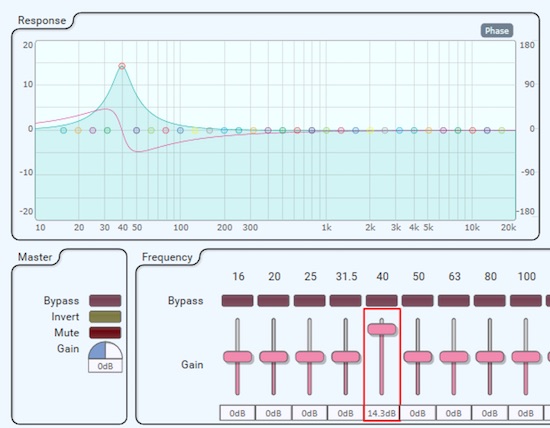
 -

As one EQs a room and starts moving various frequencies...what they normally don't notice is that they are altering the phase response with it.

Have you ever heard the expression "EQed the life out of the room?" (Or words to that effect)? Likely it is the combined phase alteration that is contributing to it. And then when you have a mix with music or other sounds that will emanate from a combination of the stage speakers, those phase anomalies will combine in a non-beneficial way.

This doesn't speak to how we use analyzers and EQs in the first place. So you have a ⅓ octave analyzer...but it isn't good at letting you see the bits between the bands. Graphic EQs and RTA feel nice because there is a 1:1 relationship...if you are willing to ignore that there is detail you are missing. Parametric EQ and higher resolution RTAs are a better way to fly because you can better shape the signal and apply the least amount of damage. And, you can even apply ALL-PASS filters to repair the phase problems though that takes different tools and experience than the relatively simple RTA.

I think this is an area where the Ovation shining because it does this work for you. You just have to set up the mics and "press a button" and let it work its magic without a lot of human analysis.

Of course, having the room built properly (low noise, low RT-60) and good speakers are the best fix of all, if not always practical or possible. The best fix is the one you don't need.

 |  IP: Logged

Mike Babb
Master Film Handler

Posts: 250
From: Norwich UK
Registered: Jul 2002


 - posted 12-11-2019 05:08 AM      Profile for Mike Babb   Author's Homepage   Email Mike Babb   Send New Private Message       Edit/Delete Post 
Hi Marcel, Paris is not so far if you want to connect in our office sometime for a demo and q&a, I can probably ask the CEO to lunch with us. He knows the technology and development history, as well as being able to decide how much is able to be discussed vs proprietary.

 |  IP: Logged

Khushwant Singh
Film Handler

Posts: 27
From: New Delhi , India
Registered: May 2018


 - posted 12-11-2019 12:26 PM      Profile for Khushwant Singh   Email Khushwant Singh   Send New Private Message       Edit/Delete Post 
Trinnov is gaining the market ....difference is only felt when we have live demonstration .... content played in normal 5.1 vs Trinnov 5.1 ....wow effect.

 |  IP: Logged

Marco Giustini
Film God

Posts: 2713
From: Reading, UK
Registered: Nov 2007


 - posted 12-12-2019 02:27 PM      Profile for Marco Giustini   Email Marco Giustini   Send New Private Message       Edit/Delete Post 
Ok - so what’s the difference between what the trinnov does and what Dirac does? Dirac will give you a flat phase response - I measured it.

 |  IP: Logged

Mike Babb
Master Film Handler

Posts: 250
From: Norwich UK
Registered: Jul 2002


 - posted 12-13-2019 07:08 AM      Profile for Mike Babb   Author's Homepage   Email Mike Babb   Send New Private Message       Edit/Delete Post 
Marco, I don't know much about how Dirac does it so I can't comment really on that side. I don't remember the Dirac having much in the way of analysis. On the Ov2 you can see room response, direct response, phase and impulse response, by microphone, which can be valuable to take you beyond the wizard, which in itself yields a very impressive result. It will also measure up to 8 mics at once, and as I remember the Dirac involved moving the mic for 9 measurements?

Keep in mind I am not saying anything negative about AP or Dirac, the AP was my go to processor before I was introduced to Trinnov, which I thought was a better result and a better analysis tool.

 |  IP: Logged

Marco Giustini
Film God

Posts: 2713
From: Reading, UK
Registered: Nov 2007


 - posted 12-13-2019 10:27 AM      Profile for Marco Giustini   Email Marco Giustini   Send New Private Message       Edit/Delete Post 
Dirac is automatic and will take an average of readings and correct amplitude AND phase. As I am a sceptical person by nature, I did my own test on a speaker using a single reading (actually 5 readings taken in the same place as moving the microphone would have averaged a phase response) and then checking the phase with and without Dirac: with Dirac applied the phase of the signal becomes flat +/- a few degrees.

 |  IP: Logged

Mike Babb
Master Film Handler

Posts: 250
From: Norwich UK
Registered: Jul 2002


 - posted 12-16-2019 03:34 AM      Profile for Mike Babb   Author's Homepage   Email Mike Babb   Send New Private Message       Edit/Delete Post 
Marco, happy to show you the procedure and let you hear the results if the opportunity arises, let me know.

 |  IP: Logged


All times are Central (GMT -6:00)
This topic comprises 5 pages: 1  2  3  4  5 
 
   Close Topic    Move Topic    Delete Topic    next oldest topic   next newest topic
 - Printer-friendly view of this topic
Hop To:


Powered by Infopop Corporation
UBB.classicTM 6.3.1.2

The Film-Tech Forums are designed for various members related to the cinema industry to express their opinions, viewpoints and testimonials on various products, services and events based upon speculation, personal knowledge and factual information through use, therefore all views represented here allow no liability upon the publishers of this web site and the owners of said views assume no liability for any ill will resulting from these postings. The posts made here are for educational as well as entertainment purposes and as such anyone viewing this portion of the website must accept these views as statements of the author of that opinion and agrees to release the authors from any and all liability.

© 1999-2020 Film-Tech Cinema Systems, LLC. All rights reserved.