|
|
 
|
|
Author
|
Topic: Upload your random pictures (part 2)
|
|
|
|
|
|
|
|
|
|
|
|
|
John Pytlak
Film God

Posts: 9987
From: Rochester, NY 14650-1922
Registered: Jan 2000
|
 posted 09-15-2005 12:16 PM


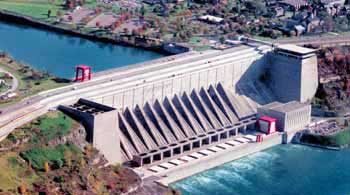
Robert Moses Generating Station, Niagara Falls NY
http://www.nypa.gov/facilities/niagara.htm
quote:
When the Niagara project produced its first power in 1961, it was the largest hydropower facility in the Western world at the time. Today, Niagara is the biggest electricity producer in New York State, generating 2.4 million kilowatts—enough power to light 24 million 100-watt bulbs at once! This low-cost electricity saves the state's residents and businesses hundreds of millions of dollars a year.
In 1991, the Power Authority began a $300-million upgrade and modernization at the project’s Robert Moses Niagara Power Plant. All 13 turbines are being replaced and other improvements are being made to generating equipment in the power dam, with completion scheduled for 2006.
Here's how it works:
The Niagara project, located about 4 1/2 miles downstream from the Falls, consists of two main facilities: the Robert Moses Niagara Power Plant, with 13 turbines, and the Lewiston Pump-Generating Plant, with 12 pump-turbines. In between the two plants is a forebay capable of holding 164 billion gallons of water; behind the Lewiston plant, a 1,900-acre reservoir holds additional supplies of this liquid fuel.
Put very simply, we divert water from the Niagara River—up to 375,000 gallons a second—and convey it through conduits under the City of Niagara Falls to Lewiston. From there, water flowing through the Robert Moses plant spins turbines that power generators, converting this mechanical energy into electrical energy.
At night, when electricity demand is low, the Lewiston units operate as pumps, transporting water from the forebay up to the plant's reservoir.
During the daytime, when electricity use peaks, the Lewiston pumps are reversed and become generators, similar to those at the Moses plant. In this way, the water can be used to produce electricity twice, increasing production and efficiency.
To balance the need for power with a desire to preserve the beauty of Niagara Falls, the United States and Canada signed a treaty in 1950 that regulates the amount of water diverted for hydroelectricity production. On average, more than 200,000 cubic feet per second (cfs), or 1.5 million gallons of water a second, flow from Lake Erie into the Niagara River. The 1950 pact requires that at least 100,000 cfs of water spill over the Falls during the daylight hours in the tourist season, April through October. This flow may be cut in half at night during this period and at all times the rest of the year.
http://www.niagarafrontier.com/riverdiversion.html
quote:
In order to preserve the scenic beauty of the Falls, the Niagara River Water Diversion Treaty of 1950 stipulated that no water diversions for power generation would be allowed that would reduce the flow of water over Niagara Falls as follows:
no less than 100,000 cubic feet of water per second (cf/s) From April 1st to September 15th (inclusive) between 8 a.m. and 10 p.m.
no less than 100,000 cubic feet of water per second (cf/s) from September 16th to October 31st (inclusive) between 8 a.m. and 8 p.m.
no less than 50,000 cubic feet of water per second (cf/s) from November 1st to March 31st (inclusive)
| IP: Logged
|
|
|
|
|
|
|
|
Mark Gulbrandsen
Resident Trollmaster

Posts: 16657
From: Music City
Registered: Jun 99
|
posted 09-15-2005 08:04 PM
John..... that barely qualifies as hydro anymore... might light up a couple of florescent work lights though...
While your "baby" sized hydro generating station may be older and more famous ours is much more stately, has an incredible bridge with a 700 foot drop in front of it, and has caused far more political trouble and unrest with those that claim to be ecolgically minded(they claim that until you shut off their power ![[Big Grin]](biggrin.gif) ). I find it hard to beat Lake Powell and Glen Canyon Dam for visuals or specs. ). I find it hard to beat Lake Powell and Glen Canyon Dam for visuals or specs.
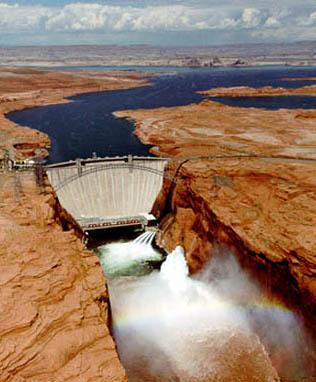
Glen Canyon Dam
Glen Canyon Dam is the second highest concrete-arch dam in the United States (Hoover Dam, which stands 726 feet (221 meters) above bedrock, is 16 feet (4.9 meters) taller)
Type ................................................................................................................................. Concrete arch
Construction period .................................................................................................................. 1957-1964
Prime contractor ............................................................................... Merritt-Chapman & Scott Corporation
Height above bedrock ............................................................................................... 710 feet (216 meters)
Height above original river channel ............................................................................. 583 feet (178 meters)
Thickness at lowest point of foundation ........................................................................ 300 feet (91 meters)
Maximum thickness (right abutment) ......................................................................... 350 feet (106 meters)
Thickness at crest ...................................................................................................... 25 feet (7.6 meters)
Crest length (arc at axis of dam) ............................................................................. 1,560 feet (475 meters)
Volume of concrete
Dam only ................................................................ 4,901,000 cubic yards (3,750,000 cubic meters)
Powerplant only ............................................................ 469,000 cubic yards (359,000 cubic meters)
Total concrete ......................................................... 5,370,000 cubic yards (4,110,000 cubic meters)
Capacity of bucket used to pour concrete ............................................................... 24 tons (22 metric tons)
Number of buckets of concrete poured to construct the dam ...................................... approximately 400,000
Total rock and sand excavated ............................................ 5,509,484 cubic yards (4,212,551 cubic meters)
(This includes 18,000 feet (5,486 meters) of tunnels and 127 feet (38.7 meters) below the original river channel)
Cost of dam ........................................................................................................................ $187,000,000
Cost of dam, powerplant, switchyard, town of Page, and other associated facilities ................... $314,000,000
Cost of recreational facilities ................................................................................................. $ 28,000,000
Cost of environmental studies (1983-1995) ............................................................................. $104,000,000
(Power revenues continue to fund monitoring and research activities at a cost of about $8,000,000 per year)
River Outlet Works
Number of outlet pipes ........................................................................................................................... 4
Size of each outlet pipe ................................................................................. 8 feet ( 2 meters) in diameter
Combined discharge capacity ............................ 15,000 cubic feet per second (420 cubic meters per second)
Spillways
Number of spillway openings .................................................................................................................. 2
(Each spillway tunnel reduces in size from 48 to 41 feet (15 to 12 meters) in diameter)
Elevation of spillway crest ................................................................................... 3,648 feet (1,112 meters)
Combined discharge capacity ....................... 208,000 cubic feet per second (5,890 cubic meters per second)
Glen Canyon Powerplant
Number of generating units .................................................................................................................... 8
Nameplate capacity .................................................................................................... 1,296,000 kilowatts
Number of penstocks ............................................................................................................................ 8
(Each penstock reduces in size from 15 to 14 feet (4.6 to 4.3 meters) in diameter)
Combined discharge capacity ........................... 33,200 cubic feet per second (940 cubic meters per second)
Hydraulic turbines ................................................................................................................. Francis-type
Cost of powerplant ................................................................................................................ $97,000,000
Milestones
Construction authorized ...................................................................................................... April 11, 1956
First construction contract awarded (right diversion tunnel excavation) ................................. October 1, 1956
Diversion of Colorado River around dam site .................................................................... February 11, 1959
First bucket of concrete ...................................................................................................... June 17, 1960
Last bucket of concrete ............................................................................................. September 13, 1963
First power generation ................................................................................................. September 4, 1964
Dedicated by Mrs. Lyndon B. Johnson ........................................................................ September 22, 1966
Glen Canyon National Recreation Area established .......................................................... October 27, 1972
Glen Canyon Bridge
Glen Canyon Bridge is the second highest steel-arch bridge in the United States
Type ....................................................................................................................................... Steel arch
Prime contractor ....................................................................................... Kiewit-Judson & Pacific-Murphy
Construction period .................................................................................... February 1957 to January 1959
Height above river .................................................................................................... 700 feet (213 meters)
Span of bridge arch ................................................................................... ........ 1,028 feet (313.3 meters)
Length of deck ................................................................................................... 1,271 feet (387.4 meters)
Vertical rise of arch ................................................................................ ................ 165 feet (50.3 meters)
Width of roadway (including sidewalks) ........................................................................... 30 feet (9 meters)
Lake Powell
Start of storage ............................................................................................................... March 13, 1963
Completion of initial filling ................................................................................................... June 22, 1980
Total capacity when full at elevation
3,700 feet (1,128 meters) .................................... 26,215,000 acre-feet* (32,336 million cubic meters)
Surface area when full ......................................................................... 266 square miles (68,900 hectares)
Surface acres when full .................................................................. 61,390 surface acres (65,315 hectares)
Length of lake .................................................................................................. 186 miles (299 kilometers)
Miles of shoreline ....................................................................................... 1,960 miles (3,150 kilometers)
Depth of water at dam when full ................................................................................ 560 feet (171 meters)
*An acre-foot of water = 325,851 gallons (1,233,350 liters); enough to supply an average family of four for one year
| IP: Logged
|
|
|
|
|
|
|
|
|
|
|
Powered by Infopop Corporation
UBB.classicTM
6.3.1.2
The Film-Tech Forums are designed for various members related to the cinema industry to express their opinions, viewpoints and testimonials on various products, services and events based upon speculation, personal knowledge and factual information through use, therefore all views represented here allow no liability upon the publishers of this web site and the owners of said views assume no liability for any ill will resulting from these postings. The posts made here are for educational as well as entertainment purposes and as such anyone viewing this portion of the website must accept these views as statements of the author of that opinion
and agrees to release the authors from any and all liability.
|

 Home
Home

 Topic Closed

![[thumbsup]](graemlins/thumbsup.gif)
![[beer]](graemlins/beer.gif)

![[Smile]](smile.gif)








![[Razz]](tongue.gif)
![[fu]](graemlins/fu.gif)


 Printer-friendly view of this topic