Addressing the last few comments and confusion.
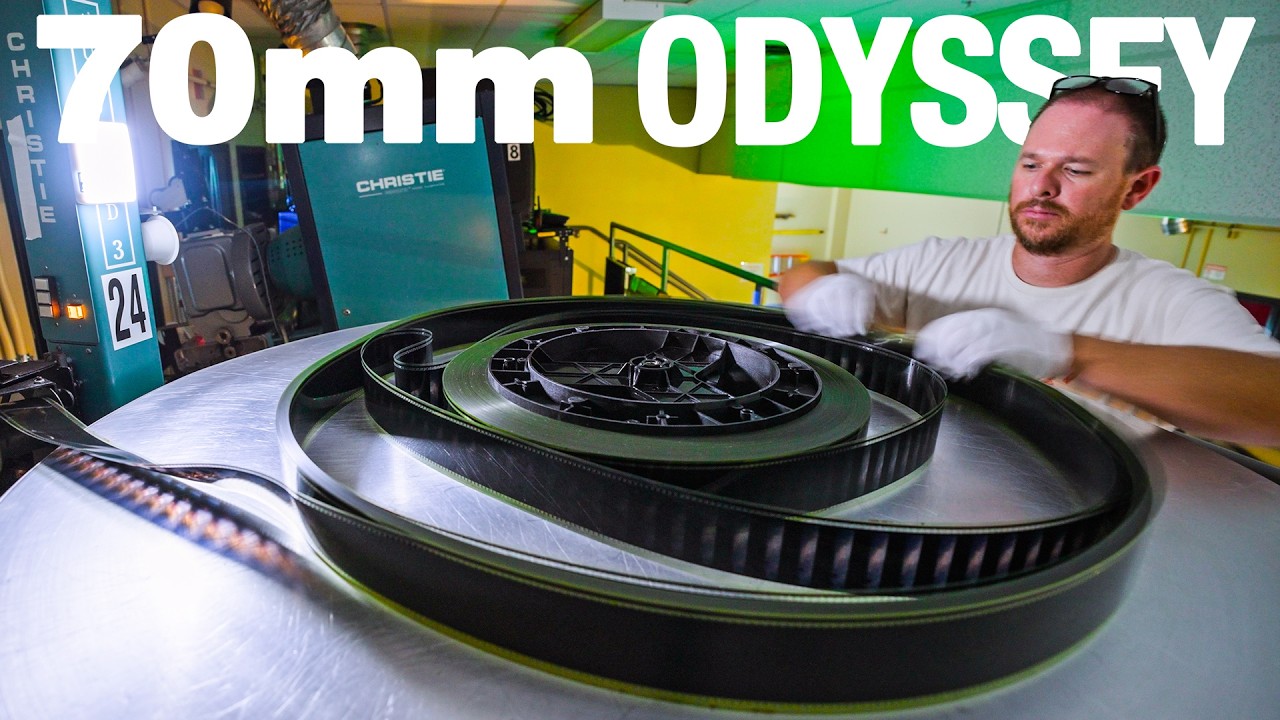
The pair of gloves shipped with the Platter Loader, not the print. There was never any intention of having people wear gloves when threading the platter. It's a complete waste. Everyone expects the first 10 feet of protection leader on changeover prints to be handled bare-handed. Same for the first 50-60 feet of protection leader on the platter prints.
Some people prefer to wear gloves when splicing and handling prints on the rewind table. Other people have their own methods of only touching the film by the edge and can do so without leaving any fingerprints. Either is fine. What matters is the quality of the splice. The projectionists who truly know what they are doing will handle that leader and put it back on without any dirt or even a mark on the leader. Anyone who utters things such as "it doesn't matter, we don't project the leader" are the actual problem people because it shows that they aren't able to grasp how dirt migrates and how that dirt then turns into scratches with future runs.
But to fixate only on wearing gloves vs. not wearing gloves during the splice? Again, I've seen lots and lots of splices made without gloves that have no fingerprints or marks. It CAN be done.
Getting back to the leaders, on a changeover house after they thread in the first 10 feet, there is about a solid minute of the projector motor running at full speed before the Academy countdown starts pulling down from the feed reel. On a platter house, after they thread in the first 50-60 feet there is about 2 minutes of the projector motor running at full speed before the Academy countdown. The intent here is twofold. First, to make the handling section of the leaders far enough away so dirt migration isn't an issue. Second, it gives the projectionists time to literally look at the machine running full speed after the thread to look for anything not sitting properly, a loop hitting something, etc. This has drastically reduced the amount of startup issues on returning prints.
And yes we do run each print through one of our ultrasonic cleaners running perc before they ship out again. Without that, all the dirt left on the print from the previous venue will just lower the presentation of the next venue to play that print and also speed up the inevitable process of cinch scratches appearing due to the dirt being an abrasive from film layers that slip against adjacent layers.
You might be shocked to learn this, but most theaters just add extra dirt and marks to the print when they do this. If it's a library title, there is certainly an argument for this, but on a brand new print where your theater is the first to play it, the preference is to just load it direct to the platter. The less handling, the better.
The pair of gloves shipped with the Platter Loader, not the print. There was never any intention of having people wear gloves when threading the platter. It's a complete waste. Everyone expects the first 10 feet of protection leader on changeover prints to be handled bare-handed. Same for the first 50-60 feet of protection leader on the platter prints.
Some people prefer to wear gloves when splicing and handling prints on the rewind table. Other people have their own methods of only touching the film by the edge and can do so without leaving any fingerprints. Either is fine. What matters is the quality of the splice. The projectionists who truly know what they are doing will handle that leader and put it back on without any dirt or even a mark on the leader. Anyone who utters things such as "it doesn't matter, we don't project the leader" are the actual problem people because it shows that they aren't able to grasp how dirt migrates and how that dirt then turns into scratches with future runs.
But to fixate only on wearing gloves vs. not wearing gloves during the splice? Again, I've seen lots and lots of splices made without gloves that have no fingerprints or marks. It CAN be done.
Getting back to the leaders, on a changeover house after they thread in the first 10 feet, there is about a solid minute of the projector motor running at full speed before the Academy countdown starts pulling down from the feed reel. On a platter house, after they thread in the first 50-60 feet there is about 2 minutes of the projector motor running at full speed before the Academy countdown. The intent here is twofold. First, to make the handling section of the leaders far enough away so dirt migration isn't an issue. Second, it gives the projectionists time to literally look at the machine running full speed after the thread to look for anything not sitting properly, a loop hitting something, etc. This has drastically reduced the amount of startup issues on returning prints.
And yes we do run each print through one of our ultrasonic cleaners running perc before they ship out again. Without that, all the dirt left on the print from the previous venue will just lower the presentation of the next venue to play that print and also speed up the inevitable process of cinch scratches appearing due to the dirt being an abrasive from film layers that slip against adjacent layers.
You might be shocked to learn this, but most theaters just add extra dirt and marks to the print when they do this. If it's a library title, there is certainly an argument for this, but on a brand new print where your theater is the first to play it, the preference is to just load it direct to the platter. The less handling, the better.


Comment