Film-Tech Cinema Systems
Film-Tech Forum ARCHIVE
Topic Closed  Topic Closed


my profile | my password | search | faq & rules | forum home
  next oldest topic   next newest topic
» Film-Tech Forum ARCHIVE   » Operations   » Film Handlers' Forum   » How to thread leader, which way is correct? (Page 4)

 
This topic comprises 7 pages: 1  2  3  4  5  6  7 
 
Author Topic: How to thread leader, which way is correct?
Monte L Fullmer
Film God

Posts: 8367
From: Nampa, Idaho, USA
Registered: Nov 2004


 - posted 04-28-2005 03:14 AM      Profile for Monte L Fullmer   Email Monte L Fullmer   Send New Private Message       Edit/Delete Post 
Platter transport to the left of the machine/console is called "gear side" platters, and the opposite is called "operator, or driver's side" platters.

Lot of theatres uses the "gear side" for the sake of having a open path from machine to operator so the operator isn't going to get himself all tangled up in the film coming overhead and down by his feet.

The obvious advantage of the "drivers side" platter is that if there is a mis-start or have to make a sudden shutdown, one can spin around and immediately grab the platter deck before the film wants to do nasty things and make your life miserable for the rest of the day..(unless that platter is 'miles' away from the machine...then you're seriously screwed in any case...lol..)

If you have such a messy wiring configuration at that theatre, and with "gear side" platters, take your leads over the top guidance roller, then feed the leads down across the front of the machine and reach under, when you see the end of the lead and grab the head of the lead then pull it back to the platter. This, what I call, a "square" threading configuration - being the thread path is in the square shape.

I use, what I call, the "triangle" load being that I don't go down to the lower guidance roller but grab the lead and bring it straight down to the lower roller on the platter tower.

Now, if you're going to reverse thread, one must do the "square" load so to keep the leads hitting the floor.

thx-Monte

 |  IP: Logged

John Hawkinson
Film God

Posts: 2273
From: Cambridge, MA, USA
Registered: Feb 2002


 - posted 04-28-2005 04:15 AM      Profile for John Hawkinson   Email John Hawkinson   Send New Private Message       Edit/Delete Post 
[uhoh] The side opposite the operator's/operating side is known as the "driving side" or the "drive side," because thats where the gears that drive the projector are. I don't think it's advisable to use the term "driver's side" -- its too confusing.

(See, for instance, the Century C manual, for examples of this terminology).

--jhawk

 |  IP: Logged

Monte L Fullmer
Film God

Posts: 8367
From: Nampa, Idaho, USA
Registered: Nov 2004


 - posted 04-30-2005 02:05 AM      Profile for Monte L Fullmer   Email Monte L Fullmer   Send New Private Message       Edit/Delete Post 
Where "driver's side" came from was from one of my operator's where I was projection manager.

...aren't we "driving",or operating a projector?

-Monte

 |  IP: Logged

Brad Miller
Administrator

Posts: 17775
From: Plano, TX (36.2 miles NW of Rockwall)
Registered: May 99


 - posted 04-30-2005 02:21 AM      Profile for Brad Miller   Author's Homepage   Email Brad Miller       Edit/Delete Post 
I fail to see why "operator side" and "non-operator side" isn't easier and less confusing.

 |  IP: Logged

Monte L Fullmer
Film God

Posts: 8367
From: Nampa, Idaho, USA
Registered: Nov 2004


 - posted 04-30-2005 02:44 AM      Profile for Monte L Fullmer   Email Monte L Fullmer   Send New Private Message       Edit/Delete Post 
..maybe less syllables to speak...using a simple visual term (gear, and operator's side), easier words to use (for the high school trainees and the MO's..) and still want to get the message across..

..just personal preference that I've used and trained with.

-thx Monte

 |  IP: Logged

Manny Knowles
"What are these things and WHY are they BLUE???"

Posts: 4247
From: Bloomington, IN, USA
Registered: Feb 2002


 - posted 04-30-2005 05:32 AM      Profile for Manny Knowles   Email Manny Knowles   Send New Private Message       Edit/Delete Post 
I usually say "gear side" and "operating side."

 |  IP: Logged

Richard Greco
Phenomenal Film Handler

Posts: 1180
From: Plant City, FL
Registered: Nov 2003


 - posted 05-01-2005 02:30 AM      Profile for Richard Greco   Email Richard Greco   Send New Private Message       Edit/Delete Post 
My tech told me last week that in the Chicago Union houses, changeovers btw, that they would thread the leader from the top reel, to the floor, thread the projector, and then take up whats on the floor on the bottom reel.

He also says that it doesn't matter if leader gets dirty or not. It won't go on the film.......HE says. Not me. Anyways, thought you'd like to know.

 |  IP: Logged

Monte L Fullmer
Film God

Posts: 8367
From: Nampa, Idaho, USA
Registered: Nov 2004


 - posted 05-01-2005 02:35 AM      Profile for Monte L Fullmer   Email Monte L Fullmer   Send New Private Message       Edit/Delete Post 
...Going back to "reverse threading" - This time for the owners of the Simplex/5-Star configuration:

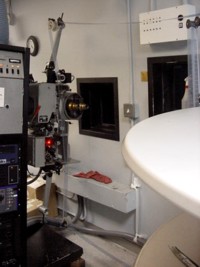
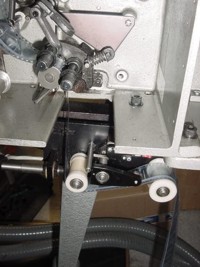
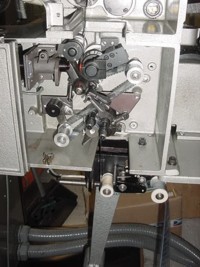
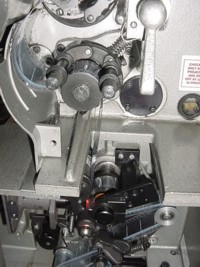
I took the liberty of taking some pictures at the theatre that I work at and share with those who seems to have the 'all thumbs' syndrome in figuring out how to lace one of these monsters up backwards.

1 - lace the film as such from platter to machine and back to platter through both upper and lower guidance rollers. This example is with the "operator (driver's) side" system layout, and do the same for the "gear side" system layout as well.
 -

2 - lace the film through the failsafe, then around the lower holdback sprocket and close the pad roller assembly.
 -

3 - lace the film around the snub roller, the front roller, around the scanner drum, lock the pressure roller, then around the middle constant speed sprocket and lock down the pad roller assembly.
 -
 -

4 - with the intermittent sprocket locked, lace the trap. If the sprocket is locked and when you frame in the trap, the lower loop is automatically set to size, so no adjusting is needed.
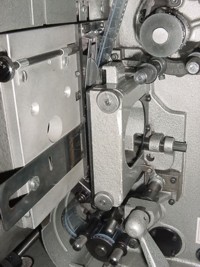
 -

5 - With trap closed, then make your upper loop, close the pad roller assembly and finish off with the digital readers, if applicable.
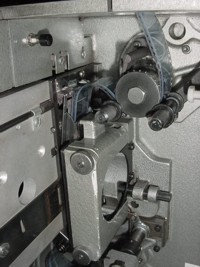
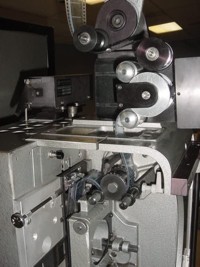
 -

 -

Give this a whirl. Granted, this can be confusing at the first, but with a few more tries, one can almost make this practice as second nature.

thx-Monte

 |  IP: Logged

Brad Miller
Administrator

Posts: 17775
From: Plano, TX (36.2 miles NW of Rockwall)
Registered: May 99


 - posted 05-01-2005 04:30 PM      Profile for Brad Miller   Author's Homepage   Email Brad Miller       Edit/Delete Post 
One correction there Monte...

quote: Monte L Fullmer
1 - lace the film as such from platter to machine and back to platter through both upper and lower guidance rollers. This example is with the "operator (driver's) side" system layout, and do the same for the "gear side" system layout as well.
No, do not do this. Make a triangle out of the film when threading the platter by BYPASSING the lower guidance roller. When you run through that roller, you almost always end up bouncing the film across the floor. The film should be put in that lower roller only right as you are threading the failsafe/clamping the film to the holdback sprocket. Watch as someone threads like that and you will see what I mean...the leader almost always hits the floor when that lower roller is used.

quote:
My tech also says that it doesn't matter if leader gets dirty or not. It won't go on the film.
Richard, you might as well stop bothering to quote your tech. It's painfully obvious to everyone reading these forums that he is a certified F'ing moron with those kind of instructions and attitude towards quality presentations.

 |  IP: Logged

Monte L Fullmer
Film God

Posts: 8367
From: Nampa, Idaho, USA
Registered: Nov 2004


 - posted 05-01-2005 07:50 PM      Profile for Monte L Fullmer   Email Monte L Fullmer   Send New Private Message       Edit/Delete Post 
quote: Brad Miller
Make a triangle out of the film when threading the platter by BYPASSING the lower guidance roller
That'll work as well. Thx for the help.

Thx-Monte

 |  IP: Logged

Scott Norwood
Film God

Posts: 8146
From: Boston, MA. USA (1774.21 miles northeast of Dallas)
Registered: Jun 99


 - posted 05-01-2005 08:16 PM      Profile for Scott Norwood   Author's Homepage   Email Scott Norwood   Send New Private Message       Edit/Delete Post 
quote: Richard Greco
My tech told me last week that in the Chicago Union houses, changeovers btw, that they would thread the leader from the top reel, to the floor, thread the projector, and then take up whats on the floor on the bottom reel.

He also says that it doesn't matter if leader gets dirty or not. It won't go on the film.......HE says. Not me. Anyways, thought you'd like to know.


Remind me not to go see movies in Chicago. Is it really that much trouble to hook the film into the takeup reel and wind the first bit of leader onto it (or loop excess leader on the lamphouse douser handle) before threading? Not only does it get the leader dirtier, but it also means threading the outermost (=dirtiest) part of the leader through the projector, thus getting more dirt than necessary inside it. [Mad]

I've never seen or heard of anyone doing something this dumb in any type of booth.

 |  IP: Logged

Monte L Fullmer
Film God

Posts: 8367
From: Nampa, Idaho, USA
Registered: Nov 2004


 - posted 05-01-2005 08:47 PM      Profile for Monte L Fullmer   Email Monte L Fullmer   Send New Private Message       Edit/Delete Post 
quote: Scott Norwood
I've never seen or heard of anyone doing something this dumb in any type of booth.

...True as always. Yet, when I started in this projecting field back in '69, I was taught this way-to let the film pile on the floor, lace the machine up then secure the end to the takeup reel.

During this time, I began to visit other booths of small single screeners and noticed the operators doing the same as above-piling the leads on the floor.

It wasn't shortly afterwards that I began this trait of after pulling the lead from the supply reel, secure the end to the takeup reel and have enough leader to lace the machine up, thus keeping the lead off the floor.

Then I went to work in a union house where the operators would actually take the lead, pull down the lead and gather the rest of the lead in hand. Then while holding onto this handful of leader while lacing up the machine, then he would secure the end to the takeup reel. Another way to prevent leads of being on the floor. Course, when I operated, I did the secure the end first on the takeup reel then finished the lace as mentioned above.

If this tech that is working on Richard's drive-in, has any credentials of sorts, I wonder what the rest of the theatres that he services are like (but be a nightmare to witness though...)

 |  IP: Logged

Mike Blakesley
Film God

Posts: 12767
From: Forsyth, Montana
Registered: Jun 99


 - posted 05-01-2005 09:49 PM      Profile for Mike Blakesley   Author's Homepage   Email Mike Blakesley   Send New Private Message       Edit/Delete Post 
quote: Monte L Fullmer
when I started in this projecting field back in '69, I was taught this way-to let the film pile on the floor, lace the machine up then secure the end to the takeup reel.
Same here. I originally learned from two different guys (at the indoor and at the drive in) and they both did it the same way. Both of those guys are now out of the business.

Film-on-the-floor... That's one bad habit I'm happy to say I ditched even before I found Film-Tech.

 |  IP: Logged

Phil Hill
I love my cootie bug

Posts: 7595
From: Hollywood, CA USA
Registered: Mar 2000


 - posted 05-01-2005 09:55 PM      Profile for Phil Hill   Email Phil Hill       Edit/Delete Post 
quote: Manny Knowles
I usually say "gear side" and "operating side."

Ya know Manny...that's the stupidest thing I have EVER heard! How do yous refer to a Christie or a Ballantyne or a Kinoton? I totally agree with Brad and the other professionals:

quote: Brad Miller
I fail to see why "operator side" and "non-operator side" isn't easier and less confusing.


 |  IP: Logged

Monte L Fullmer
Film God

Posts: 8367
From: Nampa, Idaho, USA
Registered: Nov 2004


 - posted 05-01-2005 10:18 PM      Profile for Monte L Fullmer   Email Monte L Fullmer   Send New Private Message       Edit/Delete Post 
quote: Phil Hill
How do yous refer to a Christie or a Ballantyne or a Kinoton?
..I can see your point, Phil and Brad.

But, of course, belts, enclosed mechanisms and chains are actually newcomers to the world of the gear driven machines of Powers, Brenkhert, Motiograph, Century and finally Simplex. (whoops, forgot about those chain driven DeVrys..lol)

Being raised with some of these old "fellers," comes the 'gear side' and 'operating side' terminology that I've been accustomed with.

thx-Monte

 |  IP: Logged


All times are Central (GMT -6:00)
This topic comprises 7 pages: 1  2  3  4  5  6  7 
 
   Open Topic    Move Topic    Delete Topic    next oldest topic   next newest topic
 - Printer-friendly view of this topic
Hop To:


Powered by Infopop Corporation
UBB.classicTM 6.3.1.2

The Film-Tech Forums are designed for various members related to the cinema industry to express their opinions, viewpoints and testimonials on various products, services and events based upon speculation, personal knowledge and factual information through use, therefore all views represented here allow no liability upon the publishers of this web site and the owners of said views assume no liability for any ill will resulting from these postings. The posts made here are for educational as well as entertainment purposes and as such anyone viewing this portion of the website must accept these views as statements of the author of that opinion and agrees to release the authors from any and all liability.

© 1999-2020 Film-Tech Cinema Systems, LLC. All rights reserved.