|
|
 
|
|
Author
|
Topic: An open letter to Tyler Perry
|
|
|
|
|
|
|
|
|
|
|
|
|
|
|
Steve Guttag
We forgot the crackers Gromit!!!

Posts: 12814
From: Annapolis, MD
Registered: Dec 1999
|
 posted 06-09-2012 12:40 PM


Mr. Miller,
First off...THANK YOU for participating here. It is great when someone from production gets into the mix (no pun). It offers a different perspective.
While I agree with you that much of the problem with how movies sound in the typical multiplex can be attributed to the poor set up of the theatre (not just the tuning but the equipment choice and acoustics of the room) but some blame HAS to be pointed at you guys who mix movies just too damn loud. Furthermore, you are not helped by your "friends" in the promotional departments that start every movie with trailers (or ads) that are mixed even LOUDER for the sole purpose of advertising...to satisfy the customer, the volumes get lowered and then the feature...that which you put your heart and soul into, gets to suffer as a result.
I have MANY (and I mean VERY MANY) studio screenings in my time...from World Premier on down and I have to say, regardless of the room I'm in, most of the time the mix was way too hot. And it really varies based on who mixed the movie too. I almost never get into a problem when I screen a movie mixed by say Larry Blake. It has a lot of dynamics, can be played at reference and very few complain about the level. Again, the room and the equipment play a very large part in this.
This past week, I did a screening of Prometheus in a THX certified screening room. All I can say is "wow!" Those guys/gals who mixed this movie had a lot of fun on that one. The film had a lot of dynamic range, and great balance. The mix was most excellent and did not fatigue ones ears despite having some VERY loud scenes. Now this room has very good acoustics and very good equipment too...key factors in making the sound mix translate into the theatre environment successfully.
One big complaint I have with most of the mixes I hear coming out of Hollywood is that the dialog seems to get buried behind the effects and music. It is as if you all don't get that the music and effects only augment the performance. The dialog is the most important sound coming from the speakers (at least 99% of the time). When you all over do with with the explosions and the music, if causes the typical movie goer to complain about the volume...which brings the whole mix down, including the dialog...which ruins the movie (for me, at least).
And on a personal note...please try to pan the dialog...my brain knows that when someone is standing on the left part of the screen that their voice is 20-40 feet away from their mouth...it is most distracting.
| IP: Logged
|
|
F. Hudson Miller
Film Handler

Posts: 48
From: Los Angeles, CA, USA
Registered: Jun 2009
|
posted 06-09-2012 01:52 PM
Very cool to be allowed to play in this pool!
I agree, we can go overboard at times. I think that this happens for a number of reasons. Among them is the fact we are often covering up for the lack of story - you can't blame that one on us! Additionally it is usually the director who makes the final calls on track level, he is trying to get in his last licks with the mix and the overzealousness can sometimes show.
I have worked on a great many Jerry Bruckheimer films. If you notice the dial tends to be a little hot and can jump off the screen a bit. As a result, we sometimes are accused of an "ADR'd" sound by critics. That is part of the choice made to insure you aren't afflicted with "what did he say" syndrome.
It is this dialogue intelligibility that also makes us timid with panning the dial very much. The L & R channels are often running fx and, sadly, almost always running music. We try to keep the center as clear for Dial as possible. There is a theory that 5 across the front would make everything cleaner - since I haven't worked on many films that originated in that format I can't tell you if that is true or not. Another reason dial is not panned is because theaters are notorious for having screwed up L&R channels. If the dial moves right and there is a mis-matched, damaged, or worse no speaker at all, the dial just goes away. Management is much more likely to replace the broken center channel if there is no dia.
As for over all volume levels, a couple of notes. Theater trailers and ads are too hot. In the TV world they have set up standards that are messing with the dynamic range of theatrical films when they are broadcast. Too bad, because it is the ads and not the programs that were the main offenders.
Also, many theaters are under-equipped to play big sound films. When a cheap sound system is driven by huge track everybody suffers, but mostly the audience. When the playback system is smokin most films sound pretty good. Don't underestimate the effect of over modulation (distortion) to turn loud into horrific!
This all said, people ask "why not make the films to match the average theater?" But would you really want us to? An Indy 500 car is kind of a joke on a city street, but it would be a shame not "go for it" in its designed venue. We often take films and play them back in good theaters to see how they "translate." We obviously choose the best theaters to do this in. If it plays well in the AMPAS Samuel Goldwyn Theater, we know we have done our part of the job!
Also, don't under-estimate the influence of out target audience (12-24, everything else is gravy). What may be over the top for the "sophisticated" ear is just right for the "less seasoned" ear. In the end $$$ do have a huge impact.
This all said we, are also continuing to learn how to use and not abuse all the digital formats. The goal is to get the max bang without the max pain!
Enjoying the colloque!
| IP: Logged
|
|
Joe Redifer
You need a beating today

Posts: 12859
From: Denver, Colorado
Registered: May 99
|
posted 06-10-2012 03:14 AM

Hello F. How are you? While I certainly agree with the level setting, I imagine you'll also agree that's only a small part of the B chain that can affect such things. Even if everything is at 85db etc, if the room is poorly EQ'd as they often are, it's still going to sound much too harsh and often way too loud. You should start with setting the levels, then EQ, then check the levels again and then do a listening test. Like Brad says, you should never rely on the testing equipment 100%. I have also found this to be very, very true. Most theater techs tune a room to the number and call it a day. So when mixing, calm down around the 4K and make sure never to put Aerosmith in the mix again! ![[Smile]](smile.gif)
Interesting story (I hope): We did a test screening of the movie Hope Floats. Sandra Bullock was here and all that. The sound was run from a dubber for this cinematic masterpiece. The auditorium they ran it in normally had fairly decent sound. I don't purport that it was anywhere near perfect, but it did pass THX certification at a time when THX still almost meant something. Of course they came in and re-EQed and adjusted everything for Hope Floats. Afterwards the auditorium just sounded awful. Very harsh and we had to lower the volume. I couldn't fix it with any great effect because I was just learning about that stuff at the time. By the time Star Wars Ep 1 came out I did fix it and it sounded pretty damned awesome. Anyway I really wish they would have attempted to put it back the way they found it. I don't know if they cranked the high frequencies to compensate for the magnetic track but man it sounded harsh. They should have brought their own Cat 64's but they did not.
Oh, and I'm betting trailers are "loud" because there's usually lots of explosions going off in quick successions and I wouldn't be surprised if some were compressed to the point of a 50db dynamic range (at most). It seems that way with TV ads.
Well, nice talking with you, F! Tell your brother, Murray Abraham, that I said "Hi!"
| IP: Logged
|
|
Marco Giustini
Film God
Posts: 2713
From: Reading, UK
Registered: Nov 2007
|
posted 06-10-2012 05:34 AM
Welcome and thanks for your contribution.
Everything that has been said is very interesting and educational.
I used to work in post production and it's really amazing how much difference there is between it and the exibition world. In Post production a "click" in sound is totally unacceptable. In a commercial cinema we can live with HF units that have fallen on the floor.
It's so true when it's said that a good sound system will sound terrific and won't require many adjustments/repairs. But most of the theatres wouldn't understand, they prefer to install cheap stuff, which then needs to be repaired every now and then - and they sound horrible.
Also the average "sound check" is easily summarized into a few points:
- Place a non calibrated microphone on the Dolby Spot
- Dial the EQ to the line at all costs
- Level the channels
- Walk away
Next time the engineer comes, they choose a slightly different position for the mike and "wow, you need a new EQ".
This is often requested by the theaters themselves. If you spend 2 hours doing your EQ, listening to some material, and checking that the speakers are still aimed correctly, you're an incompetent, since "the other guy" did everything in 15 minutes.
Pink auditoria? I've met so many people using different test equipment. There is no consistency between calibrations, so the level read usually varies 2-3dB depending on the equipment used. So what's the point in having the sound system checked regularly?
It's so annoying that sound is so underestimate in cinemas. But you keep doing the right job, don't adapt your sound for crappy theatres. And please do pan the dialogues, that would force many installers to make sure L and R are consistent with the Centre channel, something that is very hard to do following the aforementioned task list
Looking forward to reading your posts again,
Thanks
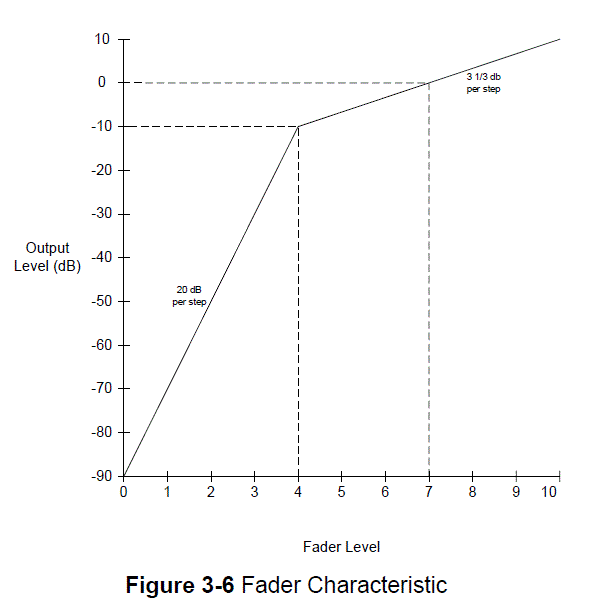
PS: attached CP650 fader graph
| IP: Logged
|
|
|
|
Chuck McGregor
Film Handler
Posts: 47
From: Bremen, ME, USA
Registered: Mar 2012
|
posted 06-11-2012 03:30 AM
For what it's worth here is another graph of fader levels. The specific non-USL processors models are unfortunately not identified, although the Dolby curve is consistent with the CP650 graph already posted. Each dot is a 0.1 "notch."
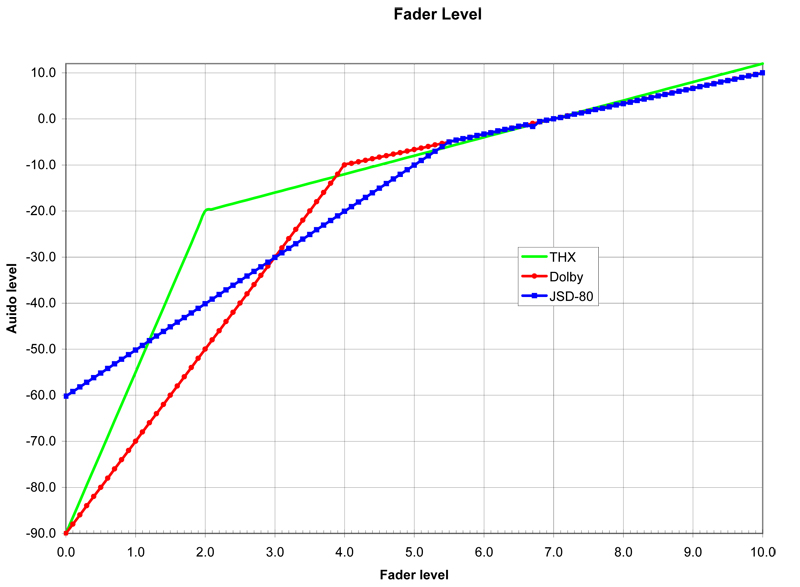
It should be obvious that below 7.0 a "notch" can vary considerably depending on the processor and/or manufacturer.
As to audio levels, the theater I work with does a lot of alternative content (Emerging Pictures, Met Live, Nat'l Theater, et al) in addition to 35 mm (optical).
Since the system was completely "renovated" last fall, to keep consistent dialog levels for the various presentations, the fader levels have covered a 27 dB range or a fader range on the JSD-80 from 4.6 to 10.0. Just to be clear, we preview everything to determine the fader level for that content, often 2 settings are needed if there are trailers or video previews. Films are more consistent than the video content, but including trailers have covered a 15 dB range.
I posted an Excel chart next to the processor of the fader settings listing the +/- dB from 7.0 for every 0.1 fader step.
In case there is any question, the theater's equipment is high quality that has been properly gain structured, calibrated, and tuned with hard copies of all the performance measurements. (Curious if other cinemas have or are provided with the measured performance data.)
| IP: Logged
|
|
|
|
|
|
|
|
All times are Central (GMT -6:00)
|
This topic comprises 12 pages: 1 2 3 4 5 ... 10 11 12
|
Powered by Infopop Corporation
UBB.classicTM
6.3.1.2
The Film-Tech Forums are designed for various members related to the cinema industry to express their opinions, viewpoints and testimonials on various products, services and events based upon speculation, personal knowledge and factual information through use, therefore all views represented here allow no liability upon the publishers of this web site and the owners of said views assume no liability for any ill will resulting from these postings. The posts made here are for educational as well as entertainment purposes and as such anyone viewing this portion of the website must accept these views as statements of the author of that opinion
and agrees to release the authors from any and all liability.
|

 Home
Home


![[thumbsup]](graemlins/thumbsup.gif)



![[Big Grin]](biggrin.gif)




 Printer-friendly view of this topic