|
|
 
|
|
Author
|
Topic: Dolby's new sound system
|
|
|
|
|
|
|
Bobby Henderson
"Ask me about Trajan."

Posts: 10973
From: Lawton, OK, USA
Registered: Apr 2001
|
 posted 04-24-2012 11:26 AM


Dolby Atmos. While the idea seems interesting I'm not very optimistic it will get much use.
I have always thought the 2 channel surround array was limited. Certain effects fell flat in the middle of the room rather than clearly moving from the front to back wall or vice versa. "Surround ex" and the more recent development of 7.1 with four surround channels was supposed to make surround effects like transient fly-bys and such much more convincing. The problem is few movie productions have embraced the idea even when the 7.1 quad surround format could be supported in home theater thus extending the useful shelf life of a more elaborate audio mix.
The current D-cinema system can support 16 discrete channels of audio. The 10.2 surround format, the surround audio model promoted by Tomlinson Holman, could work in that arrangement. Any movie production could mix a feature in 10.2 surround. With a few phone calls it wouldn't be difficult to get at least a few dozen theaters rewired to support it. No movie productions have taken advantage of the capability. It's difficult enough to get any to mix in 7.1.
If anything, I think the Dolby Atmos idea is another attempt to secure the Dolby brand name on movie posters, movie end credits and theater booth racks. With D-cinema the audio is straight Linear PCM. There is no proprietary audio compression format used to where a brand name like Dolby or DTS can be applied. Essentially, Dolby and DTS are turning into audio formats exclusive to home theater. Dolby Surround 7.1 was false advertising in one sense since the audio was really LPCM 7.1. With Atmos, Dolby could apply TrueHD lossless encoding along with using proprietary hardware to get its brand name more prominently displayed in movie marketing.
quote: Joe Redifer
I think the idea is to take a sound effect and steer it around some sort of 3D globe in the mixing stage so that the sound can travel wherever you put it. I don't think that the sound mixer would be paying attention to each individual channel specifically. He'd just move the sound around and it's basically just for fancy panning.
A lot of audio editing software already allows for this sort of thing in the 5.1 format. For example, Adobe Audition can apply a timeline based surround steering control on every audio element in a multi-track mix. The round control reminds me of an analog clock. A "globe" audio positioning element wouldn't be much different. The Atmos style steering control would need good & fast downmix capability for 7.1, 5.1 and 2.0 channel layouts. If Atmos creates more work & expense for the 5.1/7.1 home theater mix then movie productions may avoid using it.
The biggest problem facing Atmos is the hardware side of things. All the extra speakers and amplification needed will represent too much of a pain and expense for the vast majority of commercial movie theaters to handle. Let's not forget the need of an entirely new cinema processor. But I imagine Dolby has a particular Dolby-branded product in mind for that.
And I imagine audiences will be bracing for yet another damned add-on surcharge to see a movie in an Atmos-equipped auditorium. Such an surcharge is almost a sure thing. Too many theaters don't do enough to maintain their regular 5.1 digital surround sound systems. Certain theaters are already charging extra for louder, boomy digital surround along with a 2K image being blown up to a giant size.
| IP: Logged
|
|
|
|
Scott Jentsch
Phenomenal Film Handler

Posts: 1061
From: New Berlin, WI, USA
Registered: Apr 2003
|
posted 04-24-2012 04:18 PM

Is there a definitive list of the channel assignments for Digital Cinema? I looked around, but came up blank.
I watched the video where they talk about Atmos, and afterwards, and after reading through the text in the first post there, I'm still scratching my head as to how this is different than traditional multi-channel mixing, just with more channels.
My impression after watching the video was that they were trying to distance themselves from the idea of channels so that the expected Dolby processor box will appear to be magical in some way in how it does its job. At some point, it's still going to be multi-channel, so it seems like a smoke and mirrors ploy to me.
That said, I like the idea of more channels, especially a height channel. Give the mixers the tools to mix into that space above the audience and map those sounds to the appropriate channels in the theater, and voila, you have over-the-head sound and a more immersive experience.
However, the reality of the situation is that theaters aren't doing 7.1 now, or at least they're not admitting to it. If they can't even do that, I can't imagine that they're going to go through the effort of installing height channels, much less calibrating them.
Theatrical exhibition can't be Dolby's only play with this. I would imagine that they're coming up with a home version that will be implemented in the next round of home theater receivers. They may be able to shoehorn it into ProLogic IIz processing or something for backwards compatibility with existing receivers and the Blu-ray format, which would put it on the fast track to the home. Many years ago, I heard a demonstration of the Yamaha A-1000 (or some model close to it) and its use of upper-front channels to provide greater ambience, and it was really impressive. I've not played with ProLogic IIz at all, but if they can work with front presence channels and rear surround channels to get an over-the-head experience, I'm sure they will.
This whole Atmos thing may be a foot in the door with studios so that they can introduce something new in the home...
| IP: Logged
|
|
|
|
|
|
Brad Miller
Administrator

Posts: 17775
From: Plano, TX (36.2 miles NW of Rockwall)
Registered: May 99
|
posted 04-25-2012 01:17 AM
Just a quick post.
Form the skimming over this thread I have done thus far, Dolby Atmos is a concept none of you are anywhere near guessing properly. In essence, it takes every individual sound, records it discretely and then permits the mixer to position it ANYWHERE in the field. The Atmos box then places it in the proper speaker(s) based upon that positioning data, and yes each auditorium is "mapped" so the sound truly goes EXACTLY where it is supposed to go, even if you have a funky shaped auditorium.
This means the mixers make one Atmos mix, and then ANYTHING else can be derived from it, whether it is 11.1 or 7.1 or even 5.1, without any effort or time delays (meaning less post production time). It also means when something pans around the room, it LITERALLY pans around the room from speaker to speaker to speaker, as opposed to an entire "zone" of surrounds.
Sure the name isn't terribly catchy, but it is absolutely THE future of sound.
| IP: Logged
|
|
|
|
Steve Guttag
We forgot the crackers Gromit!!!

Posts: 12814
From: Annapolis, MD
Registered: Dec 1999
|
posted 04-25-2012 07:25 AM
As Brad has stated...the Dolby Atmos system should NOT be thought of as in the past where one adds "channels" to the mix. There isn't a one-to-one sort of thing like in the past where with mono we had a center speaker, stereo three stage speakers and maybe surrounds, Todd-Ao, 5 stage speakers and one surround...etc
With Dolby Atmos, you have to think of speakers not as channels but a means to increase the resolution of the sound placement precision. You can keep your 3-behind the screen system or add LC/RC back in (recommended for any screens 40+ feet wide (I would say even smaller would be fine). One can't have too many surrounds and they recommend starting them right at the screen/side wall junction and then ceiling surrounds.
YOUR theatre will input your speaker locations into the Atmos processor so it knows where your speakers are. It will tune your room based on that information and then process an Atomos track so that the original sound placement creating on the dubbing stage is as faithfully located as possible based on the quantity and placement of speakers you have. This system is inherently scalable so smaller theatres do not have to have as many speakers as larger ones. The better the speakers, the better results, however. One wants to maintain constant Timbre between all channels and the Atmos processor will aid in that.
The possibilities for incredible sound mixes with this system are limitless...I do fear, however, that too much emphasis on "surround" audio placement will distract from what is happening on screen. I'm hoping that the ability to locate sounds on screen is greatly improved with this system and the surround speakers (regardless of where they are placed and how many of them there are) are used to merely augment what we see on screen and never "be the show."
What Dolby has done with Atmos is to pretty much take channels out of the equation from a movie mix standpoint. This is why it is likely to gain acceptance. It is a new sound format that hearkens back to the backward compatibility era so that and standard DCP can be used that will play 5.1 in in "normal" theatres and Atomos in Dolby-Atmos theatres. Compare that to Surround-7.1 where we have dual inventory DCPs that require separate kdms and loading two versions...Atmos will not have that overhead at the theatre or distribution level. So if you don't believe or can afford it...you can gleefully ignore it. If you are looking for an edge in your presentation, you can go about as wild with it as you want.
That is probably its biggest flaw, actually. One can do a very minimal Atmos installation in their theatre...put in say one ceiling speaker to a normal 5.1 system...and call that Atmos...while the guy down the street goes full-bore and follows all of the recommendations...the experiences will NOT be identical because the minimalist version does not have the "resolution" that the properly sized version has. So I do fear that it will cause customer confusion. I do hope that those that go for it do not do a crap job...but since I've seen mono in DCinema and people are already really under specifying lamp sizes and running them too long...I can't help but believe that some rotten apples will ruin this potentially revolutionary sound system.
| IP: Logged
|
|
Frank Angel
Film God

Posts: 5305
From: Brooklyn NY USA
Registered: Dec 1999
|
posted 04-25-2012 08:00 AM
quote: Manny Knowles
No users --> No product --> No users
Actually, it's: No users --> No product --> No users --> No Consumer Interest/Demand --> Dead Format
Quite frankly, this almost seems like a knee-jerk reaction by Dolby, who for so long dominated exhibtion sound, to counter the upstart Barco with their new immersive Auro 11.1 sound system, which promotes height channels, as in:
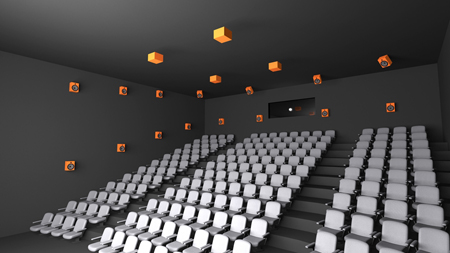
So is Dolby just trying to capture some of Barco's thunder and/or trying to maintain its dominance?
Thing is, even if this can translate into what can be marketed to the Blu-Ray home theatre crowd, and EVEN if guys like us who love surround sound would want to put this in our home theatres, realistically, what size market is that? What proportion of the "home theatre" market actually have a separate theatre rather than a setup in the living room and what woman will let her hubby, no matter how enthusiastic he is about Atmos, will let him put speakers all over the room? and UP ON THE CEILING?!
So if this format can't also be pushed into the consumer market, good luck with studios mixing for it if the only market is the commercial cinema. But let's for the moment say some productions did get the Atmos umpteen channel treatment, then it's all on the exhibitor to spend and install the extra stuff which he will do ONLY if he thinks he can sell this to the public and more importantly, if the public will BUY it. My gut says, No, they won't. Anyone hear any demand for 7.1 from Joe and/or Jane Public? Anyone REALLY think either Joe or especially Jane them will PAY EXTRA for Atmos or even choose a multiplex based on sound format?
I just went to see a movie...in a movie neighborhood multipled...walked up to the b.o. and asked for a ticket. The young man said, "That will be $13.50 please." I said, "No, no, son, not the IMAX theatre." He said, "Sir, that's the price for the regular cinemas." I was grateful he didn't immediately offer me the senior discount, truly I was, but I said to myself, screw this, and then said "Senior ticket please." He was kind enough to say "Really? Wow." Bless the lad. My point is, $13 effin dollars to see a MOVIE?!! What are these guys charging for IMAX and IMAX 3D? Wasn't this much as recently as 6 months ago.
| IP: Logged
|
|
|
|
Bobby Henderson
"Ask me about Trajan."
Posts: 10973
From: Lawton, OK, USA
Registered: Apr 2001
|
posted 04-25-2012 09:23 AM
quote: Frank Angel
So if this format can't also be pushed into the consumer market, good luck with studios mixing for it if the only market is the commercial cinema.
Mixing for Atmos -or rather, doing the computer-based digital sound design for it shouldn't be difficult. As I said earlier, modern audio editing applications already allow the user to individually position and move every audio element in the mix around the surround field and change it along the time line. The current surround steering metaphor is a flat, 2D clock-like model. All Dolby and the audio editing software people have to do is create a more 3D oriented positioning metaphor in the editor and an export module to target the Atmos format.
If Atmos support is implemented properly in software it should be possible for editors to open other existing projects originally tailored for 5.1/7.1 and scale them over to Atmos. But those old mixes would be based on more of a level plane matching a traditional theater speaker layout, but various fly-by effects and what not would move about the sound field more smoothly.
The real issue is hardware cost to the theater. Both in terms of initial install and sound system maintenance. Many theaters are already very lax on keeping sound systems properly maintained. Atmos, or Barco's 11.1 thing, would make it a bigger issue. Atmos will require a more complex amplification scheme (according to Dolby's white paper, one channel of amplification for every speaker). Dolby probably won't be selling its Atmos processor for cheap either.
This system probably won't work so well in stadium seated theaters. Where are the back wall sub-woofers going to be installed?
I can't be the only one who thinks customers are simmering with anger over all the various upcharges at theaters. 3D: upcharge. Big screen: upcharge. Balcony seating: upcharge. Big cushy seat with a waiter call button: upcharge. Sound done well or loud: upcharge. Add to this some serious cost inflation at the snack counter. It's getting pretty damned ridiculous.
It's a guarantee Dolby Atmos will add another upcharge to an already expensive movie ticket price, especially when install costs are estimated between $20K and $30K. The idea that one theater can have an "Atmos done right" installation while another can install "Atmos half-assed" and still gouge the customer should be a warning to Dolby. They better have some enforceable standards to protect customers.
| IP: Logged
|
|
|
|
|
|
All times are Central (GMT -6:00)
|
This topic comprises 38 pages: 1 2 3 4 5 ... 36 37 38
|
Powered by Infopop Corporation
UBB.classicTM
6.3.1.2
The Film-Tech Forums are designed for various members related to the cinema industry to express their opinions, viewpoints and testimonials on various products, services and events based upon speculation, personal knowledge and factual information through use, therefore all views represented here allow no liability upon the publishers of this web site and the owners of said views assume no liability for any ill will resulting from these postings. The posts made here are for educational as well as entertainment purposes and as such anyone viewing this portion of the website must accept these views as statements of the author of that opinion
and agrees to release the authors from any and all liability.
|

 Home
Home





 Printer-friendly view of this topic