|
|
 
|
|
Author
|
Topic: The "What did you buy today (or recently)?" Thread
|
|
|
|
|
Bobby Henderson
"Ask me about Trajan."

Posts: 10973
From: Lawton, OK, USA
Registered: Apr 2001
|
 posted 03-05-2010 09:51 PM


I'm pretty confused by that comment because it runs very contrary to so many raves that have been posted online about Canon HDSLR video. The TV series 24 is shooting camera car backgrounds using a series of 5D Mk II and 7D cameras. TV series like Numb3rs have used the cameras for some principal photography work. Just recently Ron Howard used 5D Mk II and 7D cameras for a "Funny or Die" web feature.
The composite color space thing is a real surprise. Everything I've seen regarding the 5D Mark II, 7D and even the new 1D Mark IV suggest those cameras capture in at least 4:2:2 component mode. The 5D Mark II will actually allow HDMI-out video capture, but I don't know for sure if that is pre or post compression.
As I've said before, I haven't shot a lot of HD video with my camera, and I did not buy it for its HD video capability either. So I'm not the best expert to diagnose problems on this topic, but it definitely sounds like an urgent issue.
A couple of things I would check: make sure you have the latest 7D firmware update. I know the 7D had one firmware update to correct color banding in still imagery. I don't know if that translates to video. Another thing: were you using "auto" functions for the video capture, such as auto white balance? IMHO, auto white balance on any camera anywhere no matter how high end SUCKS. There is no substitute for a custom white balance. That alone can make a big difference on color quality and consistency of color from shot to shot (or scene to scene).
I don't know what color space the 7D defaults to when capturing video, but I would make sure the color space is at least in sRGB.
| IP: Logged
|
|
|
|
|
|
|
|
|
|
Julio Roberto
Jedi Master Film Handler
Posts: 938
From: Madrid, Madrid, Spain
Registered: Oct 2008
|
posted 03-06-2010 01:31 AM
The "high end-ish" current Canons DSLR do produce more moiré than "normal" in video modes (i.e. than using a regular video camera) due to the way the work. Let's say this amount of moiré is "X".
When you try to downscale the image to standard definition from HD, you get aprox. X times 4 more moiré on the luminance, since you are adding to the moiré yet more downscaling missed false-detail and the downscaling doesn't seem to be all the smart it could be to even try to minimize it a bit.
Then, when you use the composite output, the color gets yet downscaled again (color resolution in the composite signal is further reduced compared to the luminance). So now you add about another additional 2X to the color moiré.
Then, you have to deal with a little extra crosstalk inherent in the NTSC system. The PAL output is a bit better as it has more resolution in both luminance and crominance (and thus, fewer false-details from the downscaling) and much less color crosstalk thanks to the Phase Alternate Line design ![[Wink]](wink.gif)
But even if you didn't use the composite output, the moiré in these cameras (5D M2 and I hear even more on the 7D) can be there (somewhat easy), as the camera is line-skipping on the sensor rather than minimizing it with line-averaging.
The optical lowpass filter is tuned for the still-image performance of +3.7K horizontal lines in the 5DM2 and in video mode it only records 1080 of those lines and skips the rest, so you have quite an amount of missed detail=potential false detail=potentially noticeable moiré.
It produces very little moiré in the horizontal direction, as the sensor is pixel-averaged from the 5300+ pixels down to the 1920 but it has a lot in the vertical when it's line-skipped from the 3700+ to the 1080 for HD video output.
I haven't bothered to compare the pixel pitch of the 7D to the 5D to see if it would be any worse, but I hear it is a bit worse on the 7D.
Of course it would be fairly trivial to sample the whole sensor and average the lines instead of skip them, but it seems the driver Canon designed for these cameras doesn't do it only God knows why (probably to reduce power consumption a bit or avoid some silly speed bottleneck with some of their circuits).
It's not unlike when TI decided to reduce the area on the DLP chips when projecting 3D in older projectors at 144hz. Is not that the new ones are more expensive or use different DLP's or anything, just that they didn't think to design parts of the older formatter boards thinking so much bandwidth was gonna be needed and limited them to a certain practical (cheap) amount.
A little redesign and $5 later in parts upgrade and you have "triple flash DLP" projector for about the same price. If Canon wanted, they could fix the video-mode moiré issue with a $5 redesign and a bit higher power consumption.
Like that's gonna happen. ![[Roll Eyes]](rolleyes.gif)
You could add an optical bandpass filter to your lens tuned to the size of your sensor and the amount of moiré you want to reduce. Since the filter would probably difusse in a circular pattern (instead of the pixel shape which is not perfectly square to begin with) and not be perfectly tuned, you'll have to trade off between resolution and moiré. It shouldn't significantly affect the horizontal resolution as the camera has more than it needs to and averages it anyway. But it will help tremendously in reducing the vertical moiré.
If you need an easy quick-and-cheap moiré reduction, just try to slap on the lens a neutral density filter and, if you are lucky (it difusses just the right amount for the sensor and preferred detail size to break the moiré pattern), it may help a bit. If not, try a different filter. Much better if it's a diffuser filter, of course ![[Razz]](tongue.gif)
| IP: Logged
|
|
|
|
|
|
|
|
|
|
|
|
|
|
Julio Roberto
Jedi Master Film Handler
Posts: 938
From: Madrid, Madrid, Spain
Registered: Oct 2008
|
posted 03-07-2010 08:37 AM
As the optical lowpass is tuned for the maximun detail which is in photo mode, you don't have to ask around much to know that the line skipping in video mode is bound to produce moiré easily in many situations.
http://www.dvinfo.net/forum/canon-eos-5d-mk-ii-hd/357960-assessment-5d2-bbc-alan-roberts.html
quote:
Alan Roberts assessed the performance of the 5D2 (and many other cameras) for the BBC. Their official web site is not updated yet, but I have been allowed to host the white paper here:
BBC R&D White Paper WHP034 - Alan Roberts
Here is what the zone plate is supposed to look like:
The conclusion is "pictures with aliasing at the levels seen here are not acceptable as HDTV."
A zone plate was used to measure the aliasing of the 5D2:
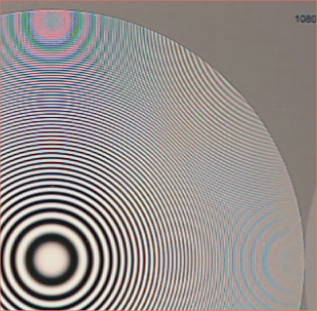
Just slap a diffuser in front of the lens tuned to the amount of moiré you want to reduce/amount of detail you want to preserve. The lens allows a >7Mpx (5DM2) resolution detail and we only need <2.2Mpx for 1080p HD video, so if you find a fine diffuser that is a good match, you may be only losing <2% detail in video mode while getting rid of >70% of the moiré ...
Just make sure you take it off to shoot in regular still photo mode
EDIT: The moiré in that video is more than I commonly find in the 5D under casual circunstances. Was it recorded from composite somehow? I haven't looked into it, but I guess it may be a bit worse on the 7D for some reason.
I just googled and it seems most people find the 7D slightly BETTER in the moiré and rolling-shutter departments than the 5D. I wouldn't have guessed from Joe's clip, but not a lot of difference anyway. But a guy that seems to have it right says:
- At 1080p, the 7D is no noticeably better/worse than the 5D
- At 720p, the 7D is way waaay worse than the 5D.
The 5D is already "pretty bad". So I guess you have to rule out 720p mode in the 7D (and composite output recording as well), use only 1080p mode and use a very mild diffuser for video.
| IP: Logged
|
|
|
Powered by Infopop Corporation
UBB.classicTM
6.3.1.2
The Film-Tech Forums are designed for various members related to the cinema industry to express their opinions, viewpoints and testimonials on various products, services and events based upon speculation, personal knowledge and factual information through use, therefore all views represented here allow no liability upon the publishers of this web site and the owners of said views assume no liability for any ill will resulting from these postings. The posts made here are for educational as well as entertainment purposes and as such anyone viewing this portion of the website must accept these views as statements of the author of that opinion
and agrees to release the authors from any and all liability.
|

 Home
Home




![[Big Grin]](biggrin.gif)


![[Smile]](smile.gif)


 Printer-friendly view of this topic