|
|
 
|
|
Author
|
Topic: Union Projectionists
|
|
|
Kevin Wale
Expert Film Handler

Posts: 167
From: Guymon, OK USA
Registered: Aug 2003
|
 posted 04-10-2005 12:59 AM


Ok, after rereading several times (I'm a bit dense sometimes. lol) I've got that you are indeed talking about changeover in the traditional sense. So, I guess another drawback to that would be extra cost for the second projector setup on say 10 screens. That would offset any advantage of not spending for 10 platters. But, there is still the part you mentioned about less potential film damage.
I guess with that, I'd ask what your opinion on those reel to reel setups on the Kinoton site is. The disadvantage here is obviously rewind time and heavy 48" diameter reels (could get pretty heavy lifting to the top of the projector there. lol ... I know rewind to the top. Just a rather bad joke. ![[Smile]](smile.gif) ) )
In any case for the most part this seems a very attractive setup to me. From what I've read rewind time is rather minimal these days anyway, and one can always be threading elswhere while another print is being rewound etc.
I don't recall ever having a significant problem with those dual side short mutts as far as scratches or any other film damage goes, as long as things are checked, and one makes sure those reels are on tight(quite a boom when one of those reels would go banging and rolling accross the room lol.) Plus, I always found the ability to rewind very liberating. Sure made aspect ratio changes nice for making sure vertical hold was right on the scope lenses.
Also, in my other post... I said 12000' reels since Kinoton says that setup will support up to that. I may have rather incorrectly assumed that equates to one of the 40+" diameter reels. a 6K' reel is the 26 ish" diameter reel right?
Forgive my ignorance. lol. I'm terrible at math and I always get the reels confused anyway.
| IP: Logged
|
|
Monte L Fullmer
Film God

Posts: 8367
From: Nampa, Idaho, USA
Registered: Nov 2004
|
posted 04-10-2005 02:57 AM
The simple possible reason of not wanting to train for a period of time, because the candidate might leave within a year, is that the attitude of the theatre is that "being a projectionist is just a job-a job to do day in and day out without any reason to continue." Thus the lower wage levels. NOW, if the attitude of the threate would make it like as if this a CAREER opportunity-for someone to grow into and become professional at this job, in as well as money incentives/benefits, then they might stay there for a goal setting occupation. But unfortuately, most of the circuits are presenting the employment at their complexes as just a "steeping stone" sort of occupation-no growth, very little incentives, very small raises and bonuses, and the majority of the attitude is that "it's just a job-not a career to look forward to.."
Granted, working in a theatre as an employee ISN't the most perfect job there is. Theatres are going almost 24/7/365 at all times. Some people doesn't like working nights, for this is playtime if the one is a social bug of sorts. Then you have weekends where other folks have off and the theatre doesn't believe in weekends off to the employees.
Then there are the wages involved: 12 bucks/hour in California is still almost poverty level area with the cost of living down there. If one plans on being single and reclusive for the rest of their lives, then 12 bucks possibly can suffice if the apartment is small and cheap enough. Forget about buying a house down there with this wage. Also, if a theatre's budget merits such a wage limit, so be it, but this limit will attract that certain kind of employee, and a good possibility is that employee will be, or just out of high school, who is mainly looking WAY into the future for a solid career-and mainly not in the theatre business.
I've always looked at the IA (and other unions in the country)in way that it recognized us union members as a "career and professional" type of employee that deserved to be protected. Thus, we/they got paid a higher scale than the non-union employee, who were mainly taking the title as "just a job to do." And some fought joining for they believed that "why join a union to do the job that I have/want to do?" Well, it was called "telling the employer's that your employees deserve respect in what they have and do, and we are going to protect them from your 'system' so that their job is secure." Yet, both parties have agreed on terms for a good workforce balance.
Now, Jim, since you're in charge of a 6 screen there outside Fresno, you know, when the prospective employee has signed that application, there is a phrase within the paragraph of condition of the employer, which is above the signature line mentioning two small, but very important words: "at will" - meaning that you can let an employee go without cause. To the employee, this means insecurity in an actual sense. They could lose their job without cause at any time for any reason.
Now, you have destined yourself to have a certain training/probation program to ensure high quality booth operations and there is absolutely nothing wrong with this whatsoever. It's your operation and deemed fit for such. But,in the back of each employees mind is still these two words above: "at will". You pay them the wage fitted for their quality and offer them with bonues to ensure them of their good work, but you still have total control over them to do with them whatever in the long shot.
Unions came along and "protected" the employees with a guarantee that their job will be secure and with a wage contract to keep them there as long as they want.
Well, as possibly yourself, and other employers, employers DIDN'T like someone to come along and tell them how to run their business and to where they couldn't "control" their own employees. The union came along and created representatives to negoiate with the employer to allow the employer to let the union "control" that union member by the "protection" and "condition" clauses between union and employer's agreement(s) which was stated in the contract(s).
Sam Chavez brought up the history of Henry Ford. True, Ford didn't allow the UAW unto the Dearborn factories until after the war. Ford wanted control and he got it with his henchmen who would make sure of the "keeping in the harmony" in the workforce.
I come from a family of union members on both sides. My mother was a member of the CWA with MaBell. Father was member of the FAA union. Aunts and Uncles were members of the Teamsters Union, and the Grocery's Union. All got treated well and the unions fought for their jobs and wages that the union felt that they deserved. Many went on strike when the contracts expired, but settlements were quickly made to keep the workforce going.
What a topic this has evolved into. And unfortunately, topics with with word "unions" have been 'boils on the neck' to many.
quote: Kevin Wale
Also, in my other post... I said 12000' reels since Kinoton says that setup will support up to that. I may have rather incorrectly assumed that equates to one of the 40+" diameter reels. a 6K' reel is the 26 ish" diameter reel right?
I have this posted in the "best/worst projector" topic, but here it is again. This is a Cinemeccanica V8 machine which is actually a V18 unit-with the big reel tower behind the machine.
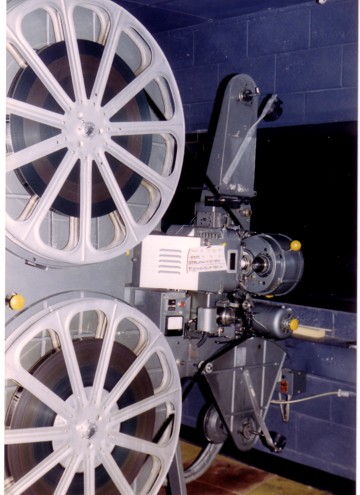
The reels are 36 inches in diameter (13K for the top reel and 11K for the lower with that hub insert. If I had to use a 13K for the lower, I had Goldberg "E-Z" 36inch reels to use..) With these 36inchers are full, they weigh in close to 70 lbs. If one notice underneath the supply reel, a small round opening. This is where a set of pins would come out and aid in supporting the reel to align the reel up to that upper spindle. There were some "grunting" when hefting that full reel up on that spindle.
For Mark: At the Valley Fair 9 in SLC, it used to be the Valley Fair 4. Two of the houses had these V-18's, which had a cable hoist system to hunker these big reels up to that upper spindle. The other two smaller houses each had a pair of V4-E's with 6k reels and changovers. ... and this was a full-union booth, and what an elaborate booth this was!
-Monte
| IP: Logged
|
|
|
|
Jim Ziegler
Jedi Master Film Handler
Posts: 753
From: West Hollywood, CA
Registered: Jul 99
|
posted 04-10-2005 04:37 AM
quote:
I would LOVE to see your 6 week trainee be able to trouble shoot and repair ANY type of sound, mechanical or electrical problem that may arise...ESPECIALLY if it would mean a dark screen for several days until a repair tech could get on site! [Wink] [Big Grin]
6 weeks covers basic threading, splicing, theory of operation, etc. Level 2 covers things such as more advanced trouble shooting and maintenance, changing bulbs, print build up, etc. Estimated time to completion of Level 2 is 4-8 months. Level 3 is advanced maintenance and trouble shooting. It will probably be well over a year before someone has mastered that level.
Any issues that arise above the operators level of knowledge of the operator on duty are referred to someone more qualified. Items that I can handle are referred to an engineer.
quote: Peter Kerchinsky
Why the hell are you and your company dead set on paying someone a decent wage. That's what it sounds like in your last post. You guys must have a really low cost-of-living status there. $12.00 an hour here doesn't get you squat. No decent place to live, no decent food, no way to get around etc.
Peter, I have 2 people on staff who are not currently living with their parents. Myself and by second in command. Both of us are making a decent living. Why don't I pay people $12 an hour? Because that does not make business sense. No one working on my staff is trying to make a living, pay rent, etc. They are looking for spending money. Not every job is worth $12 an hour. If you want a $12 an hour job, then find one that an employeer feels is worth $12 an hour.
quote: Peter Kerchinsky
Like mentioned earlier, once that person has a failure who do you call. A tech who can charge $50 to $75 or more an hour to open a hand-douser, change a lamp, repair a downed sound system etc. Do you people care if a house goes down for the night with lost revenues and pissed off customers.
The last emergency call I had was to fix a lamp house that had a contactor burn out and trash all the wiring going in to it. We gave refunds to both of the customers who had come to see that show (the 10:00 show on a Tuesday of week 3 of Because of Winn Dixie), gave them passes for their trouble, and had an electrician out the next day. Tell me, would having a 50k a year projectionist have been able to prevent the failure of a 7 year old contactor?
quote: Peter Kerchinsky
Yes, it'all in training, but 2-6 weeks. C'mon.
That would be 6 weeks to get down threading, splicing and how to work the automations.. Anyone that can't grasp those functions in that amount of time needs to look for picking fruit...
quote: Monte L Fullmer
"at will" - meaning that you can let an employee go without cause. To the employee, this means insecurity in an actual sense. They could lose their job without cause at any time for any reason.
Monte, I doubt that matters all that much to most employees. I am also an at will employee, and I don't worry about it - and I have much more to lose with unemployment than a kid living at home.
quote: Monte L Fullmer
Unions came along and "protected" the employees with a guarantee that their job will be secure and with a wage contract to keep them there as long as they want.
And what do you do if thir perfomance tanks?
| IP: Logged
|
|
|
|
|
|
|
|
|
|
John Walsh
Film God

Posts: 2490
From: Connecticut, USA, Earth, Milky Way
Registered: Oct 1999
|
posted 04-10-2005 10:33 AM
I tend to agree with Darryl that we are beating a dead horse in this thread ... so I'd like to suggest we move towards how to improve the service the union (or anyone) provides. I feel the arguement should not be just, 'a person should get a decent pay,' but rather a person should provide service worth the pay.
Myself, I think union members should be forced to attend traning of both regular 35mm and digital technology, and union leaders should provide this. I know this sounds harsh, but the alterative is sending unskilled people to work at a theater.
If done correctly, a 'projectionist' requires several unique skills.
Many of today's theaters already have digital projectors for slides. Operators should know how to take one new out of a box and set it up entirely; not just change the bulb. Other examples include setting optical Dolby level, changing diaphrams, replacing diodes, changing amplifiers. Even changing out a CP650 if there are no complicated issues. I know there are always going to be exceptions, but generally I feel these are tasks the operators can provide.
Managers like Jim Z and Mike S are running their theaters fine by themselves, so why change something that works? But if other managers could get a sort of 'turn-key' operation for the booth, with people that really know what they are doing, they might feel this would relive them to do more higher-lever operations tasks.
| IP: Logged
|
|
|
|
Will Kutler
Phenomenal Film Handler

Posts: 1506
From: Tucson, AZ, USA
Registered: Feb 2001
|
posted 04-10-2005 11:43 AM
[QUOTE] [/QUOTEThe last emergency call I had was to fix a lamp house that had a contactor burn out and trash all the wiring going in to it. We gave refunds to both of the customers who had come to see that show (the 10:00 show on a Tuesday of week 3 of Because of Winn Dixie), gave them passes for their trouble, and had an electrician out the next day. Tell me, would having a 50k a year projectionist have been able to prevent the failure of a 7 year old contactor?
]
BAH HA HA! And you needed to hire an outside electrician for a job that a qualified Union Projectionist would handle with ease and a minimal amount of down-time! Been there, done that!
I had occasion where a simialar situation happened. The two "Booth Managers", kids who were competitent film-handlers but with absolutly no mechanical or electrical experience, literally changed out 3 igniter boxes on a Christie console without any clue of what was actually going on...as the contactor relay failed and took some wiring with it. And I also attempted to convey to them that one should not play around with major electircal components, especially if one is clueless, as electricity can kill! ![[Wink]](wink.gif)
| IP: Logged
|
|
|
|
Jim Ziegler
Jedi Master Film Handler
Posts: 753
From: West Hollywood, CA
Registered: Jul 99
|
posted 04-10-2005 03:59 PM
quote: Brad Miller
What's your turnover rate in the booth? It does no good to pay people less if they aren't going to stick around because the mere act of training requires someone else there on the payroll to train the next guy, plus that guy's rate.
Of the people I have trained, we have lost one who was terminated for misconduct. In my first month there, I also termed 2 others, but hadn't invested any time in them. One also was promoted to management.
quote: Brad Miller
One has to SEE film done TRULY right before they can see the difference in what they *think* is film done right, and I guarandamntee you that you will never see that at ANY Cinemark
Brad, I was just thinking about this comment.. There are still several Cinemarks out there with union guys - do you apply this statement equally to them? The only union Cinemark booth I was staffed by a guy who was severely lacking in training. You know, a visiting AM (me) should not have to show a union operator with Buzztrack is and how to use it.
quote: Richard May
what is so wrong with paying a dedicated operator to stay in the booth at all times. You have to have a better running booth and presentation compared to multitasking operator/managers or concessionists or whoever.
Nothing is wrong with that if the theatre can afford to do so. When I was at Cinemark, I had 2 dedicated operators on each shift for 20 screens. At the 14 I ran, we had one dedicated operator on each shift - that booth was run by a salaried booth manager who had nearly total autonomy. Right now I am running an indy 6 screen. I can't afford a dedicated operator, especially on weekdays when I am lucky to have 100 people come through the door.
quote:
Probably in all likelyhood yes! Checking lamphouse wiring every 90 days is one thing most experienced operators will do [Smile] . As a tech I always check both the AC and DC wiring of every lamphouse/console at every service visit. Compression set which causes heavy connections to loosen up is a very common thing to happen with larger gauge wiring.
I don't know what caused this to burn up. When it went down it was too late to get a part, and the next morning our dealer called Strong, who was out of stock on them, so we just called an electrician, who had the same part on his truck to fix it. Cost us around $200 for the repair. Even if the 50k operator could have prevented this, the total cost to us was less than $300. At this theatre, we have to shell out about $1000 to get an engineer down from the bay. So, say we have 4 emergencies a year, that is about $4000 in fees. Say a 50k operator will prevent that. That still makes no economic sense for us to have one on staff.
quote:
BAH HA HA! And you needed to hire an outside electrician for a job that a qualified Union Projectionist would handle with ease and a minimal amount of down-time! Been there, done that!
The down side was one show.. At 10:00.. On a Tuesday.. Tell me, would that union operator have been able to pull that contactor out of his arse? You give me someone that can make parts magically appear on demand and I will pay them $50k...
quote:
And I also attempted to convey to them that one should not play around with major electircal components, especially if one is clueless, as electricity can kill! [Wink]
Yet another reason to call an electrician. Even so, I would have probably fixed it myself if I could have gotten the part...
Of course, Will, if that theatre had "qualified union operators" wouldn't that take out your probably more lucrative engineering job?
quote: Richard May
the ones with dedicated operators had better presentations and required less repairs and maintenance.
Hell, my 20 screen with the 2 dedicated operators on each shift required a ton of mainenance.. But that had to do with the fact that all that equipment was green and had "Christie" painted on the side..
| IP: Logged
|
|
Will Kutler
Phenomenal Film Handler
Posts: 1506
From: Tucson, AZ, USA
Registered: Feb 2001
|
posted 04-10-2005 04:33 PM
HA HA HA...making parts appear out your ass?
First off, I think most of us agree that general electricians have no understanding about what is going on with projection equipment and should stay away! Contract elections should be used to just wire the projection motor and lamp power supply to the building, for legalities sake.
BTW, if the booth was unionized (IATSE), I probably would have been a member!
Usually, you should have a spare part cabinet in your booth for just this kind of occasion. But if you do not, ah well, Granger or your local electrical supply store should have a contactor relay as well as the diodes in stock. And of course your local ACE Hardware will have the needed wire and connector terminals, and that means wiring with the correct OEM safety ratings for that application!
| IP: Logged
|
|
|
Powered by Infopop Corporation
UBB.classicTM
6.3.1.2
The Film-Tech Forums are designed for various members related to the cinema industry to express their opinions, viewpoints and testimonials on various products, services and events based upon speculation, personal knowledge and factual information through use, therefore all views represented here allow no liability upon the publishers of this web site and the owners of said views assume no liability for any ill will resulting from these postings. The posts made here are for educational as well as entertainment purposes and as such anyone viewing this portion of the website must accept these views as statements of the author of that opinion
and agrees to release the authors from any and all liability.
|

 Home
Home









 Printer-friendly view of this topic