|
|
 
|
|
Author
|
Topic: Interstellar locations running in 70MM
|
|
|
|
|
Brad Miller
Administrator

Posts: 17775
From: Plano, TX (36.2 miles NW of Rockwall)
Registered: May 99
|
 posted 11-09-2014 04:37 PM


Here are some pictures of the LOOK Cinemas 70mm setup.
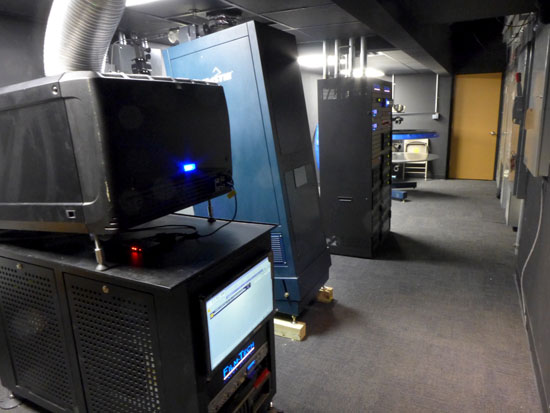
The booth used to be just barely big enough to fit the Barco projector (on a super tiny pedestal), two sound racks and a skinny tech. We had to enlarge it appropriately to make a workable environment for the 70mm film. (The rear wall of the booth used to be where the rear of the digital pedestal was.)
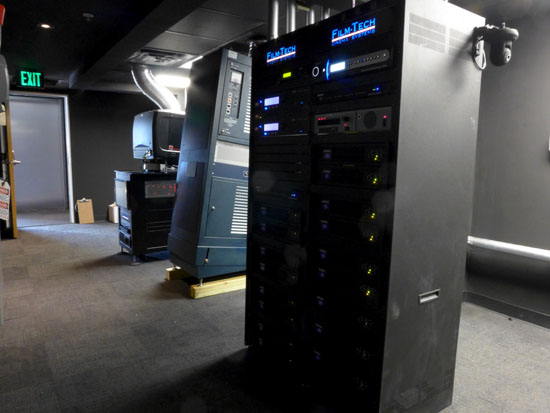
These are the existing sound racks, which were taken apart and reworked to permit the dual dts XD20 players to be installed that you see near the top of the left rack. Yes this is an Atmos system.
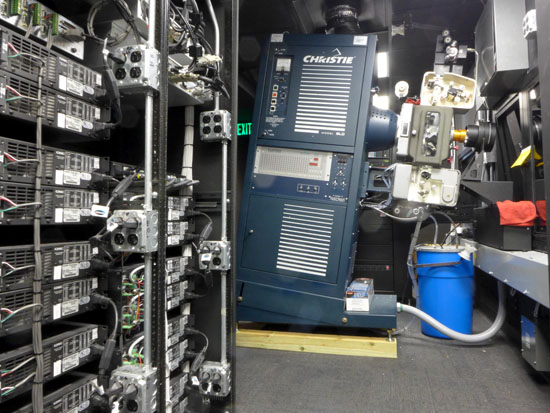
The sound racks were moved from their original location and totally rewired (by me) to get rid of the previous rat's nest from a previous installer. The 70mm console had to be put on wood blocks to get it just high enough so we could align the crazy lens setup for such a large screen with such a short throw.
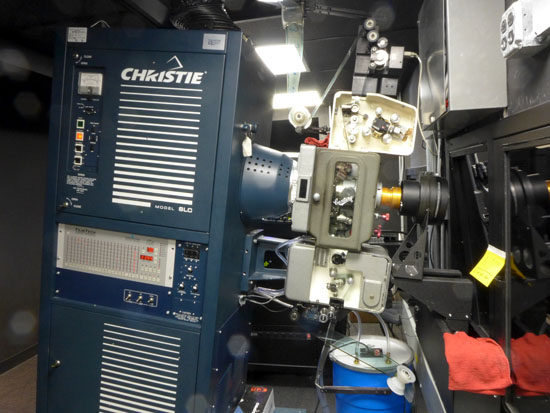
Yes that is a 1.26 magnifier from the DLP world in front of that lens. It was the only possible way to be able to fill the 65 foot screen with the crazy short throw, which we accomplished right down to the 0% cropping mark on the RP91 target film. Alignment of the lensing was terribly critical. 1/4 inch in any direction and vignetting occurs. (The RP91 was still able to resolve the thinnest lines in the target.)
Because of the lensing (and port window size) limitations, the projector had to literally be that close to the wall, as such we had to remove the two soundhead doors.
Yes we removed some of the optical soundhead parts, as we felt the clearance was too tight to be comfortable.
Also due to the low ceiling, the film had to be brought downward then back up via rollers so as not to make the twist on the film too extreme.
Quick trivia, this projector came from Datasat's screening room. It was projector #2. I purchased them a couple of years ago.
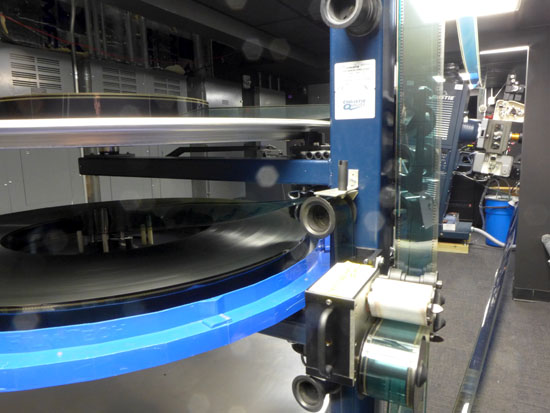
A shot of the platter's film path. Of course no presentation is complete without FilmGuard.
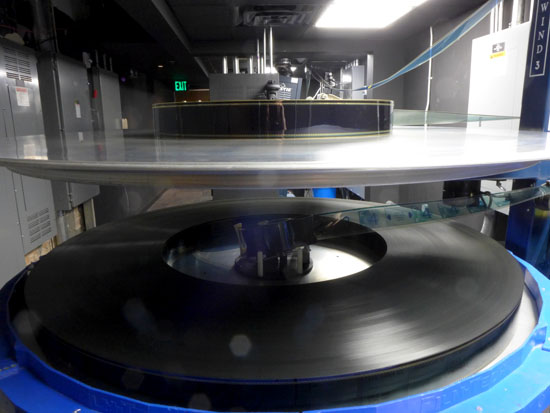
Film-Tech Safety Rings are used to protect the print from sliding (although the film has not even slightly shifted) and extra large center rings were assembled so the platter could be re-calibrated to a significantly slower maximum speed than with normal rings.
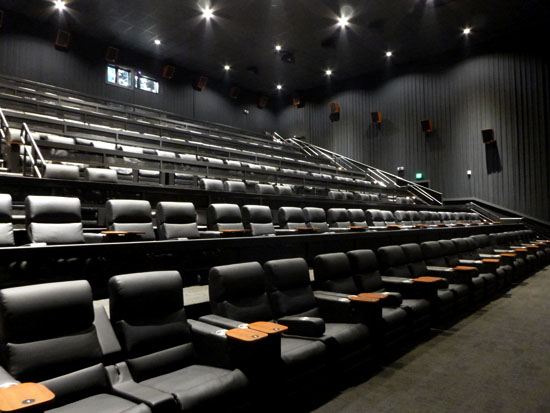
This is the auditorium, complete with motorized leather recliners.
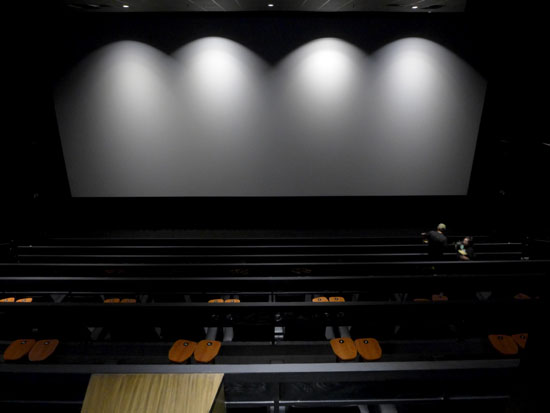
The screen is 65 feet wide, it reaches 9 inches from each side wall of the auditorium and this entire front end was redone for 70mm (and also to benefit future digital showings). The motorized masking is curved and bunches up on the side walls, hence the ability to create a properly masked screen that still reaches wall-to-wall when in scope.
The preshow and trailers for Interstellar in 70mm are presented via the Barco in flat. At the feature the masking opens up to scope and an automated digital to 70mm film changeover occurs. There is a 60 second preroll on the 70mm (not the usual 8 seconds). Preshow is presented as a collapsed mono signal. Trailers open up stereo with left, center and right. Then the feature kicks in the full 5.1 system (surrounds and subwoofer). Appropriate volume changes between formats are also automated.
The 70mm system is my personal equipment on loan to LOOK Cinemas free of charge. LOOK however did spend quite a pretty penny on construction costs to make this happen on their end.
| IP: Logged
|
|
|
|
|
|
|
|
|
|
|
|
|
|
Marcel Birgelen
Film God
Posts: 3357
From: Maastricht, Limburg, Netherlands
Registered: Feb 2012
|
posted 11-10-2014 04:35 AM

quote: Brad Miller
I'm running the 70mm at Look Cinemas tonight and now that it has finally been released digitally this evening, went to the other large auditorium to do a side-by-side comparison of the 70mm vs. digital on a Barco 32B.
I've seen it on a DP4K-32B and a DP2K-23B. I'm not (yet) able to compare it to 70mm or even 35mm, as there's no film around here. I'm certain the 70mm version, if done right, will look brighter and will have more contrast than any current digital presentation does have to offer though.
The 4K presentation looked rich and detailed. Although there's obviously no aspect-ratio switcheroo in the regular DCP versions, you could still easily see the transition between the IMAX film and 35mm footage in the 4K presentation as the increase in detail and lack of film grain is almost instantly noticeable in many scenes. This was much less apparent in the 2K presentation, unfortunately, a lot of detail gets lost there.
The biggest downside of digital projection as of now, is the lack of true black, which becomes rather obvious for movies set in space. Space should be a dark place, not a place with an omnipresent grey hue. Also important to enjoy this, is proper masking. This movie must really be a pain to watch on those oversized three-letter "premium" common-width screens.
The movie is highly popular around here, drawing more public than any of those summer blockbusters up until now. But the runtime makes it hard to pack two shows on a single night into a single auditorium. As a result, the movie gets booked into smaller auditoria (usually not equipped with 4K projectors) for the later runs. That really is a pity, as those who will see it there, will get a sub-par visual experience.
| IP: Logged
|
|
|
|
Bill Brandenstein
Master Film Handler
Posts: 413
From: Santa Clarita, CA
Registered: Jul 2013
|
posted 11-10-2014 12:26 PM
Los Angeles Times, Sunday 11/9/2014, Section D pages 8 & 9 - (big shock: just like the 1 page ad, only bigger!):

No, they didn't make the film options jump off the page at all.
quote: Bobby Henderson
...I have a theory that museum-based IMAX theaters do a better job showing IMAX movies than multiplex theaters.
Quite possibly true, but in 37 years of watching Imax films, I can't ever remember seeing a scratched or damaged print, anywhere. If only the same could be said of normal theaters.
Hoping to see Interstellar with members of the family soon, aiming for Universal CityWalk, which suffers from hot-spotting because it's a silver screen for 3D. But even our local museum Imax (California Science Center) suffers the same fate. TCL Chinese would be the same, wouldn't it? Can't say I've ever seen film Imax look better than their former location in the 80s & 90s when it was a matte screen and only game in town.
| IP: Logged
|
|
|
|
|
|
|
|
|
Powered by Infopop Corporation
UBB.classicTM
6.3.1.2
The Film-Tech Forums are designed for various members related to the cinema industry to express their opinions, viewpoints and testimonials on various products, services and events based upon speculation, personal knowledge and factual information through use, therefore all views represented here allow no liability upon the publishers of this web site and the owners of said views assume no liability for any ill will resulting from these postings. The posts made here are for educational as well as entertainment purposes and as such anyone viewing this portion of the website must accept these views as statements of the author of that opinion
and agrees to release the authors from any and all liability.
|

 Home
Home




![[Big Grin]](biggrin.gif)




![[thumbsup]](graemlins/thumbsup.gif) from me.
from me.


 Printer-friendly view of this topic