|
|
 
|
|
Author
|
Topic: Upload your random pictures (part 4)
|
|
|
|
|
|
|
|
|
|
|
|
|
|
|
|
|
|
|
|
|
|
|
Leo Enticknap
Film God

Posts: 7474
From: Loma Linda, CA
Registered: Jul 2000
|
 posted 04-15-2014 11:41 PM


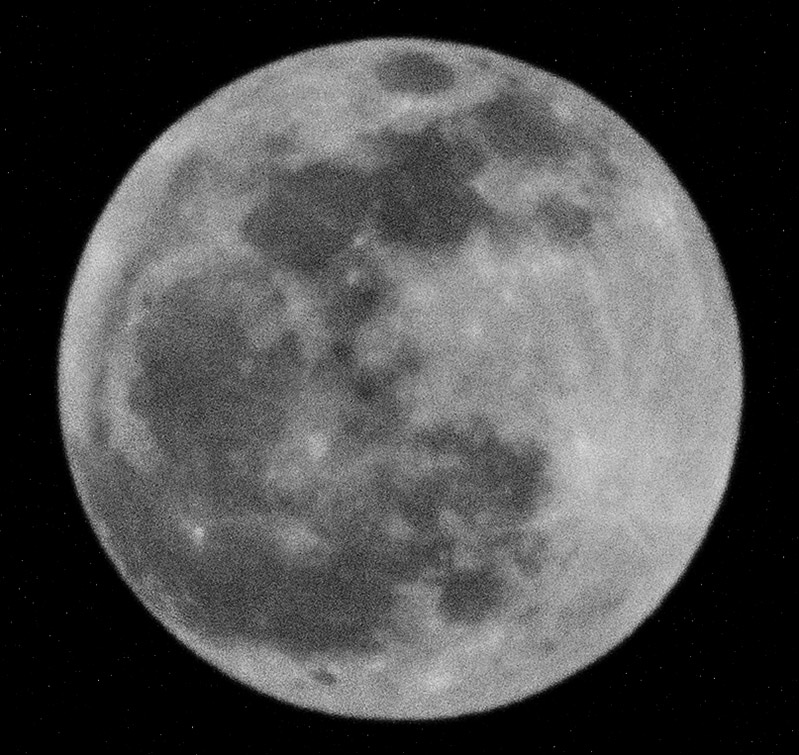
Getting reasonably sharp focus of something far away was what I was aiming for, hence f28. As mentioned earlier, f32 on that lens tends to cause slight vignetting when zoomed to 200mm ish or more, hence staying clear of it. Annoyingly, there is a bit of cloud about tonight, or I'd have re-attempted the same shot with a slightly wider aperture.
quote: Bobby Henderson
My father has an old Canon F-1 body and some good lenses to go with it. But AFAIK the bayonet mount style of those lenses is not compatible at all with newer Canon EF bodies.
You can get converters, but needless to say the focus and aperture will have to be set manually; and because the D-SLR has no way of knowing what the aperture setting is, I'm guessing that it may refuse to set the shutter speed automatically, too. I've never tried using a totally manual/mechanical lens (i.e. no servos or electronics in it) on a modern autofocus/auto-aperture 35mm or digital SLR. My understanding from people who have is that it can be done, but the results can be variable and there can be a whole new learning curve involved in persuading the camera's software to cooperate.
| IP: Logged
|
|
|
|
Bobby Henderson
"Ask me about Trajan."

Posts: 10973
From: Lawton, OK, USA
Registered: Apr 2001
|
posted 04-16-2014 12:19 PM
quote: Leo Enticknap
Getting reasonably sharp focus of something far away was what I was aiming for, hence f28.
The problem is the use of such a tiny aperture isn't necessary for photographing the moon unless you have something else in the frame nearby, such as a person standing nearby in the foreground. At a larger aperture, such as f/8 or even f/4, you'll likely see significantly more detailed results, not to mention improved contrast.
The Canon EF 70-200mm f/2.8L IS II lens I bought last May delivers exceptionally tack sharp image quality wide open at f/2.8, although depth of field is very narrow and vignetting is noticeable at that f-stop setting, especially on a full frame camera body. This lens delivers maybe a tiny bit more detail in the f/4 and f/8 range, but stopping down definitely eliminates the vignetting. At f/16 the effects of diffraction start becoming noticeable. Edge details softens slightly and contrast is a little reduced. Diffraction problems are even more noticeable at f/22. Image quality on this lens isn't terrible at f/22, but it's not in the same "wow" category I see at f/2.8 through f/11.
Diffraction is more pronounced on some other types of lenses. I've been looking at Canon's 100mm L-series f/2.8 macro as a possible future purchase. It can double as a great portrait lens. Canon's 100mm macro delivers some of the sharpest results available in their product line. But you have to shoot at bigger apertures to get those results. Diffraction really makes the lens soft at f/22.
Diffraction is a serious issue with smaller sensor cameras, like the ones built into smart phones. Some major improvements will have to be made in both camera sensor design and lens optics technology to lift smart phone camera image quality anywhere near the level of current DSLR cameras.
| IP: Logged
|
|
Randy Stankey
Film God

Posts: 6539
From: Erie, Pennsylvania
Registered: Jun 99
|
posted 04-17-2014 08:56 PM
My rule of thumb is to shoot two stops larger than the smallest aperture for maximum sharpness.
If the camera's smallest aperture is ƒ22 then ƒ11 or ƒ8 would be the setting to use for maximum sharpness with less diffraction from the aperture blades. Theoretically, you might use the largest aperture but, then, you start running into depth of field issues, especially at short distances. I've got a couple of lenses that go as wide as ƒ1.2 but, at any distance shorter than ten feet, my DoF can be only a few inches. The tip of the nose might be in sharp focus but the rest of the face will be blurry.
I suppose you could set the camera for hyperfocal distance: ƒ22@635ft, if my calculation is correct, your circle of confusion would be 0.02mm.
Given the amount of enlargement the picture has been given, the fact that you can still just make out the Tycho crater on the surface is still pretty remarkable. ![[Smile]](smile.gif)
You still have to consider that, during even a 1 sec. exposure, the moon would have moved enough to blur the picture. Unless the camera was on an equatorial mount with tracking gear, you are bound to get some motion blur.
So... Overall, it's a pretty damn good shot! ![[thumbsup]](graemlins/thumbsup.gif)
| IP: Logged
|
|
|
Powered by Infopop Corporation
UBB.classicTM
6.3.1.2
The Film-Tech Forums are designed for various members related to the cinema industry to express their opinions, viewpoints and testimonials on various products, services and events based upon speculation, personal knowledge and factual information through use, therefore all views represented here allow no liability upon the publishers of this web site and the owners of said views assume no liability for any ill will resulting from these postings. The posts made here are for educational as well as entertainment purposes and as such anyone viewing this portion of the website must accept these views as statements of the author of that opinion
and agrees to release the authors from any and all liability.
|

 Home
Home






![[Big Grin]](biggrin.gif)



 Printer-friendly view of this topic