|
|
 
|
|
Author
|
Topic: HATEFUL EIGHT 70mm - all discussion
|
|
|
Brad Miller
Administrator
Posts: 17775
From: Plano, TX (36.2 miles NW of Rockwall)
Registered: May 99
|
 posted 12-07-2015 03:08 PM


David isn't joking about 70mm film and humidity. During the Interstellar run Dallas got hit overnight with a crazy drop in temperature and when we opened the booths that next morning we found the film was curled insanely. Here is a crappy phone video showing how bad it was. It took racing out to add humidifiers as well as some McGuyvering of the brains to separate the payout arm's guides and even removing the stripper rollers on the platter brain to buy some time to get the film to lay flat again. We didn't have any issues with static (because we used FilmGuard of course), but the curl would've been even worse if we had not been using FilmGuard.
It will be interesting to see one of these new AW3 brains. Earlier this year when I was warning Chapin of the curl issues and some of the hacks we ended up making to the brains, he told me Larry Shaw was going to redesign them so it would not be susceptible to curl scratching. I still haven't seen a picture of one, but am very curious to see what all tips he used of mine and what else he came up with.
Steve is dead on the money about leader. On my installs there was a generous length of threading leader and then 2, yes two solid MINUTES of more leader. This was so the projectionist had plenty of time with the film running at normal projection speeds with all of the booth lights on to check for any issues. Back at GCC Northpark we always referred to that as "abort leader". It's there for a reason, to protect the print and provide ZERO excuse for a misthread.
After the 2 minutes the system would auto-stop at a specific cue point. We then ran the intro and trailers from the digital projector and 60 seconds prior to the last DCP clip a cue on the DCP server triggered the automation on the 70mm system which started the projector rolling again. At this point we are talking normal projection leader, 2 minutes of leader with all of the booth lights on full and the projectionist inspecting everything at full speed, then another full minute of protection leader where the projectionist could re-check the entire path again (although with low booth lighting levels and a flashlight). When the DCP finished the changeover would initiate from digital to film flawlessly every time perfectly on cue. I actually shot one of these with my phone. It's a big file, but it's here.
BTW in that changeover video, yes we ran the previews in flat and the masking is slowly opening to scope on the Paramount logo. The system was all completely automated. Once the projectionist had the system threaded and started the 3 minute abort leader running, there was nothing else required of him for the entire show. This was simple to do, and although I can appreciate the theory that if a system is manual it forces the projectionist to be there, the reverse of that argument is that it also distracts the projectionist from watching the system for problems because he is too busy pressing buttons to make the show run. Running manual like that also doesn't ensure every show is perfectly timed, and remember with few exceptions, there won't be real projectionists with years of experience running these. Case in point, these BLSI systems don't even have a simple up/down cue for lighting. How many intermissions are going to play through with the lights fully down? Any guesses? I'm going to bet a staggering amount of them!
In regards to shipping the print fully built-up, this is where more mistakes were made. First off, they are essentially using a Goldberg Show Shipper, but with bigger flanges. The size of the hubs on those are smaller than a standard Christie center ring, so that means the first show (and the final show) the platter must be calibrated to run faster, which means at the end of the show the potential for print throwing and takeup arm crashing into the motor is extremely high.
Also shipping on essentially an aluminum split reel is nuts in my opinion. Even IMAX didn't do that. IMAX shipped on special platter/shipping decks, which is what I tried to convince them to do. The AW3 platter deck has a honeycomb center and won't collapse or bend during shipment. The print could've also been easily strapped to the platter deck and a custom crate built for far less money. Plus when the print needs to get onto the platter, it's just a matter of sitting the deck on the axle. I can't imagine what will happen when those little plastic mushroom pieces on the hub of that split reel crack and the flange comes popping off. Granted I haven't seen one of these, but unless it was completely re-engineered, that's a distinct possibility. Then again if it was completely re-engineered, they could've addressed the center ring size issue, which clearly they didn't in looking at the pics.
Oversize rings like I use should have also been used. They make it so the top speed can be roughly HALF of what would otherwise be needed. This means by the end of the movie, the potential for throwing is SUBSTANTIALLY lowered, plus the takeup arm crashing is also noticeably lowered.
Here is a picture of one of my prints of Interstellar.
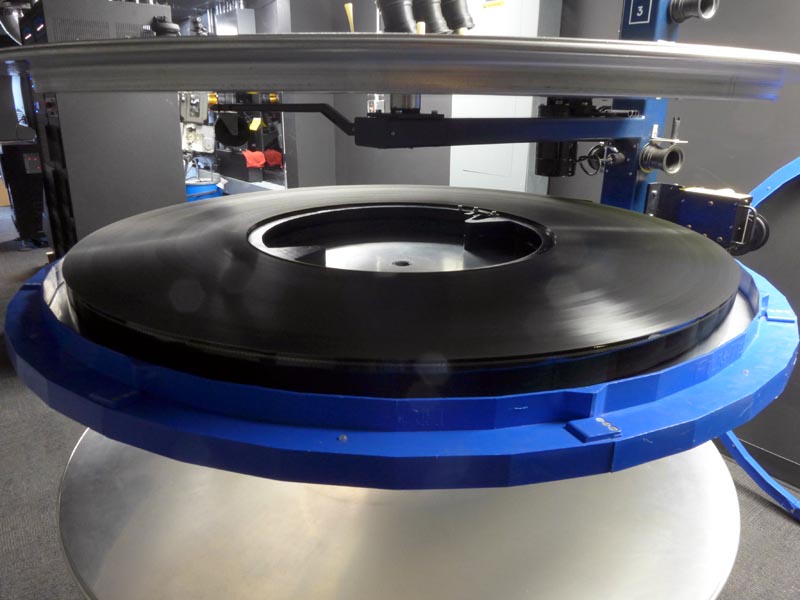
In regards to Sam's comment about how the print will be close to the edge of the platter, note also the use of the Film-Tech Safety Ring that sits around the edge of the platter in that picture above. Those were tested with a 200 pound hit too. It's impossible to have a tail wrap or a thrown print when these are used.
Then again if Kelmar film cleaners with FilmGuard had been spec'd for this deployment instead of that total waste of money on PTRs, static would have been eliminated AND the prints would have had wet gate projection.
Going back to the oversize rings point again, I'll bet a dollar Weinstein has no idea about the takeup arm crashing issue. If they have been made aware, then THREE technical screenings of the movie would have been ordered (as in with the install tech present for each of them). The reason is EACH DECK must be verified for proper calibration in the last reel of the movie. The gold standard test for this is to take the takeup deck and force spin it faster so the takeup arm almost reaches a crashing point to the motor, then hand brake it quickly to a dead stop. Now watch for a few seconds as the takeup deck then tries to spin 200+ pounds of weight from a dead stop to film speed.
What will happen is inertia will kick in and keep the platter spinning when it should be slowing down. (You've really got to be careful doing this test by the way.) Basically if you have a 3 hour 70mm print and the platter is properly calibrated, the takeup should completely stabilize within 10-15 seconds again with no oscillation of the takeup arm. Unfortunately without a full weighted down platter, you cannot truly check the calibration, so that means 3 runs of that 3 hour movie with the install technician present!!!
Since all of these platters were cobbled together from varying vintage AW3s they collected, some will have red leds, some will have green leds and some will have infrared leds. There are also 2 different types of light filters in the platters, 2 different types of led cards and different types of speed control cards (some of which will blow the fuses after a little bit of operation depending on the type of led used and settings in the led card). I've found depending on the combination used depends on how the platter must be calibrated for proper timing.
Are we to believe BLSI has extensive experience with all of the variations of the Christie AW3 platter over the years? I won't say that they don't because maybe they do, but my bet is probably not, as they were hard-core Kinoton guys. Even if they did have an AW3 platter expert on staff, did he test and calibrate each deck with a fully loaded 3 hour 70mm feature at the end of the print? I highly doubt it, and depending on the combination of parts from the varying versions of the AW3s over the years will depend on how the calibration actually must be done.
Then again the payout arm tension spring adjustment also plays into this, as that will affect the angle of the film as it enters into the brain (which could cause scratching on the payout arm) as well as the "punchiness" of the payout along with how the platter handles any knicks in the surface of the deck.
This is yet another reason why I have such high concerns for the ends of the prints not having major problems. People will try and blow it off as to "the print was just too close to the edge of the deck", but any issues could be easily avoided with the proper setup, calibration and ancillary tools. We didn't have issues with Interstellar and that had a similar running time. My theater (GCC Northpark in Dallas) was also according to Paramount the only one that didn't have to at least have reel 10 of Titanic in 70mm replaced due to thrown prints and tail wraps. (Titanic's total print length was 20 minutes longer than Hateful Eight.) This tells me even 20 years ago most people were not fully in the know of all the little things to be cautious of to calibrate an AW3 for a 3 hour 70mm feature.
Leo, BLSI has made a name for themselves doing bizarre one-off setups (bizarre meaning difficult working conditions), but I don't think they have extensive experience dealing with the typical theater-level person. They did take some of my advice on idiot-proofing the systems (such as removing unnecessary 35mm components, of which I hope they are saving and keeping with each projector, otherwise they are doing a disservice to film's future by essentially destroying all 35mm capability from some of the few remaining machines left). However in my opinion even the center ring/safety ring example I just wrote about above (or any of the other various points I've made along with other forum members) shows they aren't taking every step possible to ensure these shows truly run smoothly, and they have had a year to figure it out.
It's frustrating because with the substantially-higher-than-digital price tag BLSI is charging for these old film systems as well as Bobby's various points, if this doesn't go well, this really will be that final nail in the coffin for film. I can hear every studio executive already saying "all that money and the film shows still had lots of failures! We will never, ever release on film again!"
So at this point in my opinion the future of film surviving as an exhibition format is all on the shoulders of Chapin Cutler, as he is the one who called the technical shots for the Hateful Eight film release. If this goes smoothly, then all of us lovers of 70mm and film needs to give the guy a pat on the back and buy him a beer. If this goes badly, then lovers of 70mm and film will have to find themselves a nice metal pipe and lure him into a back alley somewhere.
| IP: Logged
|
|
|
|
|
|
|
|
|
|
|
|
|
|
|
|
Brad Miller
Administrator
Posts: 17775
From: Plano, TX (36.2 miles NW of Rockwall)
Registered: May 99
|
posted 12-08-2015 03:13 PM
Does The Hateful Eight's 70mm roadshow really impact the future of film?
quote:
Quentin Tarantino asked a bunch of newly trained projectionists to screen a 350-pound film on over 100 salvaged projectors. What could go wrong?
By Tasha Robinson on December 8, 2015 09:45 am
When the script for Quentin Tarantino’s new film The Hateful Eight leaked in early 2014, press outlets paid more attention to the way his screenplay described the look of the film than they did to the plot. His opening scene-setting text describes a shot “…in big super CINEMASCOPE 70MM filmed gloriousness.” The same words crop up over and over: “Snow banks go rolling by in GLORIOUS 70MM SUPERSCOPE.” “We see what Maj. Warren describes in BIG WIDE 70MM SUPER CINEMASCOPE.” “The sun’s out and it’s amazing looking in 70MM SUPERSCOPE.”
Clearly the format was an important part of Tarantino's vision. He's always been a cinema buff who strews his work with references to past films and tends to bring the entire history of film into any interview. Ultimately, he didn't shoot in Cinemascope, but only because he did something riskier and rarer: he revived Ultra Panavision, a format that's been used on less than a dozen films, and none since 1966's Khartoum. The process, which produces a 70mm image even more panoramic than Cinemascope, requires custom lenses to shoot and project. When he tours with the film in December, for a special event roadshow reportedly planned to hit about a hundred cities, the venues are going to have to play the film with newly acquired equipment, at a reported cost of up to $80,000 per theater, according to The New York Times. The plan is for the film to open on Christmas and run for two weeks only in the 70mm theaters, before it hits multiplexes in a conventional digital form.
"Few film houses are equipped with the gear even for conventional 70mm"
There's already been a minor resurgence in 70mm film screenings over the past few years, with Paul Thomas Anderson's The Master and Inherent Vice and Christopher Nolan's Interstellar all getting limited runs in the larger format. But the Hateful Eight 70mm roadshow is a project on a much vaster scale. Interstellar opened on only 11 screens in 70mm, and the theaters playing it could use conventional 70mm lenses. Few film houses are equipped with the gear even for conventional 70mm; that Times article claimed the The Weinstein Company effectively had to "corner the market" on existing 70mm projectors, buying out collectors and scavenging parts in order to temporarily equip the roadshow venues. "Configuring the lens took six months alone," Weinstein distribution chief Erik Lomis told Deadline's Anthony D'Alessandro in a recent interview. "The more projectors we got, the more parts we realized we were going to need."
But there are risks associated with working with nearly obsolete technology. Persistent focus issues at an early critics' screening at the Crest Westwood theater in Los Angeles led The Weinstein Company to stop the 70mm projector midway through the show and complete the screening with a digital copy of the film. Russ Fischer reported on the specific problems at The Playlist, in a piece that called the screening "very near disastrous," and suggested "the big comeback of 70mm may be over before it ever really starts." Hitfix critic Drew McWeeny is kinder in his concerned essay "What One Bad Screening Of The Hateful Eight Means For The Future Of Film," but while he acknowledges that film's imperfections as a medium are part of the appeal, he also calls the screening "a serious disaster." Sam Adams at CriticWire followed up with "Could The Hateful Eight Kill Film Instead of Saving It?"
That's a lot of broad concern over one screening and a single, clearly faulty projector — digital screenings have their fair share of isolated technical glitches as well, and any professional film critic has at least a couple of stories of digital screenings being restarted from the beginning. A later screening of the film at the Crest went more smoothly, according to The Verge's Bryan Bishop. (He did notice, however, that "the right third of the frame was definitely a touch soft," and the projection was a little dim.)
Still, an early critics' screening of a heavily anticipated film is a particularly unfortunate time to have tech issues: critics are a finicky, detail-oriented audience whose complaints can have an exceptional reach. And given the size of the investment the theaters and Weinstein are making for the special tour, a series of technical problems undermining the roadshow's reputation could be a financial disaster as well as a PR issue. There's a lot of pressure on both the studio and the theaters to make sure these screenings go smoothly.
Dana Morris, the general manager of the Crest Westwood, says the theater spent weeks preparing for its Hateful Eight screenings, bringing its old 70mm projector out of retirement. "It's been a lot of work," he told The Verge. "We brought in this expert who's been here two weeks every day, all day long, and he's coming back all day today to tweak [the projector] to get it ready for tomorrow, because we're showing it two more times." The initial attempt to get the Crest's existing 70mm projector out of storage and back up to speed involved "ordering parts from all over the country."
Even normal 70mm presents some significant extra problems, Morris says. The Hateful Eight print arrived preassembled. The film is more than three hours long, so the immense reel arrived in a custom case, and weighed around 350 pounds. The delivery man needed a forklift to get it onto the truck, and it took four people just to get it up to the projector booth.
Ultra Panavision's 2.76:1 aspect ratio is likely to be a special challenge even in locations where Weinstein provides the projector and the lens. The Ultra Panavision lenses will need to be adjusted onsite for the shorter booth-to-screen throw of modern theaters. And many houses won't have a screen that makes full use of the unusually wide format. Fischer's Playlist piece complained that the Crest "didn't properly place the matte curtains around the screen, so the top and bottom edges faded off into fuzziness rather than having the crisp delineation those mattes are meant to provide." But Morris says the Crest's adjustable curtains, known as the masking, simply don't have a setting for Ultra Panavision. "We just couldn't bring the masking up any higher. It was two feet narrower [vertically] than a normal movie." Some theaters will make special modifications for the roadshow — Chicago's Music Box Theatre is installing a new 40-foot screen for the event, as well as a new sound system — but that adds a further financial pressure for the screenings to come off flawlessly.
Union projectionist Diego Gorbea, one of the IATSE Local 33 members who's been hired to screen the film for the Director's Guild in LA, says Hateful Eight has been playing "all over town for the last couple of weeks," in a series of screenings for the DGA, the Academy Of Motion Picture Arts and Sciences, and selected members of the public, none of which have had any issues. Though he didn't work at the Crest screening, he says it suggests the kind of issues the roadshow may have in trying to train non-union, inexperienced staffers onsite on complex, unfamiliar equipment. The Times article quotes Boston Light & Sound co-founder Chapin Cutler as saying the company will be handling projection for the tour on a case-by-case basis: "One way or the other, we will fulfill this need ... It will be a combination of house staff that we can train, professional projectionists that we can bring in, projectionists that we can find locally, and potentially some technical staff that we'll bring in."
Gorbea is dubious about the idea of jumping site staff into a series of high-profile screenings if they don't already have significant 70mm experience. "In my experience, I would say that running 70 is a little more tricky. Usually you need to teach a baby to crawl before they can walk. Usually with projectionists, you teach them 35mm first, and then you move them to 70." And the added challenges of working with outside equipment becomes significant, especially for "platter" theaters, where the film comes prebuilt as that single 350-pound reel. "By no means can you take someone who is not trained and run a platter show," Gorbea said. "That's just not going to happen. You have to thread up that thing through the platter, then through the projector, then back to the platter ... The threading itself is more difficult."
On the other hand, projectionists working with single-reel projectors, and switching back and forth between them throughout the show, don't have it much easier. "With platters, you only have to thread it up once," Gorbea said. "With reel-to-reel — Hateful Eight is 11 reels long, so you have to thread it up 11 times, on two different projectors. There's more room for mistakes."
For Tarantino, though, there's more room for magic, as well. He still considers digital projection in theaters to be "HBO in public." He's holding onto history by holding onto 70mm and Ultra Panavision, but he means for the roadshow to echo history as well. The touring 70mm prints of Hateful Eight will include six minutes of extra footage, the kind of bonus used in traditional prestige tour shows to bring viewers to theaters for a special event. Tarantino and his cast explained more about his vision in an 8-minute featurette touting the excitement of the special event roadshow and the quality of the visual format. The word "glorious" comes up a lot. "Ultra Panavision!" Samuel L. Jackson enthuses. "When you absolutely, positively got to wow everyone in the room! Accept no substitutes!"
With this tour, Tarantino is still fighting for the future of cinema as a public, social experience, with every film as a super-sized epic, and every screening as a noteworthy special event rather than a vague part of a nightly Netflix blur. It's too soon to judge whether this tour will help his cause or hurt it. But even if the Crest Westwood issues are repeated elsewhere, touting isolated screening problems as "the death of film" is overstating the situation considerably. There's a difference between routine film screenings (on 35mm, or even special event 70mm screenings that don't use custom equipment to revive a defunct technology) and the exceptionally ambitious Hateful Eight touring program. If the roadshow encounters significant technical issues, it'll be an expensive embarrassment for The Weinstein Company and a disappointment for Tarantino, but it won't be a referendum on shooting on film, or projecting it in a prestige setting. If film dies, it'll have more to do with cost, convenience, and utility than with the question of how many Ultra Panavision lenses one company can Frankenstein together for a quixotic quest.
"It might be expensive or embaRrassing, but it won't be a referendum on film"
And if the roadshow succeeds, it'll be a positive model for special event cinema events, and for the directors still touting the technical qualities of 70mm film. Some early reports — sparked by an interview Tarantino gave at Comic-Con earlier in 2015 — claim Gareth Edwards' Star Wars: Rogue One, the first of the Star Wars Anthology films, is shooting in Ultra Panavision as well. If that's true, Edwards is one of the few who really needs to worry about whether Tarantino and the Weinsteins can pull it off. For the rest of us, all that matters is whether the special screenings amount to the premium experience they're meant to be.
| IP: Logged
|
|
Tyler Purcell
Expert Film Handler
Posts: 180
From: Van Nuys, CA
Registered: Dec 2015
|
posted 12-08-2015 10:27 PM

Hey guys, first post here...
Little introduction... I've been working with Thomas Hauerslev from in70mm.com for half of this year, bringing Hateful Eight news to the public. Whilst I'm probably fully capable of running a 70mm film, I'm not a projectionist... just a passionate filmmaker dedicated to celluloid.
Now that the introduction is over, lets talk about Hateful Eight.
As most of you already know, Quentin did all of his screenings for the film at the DGA and I was present for a few test screenings prior to shooting and after the film was made. What I can tell you right off the bat is how impressive I am with the outcome. Not only did the test material look amazing, but the projection so far at every venue has been outstanding. I've seen my fair share of bad 70mm projection, just this year I saw a horrible print of Bakara that looked like it had been dragged through the mud. There were constant visible scratches, probably due to cinching the prints on the spool and not ever cleaning them. There was also substantial dirt build-up at the heads and tails of each reel, to the point even before the cue mark, it was just littered with black dots. Worst part is, the projection was horrible as well. Clearly the aging projectors at the particular venue (paramount lot screening room) needed a bit of work prior to actually showing the film. The film would move in the gate left to right very slowly and there was a lot of flicker. It was embarrassing for the filmmaker who was present. When I asked him how many times the print had been shown, he shrugged and said it was struck less then 10 years ago and had only been shown at venues like this. I did thank the projectionist after the screening, as it was very cool of him to make it all work and it wasn't his fault.
The original camera test for Hateful Eight actually looks better then the film for many reasons. One of which is Richardson's use of all natural light, something which is quite the opposite in the over-lit single set piece of the final film. With this natural light, it really felt you were in a real western, something I hadn't seen before. The final film itself, does share much of that quality, but of course the final film is shot in winter, where things are more bleak. This threw me off a bit because honestly, I was really hoping for some beautiful exteriors and they just didn't exist. Quentin's vision came from a film called "The Great Silence" which is I gather full of snow. So all of that white imagery was great for checking flicker and I'll say this much, the DGA screening room had ZERO flicker. Thank GOD someone knows how to calibrate film projectors properly!
I saw Hateful Eight a week after it started showing for members. The print had been projected a few times and it was setup in an A/B change over style configuration. The projector started by hand, the projectionist looking out the window, making a small focus tweak as the red curtain opened onto the red overture card. The image had some registration issues, but nothing crazy, nothing an audience would notice. For me, the only issue was a small blob of defocused image on the right side of the screen. It literally looked like someone was changing the focus in one part of the image, very strange. I can't imagine how that problem would have occurred because the rest of the image was perfect and it was in such a small area. After the first reel change however, the problem went away and never came back. In fact, the rest of the screening was flawless in every detail. Even the end credits had zero registration problems, even though it was clearly on the B projector. So maybe just one of their projectors has a problem and maybe they didn't use both during the test screenings. I found it very odd and unfortunately, I missed seeing it again this past weekend, so I've only seen it once there.
For people interested in the film itself and what it looks like. I will say as a professional cinematographer and filmmaker living in Los Angeles, it looked outstanding. Richardson did a great job (as always), the colors are amazing, the crispness of the image is something that rivals digital in every way. It blew away every single 70mm screening I've seen prior, this was BY FAR the best 70mm film I've seen. I thought Hamlet looked great, I thought The Master looked wonderful and Interstellar even though it was a blow up, looked pretty darn good. Those films can be ignored because Hateful Eight is the top dog in my book. Even the classics can't hold up to this, mostly because today's stocks are so darn good. Quentin and Richardson reset the clock on 70mm to a point that will probably stand for quite sometime until someone else gives it a go.
In terms of the content, I've been sworn to secrecy... but I can say a few things. Had Quentin done another Django or Inglorious Bastards, it could have the potential to garnish him with some serious oscars. However, Hateful Eight feels like a film that came from Quentin of 1995, back when he was just starting out and was trying to make cool films, stuff only he wanted to see. Hateful Eight is the film he wanted to do all those years ago, but couldn't make happen and only made happen today due to his stature as a filmmaker. The Weinstein's bet the horse and cart on this film being a success and you know what, after careful contemplation, I think it WILL be a hit. I think it will do very well because ya know what, we sure need a decent western today and it's just that. Great little story, fantastic cast, witty dialog, very funny and extremely well made. Sure, there is going to be a lot of negative press, mostly by people who don't understand Quentin's straight-faced humor OR don't like the violence. I do think it's one step forward for film projection and two steps backwards for his career. I was personally hoping for the intelligent films he's been making recently, but I got a silly western instead. No real beef's, just not what I was personally expecting. I can't wait to see the film again in a few weeks! ![[Smile]](smile.gif)
A few side notes...
First off, screening this film around the country in 70mm a week after Star Wars, is absolutely retarded. They should have done limited screenings in New York and Los Angeles at the big venues starting this week since the prints are already made. Then when Star Wars comes out and those theaters get busy, move the prints to smaller venues for two weeks and open wide Jan 1st 2016.
Second, the film should only have been screened at venues with 70mm projectors already. Spending the money and time to ship projectors is incredibly wasteful, especially since the projectors will wind up going back after it's done. I would have made 35mm prints for venue's without 70mm and sent a technician around to tune ALL the 35mm and 70mm projectors. Also, there are MANY theaters with 70mm projectors that normally don't show films. So they COULD have four-walled Hateful Eight in those theaters, rent the places out for public viewing and a special event screening, instead of showing the film at cineplexes... how yucky is that. You go to theater 7 at AMC to see a roadshow film? What a joke. Every little independent theater should have been contacted, even if it was attached to something else and been given the opportunity to screen the film. That would have been fantastic and in my opinion, worth the effort, rather then simply shipping projectors to places who don't understand how to use them.
Third, no digital release. I would have not done a digital release at all. I think it's a mistake because it just gives people an excuse to compare the 70mm to something else. I'd ship 35mm and 70mm prints and move them around the country, going from city to city. That's what they're doing in Europe. They're getting a hand-full of prints and moving them from theater to theater. If you wanna see it, you've gotta show up and watch it. To me, that's the whole point of a "roadshow" screening. It's in your town one moment and gone the next. I'm sure the Weinstein's wouldn't allow Quentin to do that, especially in places like Asia, where the film will be a huge hit for sure. Still, it would have been acceptable for this country and may have cost substantially less money and in my view, been a lot more interesting. Digital projection is boring in every single way, so even 35mm would have been better.
| IP: Logged
|
|
|
|
|
|
|
|
|
|
|
Powered by Infopop Corporation
UBB.classicTM
6.3.1.2
The Film-Tech Forums are designed for various members related to the cinema industry to express their opinions, viewpoints and testimonials on various products, services and events based upon speculation, personal knowledge and factual information through use, therefore all views represented here allow no liability upon the publishers of this web site and the owners of said views assume no liability for any ill will resulting from these postings. The posts made here are for educational as well as entertainment purposes and as such anyone viewing this portion of the website must accept these views as statements of the author of that opinion
and agrees to release the authors from any and all liability.
|

 Home
Home










 Printer-friendly view of this topic