|
|
 
|
|
Author
|
Topic: Dolby's new sound system
|
|
|
Ray Derrick
Master Film Handler

Posts: 310
From: Sydney, Australia
Registered: Sep 2001
|
 posted 05-16-2012 08:53 PM


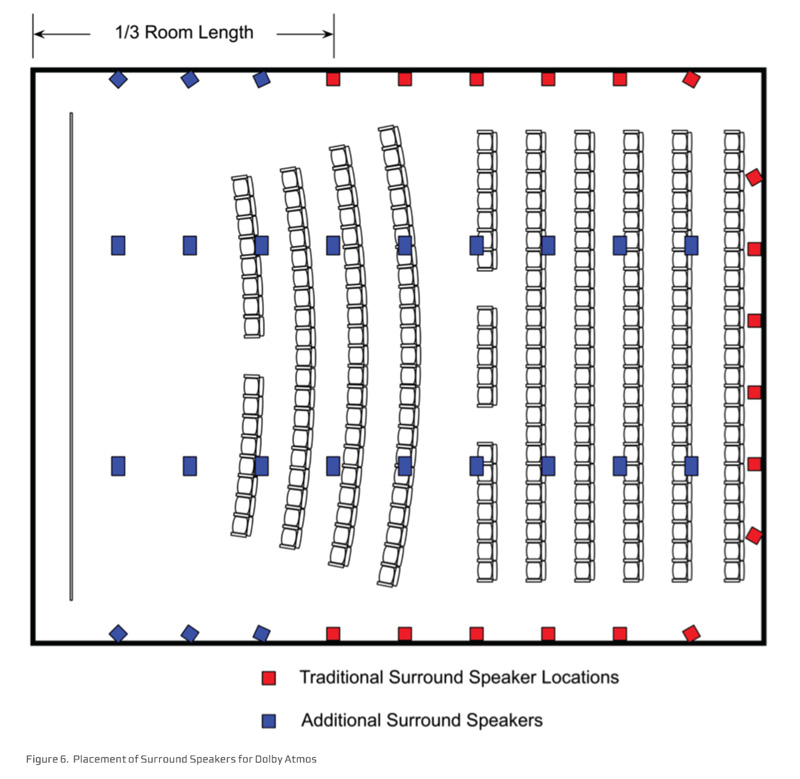
The wall speakers are angled for obvious reasons. What the diagram does not show is that ceiling speakers towards the front and rear would also need to be angled for the same reasons.
So this diagram shows a system with 51 channels, if you include five screen channels and 4 individual sub bass channels (which just happens to be 5.1 x 10) .....
Bobby, I don't see why it would not work equally well with stadium seating. The only potential issue would be that the speakers on the ceiling would be further way from the audience at the front than at the rear, but this will probably be handled using staggered delays. The fact that the rear surrounds will be higher than the front I think will not be an issue due to our poor ability to localise sounds in the vertical axis.
I suspect that the majority of theatres that adopt this system will simply split their existing surround speaker arrays into individual channels and maybe add an extra surround speaker or two closer to the screen. I can't imagine too many will be willing to entertain the considerable cost of adding celing speakers. But we shall see.
One big problem I have with the whole concept is this... Sound mixing engineers will place sounds at different points around the "sound hemisphere", based on where they are sitting when they mix it, which is nearly always in the "sweet spot". For anyone else in the room, the more distant they are from the sweet spot, the more the sound will appear to come from a quite different direction.
Imagine a sound that is placed half way down the left side wall. For the sound mixer it will appear to be positioned on the left side and a little to the front. For audience sitting on the left side of the room, particularly those closest to the wall, those sitting forward of half way will perceive the sound as coming mostly from behind, whereas those sitting rearward of half way will perceive the sound as coming mostly from in front of them.
With the present system using speaker arrays this problem hardly exists, but with multiple surround channels it will become a major consideration.
However for the simple act of panning a helicopter around or over the audience (which seems to be the only example Dolby can come up with) it will work brilliantly. Will it be worth all that the cash outlay for the very occassional helicopter flying right around the audience?
Seriously though, I know it has many other uses other than for chopper sounds, it will certainly be great for sci-fi and horror movies, where you could swirl sounds around the audience to great effect.
If Dolby were prepared to license this technology to all sound equipment manfacturers (such as USL) I would be 100% behind it. But that is not how it works is it. We will be back to the bad old days where if you want to give your audience an Atmos experience you will have to buy an expensive under-featured Dolby sound processor.
The DCI committee could easily force this on Dolby - such that if they allow it into the DCI spec it must be available to all manufacturers. But I can almost guarantee they are too gutless for that.
| IP: Logged
|
|
Bobby Henderson
"Ask me about Trajan."

Posts: 10973
From: Lawton, OK, USA
Registered: Apr 2001
|
posted 05-16-2012 11:11 PM
If Dolby had to license Atmos out to its competitors that would sort of defeat one of the purposes in creating the Atmos format in the first place: to keep the Dolby brand name prominently displayed in cinemas and movie related marketing. Like I said before, we're only a short time away from seeing those Dolby Digital, SDDS and "Datasat" logos associated with 35mm film disappear. D-cinema in its current form is not so Dolby-centric. Linear PCM requires no Dolby audio encoding.
Here is a link to the Dolby white paper:
http://www.dolby.com/uploadedFiles/Assets/US/Doc/Professional/Dolby-Atmos-Cinema-Technical-Guidelines.pdf
quote: Ray Derrick
The wall speakers are angled for obvious reasons. What the diagram does not show is that ceiling speakers towards the front and rear would also need to be angled for the same reasons.
Other diagrams in the white paper PDF show how the ceiling surround speakers should be aimed.
quote: Ray Derrick
The only potential issue would be that the speakers on the ceiling would be further way from the audience at the front than at the rear, but this will probably be handled using staggered delays.
I have other problems with what stadium seating does to a theater's sound environment.
The steep row of seating can reduce proper real wall surround imaging. Instead of a behind you effect it's more of an up above and behind effect. Natural hearing doesn't work to create such an audio blind spot. There's very little space back there compared to the front of the auditorium. The surround array has to rise on a pretty steep angle toward the back row.
Stadium seated theaters typically have taller areas of cubic air space, yet most of these theaters are using little surround array cabinets that were really designed for standard sloped rooms with much lower ceilings and much lower amounts of cubic air space to manipulate.
quote: Ray Derrick
Imagine a sound that is placed half way down the left side wall. For the sound mixer it will appear to be positioned on the left side and a little to the front. For audience sitting on the left side of the room, particularly those closest to the wall, those sitting forward of half way will perceive the sound as coming mostly from behind, whereas those sitting rearward of half way will perceive the sound as coming mostly from in front of them.
That's a good point about the disadvantages of using hard, single speaker positions in the surround array to play back sound elements. Sound mixers will have to pay attention to this. The nice thing is modern audio editing software can spread the sounds across more speaker drivers in the surround array to make surround panning effects more broad to the benefit of more listeners while actually maintaining the panning event instead of it falling dull and dead near the middle of the room.
One thing is certain, Atmos will have the capability of finally delivering proper "transient fly by" effects that smoothly move from the screen all the way to the back wall without any of the stupid, disappointing stopping in the middle of the room crap that happens too often with 5.1 setups.
With more surround array drivers positioned closer to the screen along the side walls and ceiling I can see Atmos being able to enhance more of what's happening on screen, particularly the big explosive moments. You can have 5 stage speaker enclosures firing as well as having the sound elements bleed forward from the screen into those side & ceiling surround cabinets nearest to the screen.
| IP: Logged
|
|
|
|
|
|
|
|
|
|
|
|
|
|
|
|
David Buckley
Jedi Master Film Handler
Posts: 525
From: Oxford, N. Canterbury, New Zealand
Registered: Aug 2004
|
posted 05-18-2012 07:13 AM

The issue of 5.1 and 7.1 material should be a non-issue.
You've got an auditorium with a bucket load of speakers, and a processor which has a virtual "map" of the acoustic space in three dimensions. In Atmos mode each incomming sound element has a position associated with it, and the processor places the element where the mixman says it sould be. So the process is scalable from one speaker up to hundreds of speakers with just one incoming source format.
For an incoming standard 5.1 or 7.1 mix, then that mix also has a "standard" 3D map of where the speakers should be, the same as every theatre which has that system is today. Thus the processor just does the three dimensional map translation and places the 5.1 or 7.1 (or 11.1 or whatever) into the same space. To put it another way, rather than placing 128 elements into the virtual space in the processor, only the channels other than the LFE need to be placed, and tbey dont move, they have fixed locations.
There will probably be a range of these Atmos boxes, with the price tag going up by number of outputs. You would expect that all the obvious features would be in there too, such as crossovers, parametrics, limiters, simple routing to allow non-sync, etc, plus an auto-align system.
In business terms, Dolby is trying quite hard not to do a Kodak by remaining relevant, with DCI discrete audio obviating the need for any audio kit with a Dolby sticker on it. If Atmos doesn't catch on, then if Dolby have any brains at all they will exit the cinema audio business sharpish before it drags them under.
| IP: Logged
|
|
|
|
|
|
Bobby Henderson
"Ask me about Trajan."
Posts: 10973
From: Lawton, OK, USA
Registered: Apr 2001
|
posted 05-18-2012 02:39 PM
quote: Mike Blakesley
Is that idea of surround-mounted subs in the white paper?
Yes. See section 2.3 (page 18) in the white paper pdf, Surround Sub-Woofers. A diagram on page 19 shows sub-woofer placement near (at least 1 meter away from) the rear corners of the room.
quote: David Buckley
If Atmos doesn't catch on, then if Dolby have any brains at all they will exit the cinema audio business sharpish before it drags them under.
Dolby is still doing just fine selling gear to commercial theaters, be it cinema processors and servers for digital cinema. Dolby's main problem is keeping its name in view of the general public.
IMAX and Real-D are getting all the promotional ink for 3D. I still never see Dolby 3D mentioned in any promotional material for new movies. Dolby 3D is never listed on movie posters or in movie trailers. I never see it mentioned on TV commercials. It's either IMAX 3D or Real-D and nothing else.
The Dolby brand is still prominent in home theater, but a brand loses some of its prestige to movie fans if real movie theaters move onto a different process. After almost 20 years of movie releases Dolby Digital on 35mm film is reaching the end of its life -at least in terms of being used on new Hollywood movie releases. Dolby Digital is ubiquitous in home theater, but it now has the vibe of a generic, default sound process. The promtional hype has moved on to other formats like DTS-HD Master Audio, despite Dolby TrueHD being able to do roughly the same thing.
Years ago I would not have predicted DTS to end up with the dominant lossless audio encoding format on Blu-ray. The company is trying to make inroads in other areas, like being used on "UltraViolet" cloud-based digital copies of movies. Just like Dolby, DTS is in real danger of no longer appearing to have any relevance with commercial movie theaters. The theatrical DTS company's name change to DataSat was a bad mistake, both in terms for the DataSat company and the now home-only DTS company. They should have maintained some ties in order to reinforce brand equity. DataSat has about the same level of brand equity as Kintek or something like that -basically a name regular movie theater customers aren't going to notice. I guess DataSat will live on to make hardware for digital cinema installations. Unless DTS or DataSat can develop something comparable to Dolby Atmos the DTS brand will be relevant only to home theater and primarily just to disc-based media like Blu-ray. The cable, broadcast and streaming rackets are still dominated by lossy Dolby Digital, even if Dolby Digital is seen as being generic.
I think Dolby Atmos can turn into a pretty big thing for movie theaters. But it's going to require quite a game change in how movie theaters install and maintain their sound systems.
| IP: Logged
|
|
|
|
|
Powered by Infopop Corporation
UBB.classicTM
6.3.1.2
The Film-Tech Forums are designed for various members related to the cinema industry to express their opinions, viewpoints and testimonials on various products, services and events based upon speculation, personal knowledge and factual information through use, therefore all views represented here allow no liability upon the publishers of this web site and the owners of said views assume no liability for any ill will resulting from these postings. The posts made here are for educational as well as entertainment purposes and as such anyone viewing this portion of the website must accept these views as statements of the author of that opinion
and agrees to release the authors from any and all liability.
|

 Home
Home




![[Smile]](smile.gif)




 Printer-friendly view of this topic